



- An Anthropic researcher quits the AI industry over fears self-improving models could destroy humanity.
- Wall Street is betting big on the AI boom, targeting $700B AI infrastructure spending backed by $1.65T debt.
- AI safety fears clash with Wall Street’s huge AI bet, but weak AI returns could trigger a shock across crypto.
An Anthropic researcher is quitting the artificial intelligence (AI) industry over fears that the lab and its competitors are racing to build systems that could spiral out of control and destroy humanity.
At the same time, the AI race is drawing unprecedented financial investments, as hyperscalers are targeting around $700billion in AI infrastructure investments, which are increasingly backed by bonds, private credit, and complex deal structures. The contrast highlights a growing disconnect between AI safety fears and Wall Street’s enormous financial commitment to the AI race.
Why AI Researchers Are Warning About AI as the AI Race Gets More Expensive
On September 8, 2026, Jacob Coxon, a 27 year old AI researcher, resigned from Anthropic and said he was leaving the AI industry. Coxon, who worked on AI model pretraining at OpenAI and Anthropic, including on GPT 4o, warned that the rush to build increasingly powerful AI is moving faster than safety efforts.
Coxon added that the major AI firms are now in a race to self improving superintelligence at the expense of the future of the human race. He warned that some aggressive scenarios could see AI become uncontrollable by the end of 2027. He also said frontier AI researchers increasingly use terms such as “crunchtime” and “endgame” when discussing the accelerating AI race.
Adding to those concerns, Anthropic Alignment Science Lead Evan Hubinger has echoed those concerns, saying he and colleagues believe AI could potentially kill all humans. Hubinger himself gave a probability estimate of over 10% within the next decade, and admitted that Anthropic does not currently have a clear roadmap to solve alignment with superintelligence, highlighting the unresolved risks of AI safety.
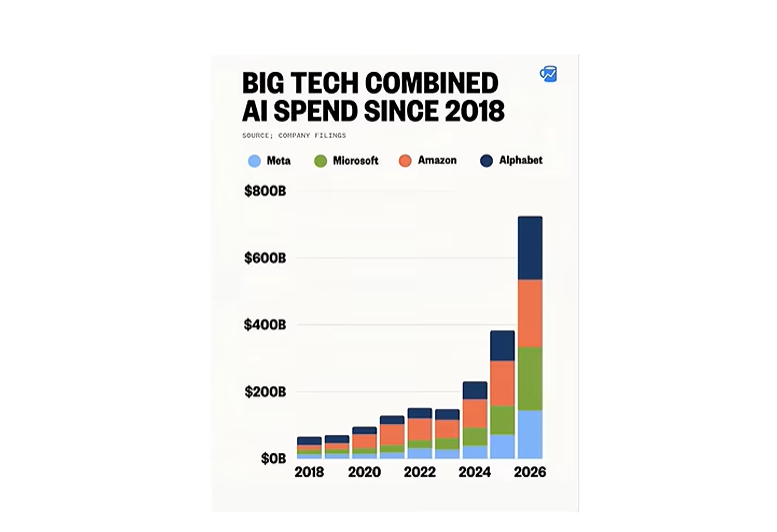
However, even as these AI safety warnings intensify, the financial scale of the AI race continues to expand rapidly. Major hyperscalers are aiming at approximately $700B to over $745B total capital expenditure in 2026, with Goldman Sachs Research forecasts that international AI related investment will surpass $1T. This difference between AI spending and AI safety highlights the stakes involved with advanced AI development.
Source: YouTube
Who Is Financing the $700B AI Buildout and the Debt Behind the AI Boom?
Major tech firms such as Alphabet, Amazon, Microsoft and Meta are planning to spend over $700B on data centers, high-performance chips and power and network infrastructure. Amazon is targeting around $200 to $220B, Alphabet $175 to $205B, Microsoft $175 to $190B and Meta $130 to $145B. Nvidia CEO Jensen Huang’s called the endeavor the largest infrastructure building process in human history, but the big question is how this kind of spending is funded.
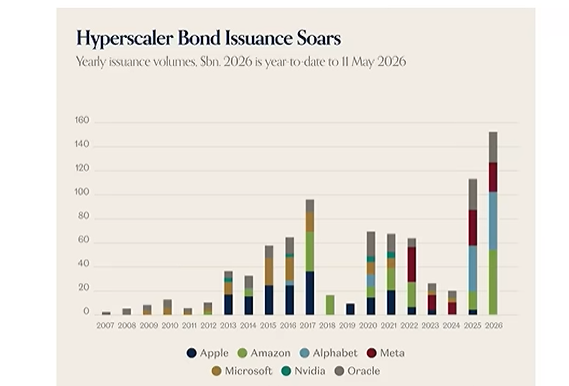
Companies’ cash flows provide financing, but AI spending is pressuring funding. Historically, firms spent 40 to 50 cents of each dollar generated on capital expenditure, versus 94 cents this year. The average annual bond issuance of the five largest cloud companies was approximately $28B between 2020 and 2024. As AI spending surges, AI debt issuance has reached nearly $500B by August 2026.
Source: YouTube
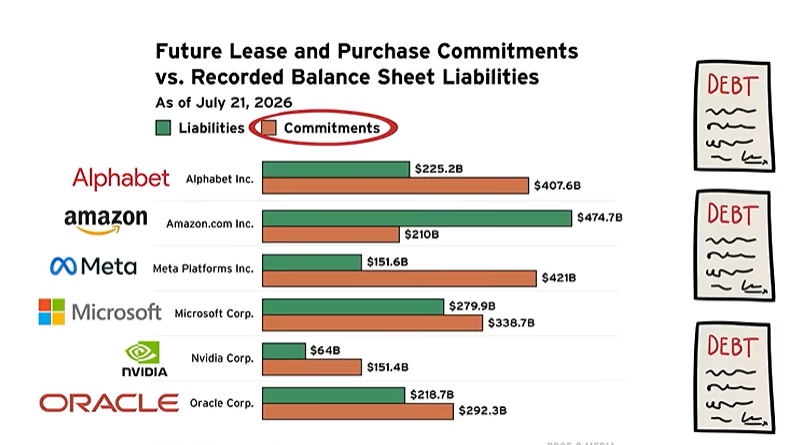
Beyond corporate bonds, AI financing includes off balance sheet liabilities, SPVs, data center leases, GPU take or pay commitments, joint ventures, private credit and private equity. A study found five major U.S. technology companies have about $1.65T in off balance sheet liabilities compared with $1.35T in on balance sheet debt. These financing structures illustrate that the debt fueling the AI boom is not just the kind of corporate borrowing.
Source: YouTube
What Happens If AI Returns Fall Short and Trigger a Reset in Risk Assets?
In case the returns on AI investments are lower than needed to maintain cash flows and current lease payments and residual values, the burden would first appear in the already depleted treasuries of companies and then in credit markets that have already taken in the explosion of issuance. Residual value guarantees would turn contingent claims into real cash outflows and specialized data center assets may be more difficult to release or refinance.
The expanding AI infrastructure also brings up leverage issues in the financial system. Similar to the parallel banking system prior to 2008, non bank financing channels are assisting in financing large-scale infrastructure projects beyond standard banking systems. A sustained AI returns shortfall could weaken confidence, pressure investment grade credit markets and increase refinancing risks. When stress is transmitted through the heavily exposed borrowers, it may not stop at technology stocks and may spread to other risk assets.
Where Bitcoin Fits Into the Bigger Picture and the Real Risk Behind the AI Race
Bitcoin (BTC) and the broader crypto market are closely tied to the same risk appetite and liquidity conditions that have fueled the AI investment boom. Investing in AI infrastructure may lead to significant financial risks if the returns on AI investment fall short. If that shortage persists, it could slow down cash flows and increase credit spreads, leading to deleveraging and a pullback on BTC as a high beta-risk asset. Meanwhile AI safety warnings point to the more serious issue as researchers note concerns over self improving AI systems, loss of control and other potentially larger implications of the pursuit of superintelligence.
Related: AI Debt Issuance to Top $570 Billion in 2026, Says Morgan Stanley
Related: AI Spending Fears Push Nasdaq to 7-Week Low as Bitcoin Drops Below $63K
Disclaimer: The information presented in this article is for informational and educational purposes only. The article does not constitute financial advice or advice of any kind. Coin Edition is not responsible for any losses incurred as a result of the utilization of content, products, or services mentioned. Readers are advised to exercise caution before taking any action related to the company.



Be the first to comment