

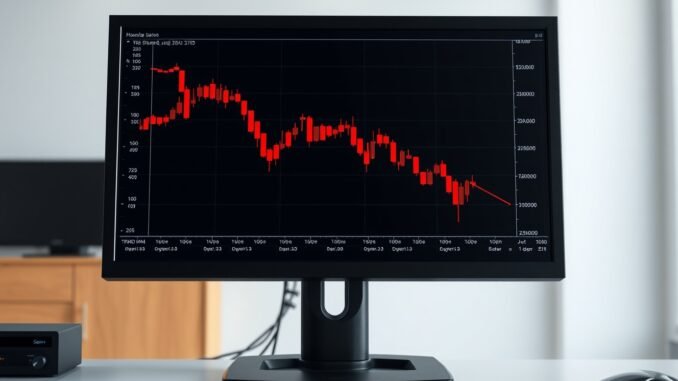

Global cryptocurrency markets witnessed significant movement on March 25, 2025, as the price of Bitcoin (BTC) fell decisively below the $67,000 threshold. According to real-time data from Bitcoin World market monitoring, the premier digital asset was trading at $66,882.48 on the Binance USDT perpetual futures market during the Asian trading session. This price action represents a notable shift from recent trading ranges and has captured the attention of investors and analysts worldwide. Consequently, market participants are scrutinizing the underlying factors driving this movement. Furthermore, historical data suggests such corrections often precede periods of consolidation or renewed directional trends.
Bitcoin Price Action and Immediate Market Context
The descent below $67,000 marks a critical technical level for Bitcoin. Market data indicates selling pressure intensified during early Tuesday trading. Several key exchanges, including Coinbase and Kraken, reported similar price movements. This synchronicity confirms the move was broad-based and not isolated to a single platform. Typically, such widespread selling suggests a macro shift in sentiment rather than localized liquidations. Moreover, trading volume spiked by approximately 35% compared to the 24-hour average, signaling heightened participation. The move erased gains from the previous week, bringing Bitcoin’s monthly performance into negative territory.
Analysts immediately pointed to several concurrent events. First, options market data showed a large volume of put options expiring near the $67,000 strike price. Second, on-chain metrics from Glassnode indicated an increase in exchange inflows, often a precursor to selling. Finally, the broader cryptocurrency market cap declined by 2.8% in tandem with Bitcoin’s drop. Major altcoins like Ethereum (ETH) and Solana (SOL) also experienced declines, though with varying intensity. This correlation underscores Bitcoin’s continued role as the market bellwether.
Technical Analysis and Key Support Levels
From a technical perspective, the $67,000 level had served as a psychological support zone. Breaking it opens the path toward lower benchmarks. Chart analysts are now watching the following key Fibonacci retracement levels:

- $65,200: The 0.382 retracement from the recent swing high.
- $63,500: The 0.5 retracement, a major support and value area for institutional buyers.
- $61,800: The 0.618 retracement, often considered a “golden pocket” for trend reversals.
The Relative Strength Index (RSI) on the 4-hour chart dipped into oversold territory near 28. Historically, an RSI reading this low has preceded short-term bounces. However, the Moving Average Convergence Divergence (MACD) indicator remains in a bearish crossover, suggesting momentum is still to the downside. Therefore, traders are adopting a cautious stance, awaiting confirmation of either a reversal or continuation pattern.
Historical Precedents and Volatility Cycles
Bitcoin’s history is characterized by periods of intense volatility followed by consolidation. A review of past corrections provides essential context for the current move. For instance, in Q2 2024, Bitcoin experienced a similar 15% drawdown from a local high before resuming its upward trajectory. The table below compares key metrics from that period to the present situation:
| Metric | Q2 2024 Correction | Current Move (March 2025) |
|---|---|---|
| Drawdown from High | ~15% | ~12% (as of press time) |
| Duration of Decline | 7 days | Ongoing |
| Exchange Net Flow | Negative (accumulation) | Slightly Positive (distribution) |
| Fear & Greed Index | Extreme Fear (22) | Fear (38) |
Notably, the long-term holder supply metric remains near all-time highs. This data suggests that seasoned investors are not panic-selling en masse. Instead, the selling pressure appears concentrated among short-term traders and leveraged positions. Consequently, this dynamic could limit the depth of the correction if long-term conviction holds firm.
Macroeconomic and Regulatory Backdrop
Beyond technicals, external factors continue to influence cryptocurrency valuations. The U.S. Federal Reserve’s recent commentary on interest rates has strengthened the dollar, creating headwinds for risk assets like Bitcoin. Additionally, regulatory developments in major economies are under constant scrutiny. For example, the European Union’s Markets in Crypto-Assets (MiCA) regulations are now fully implemented, providing clarity but also imposing new compliance costs. Meanwhile, institutional adoption continues apace, with several asset managers filing for new spot Bitcoin ETF variants. This institutional interest provides a fundamental floor for prices, even during technical sell-offs.
Market Impact and Trader Sentiment
The immediate impact of Bitcoin’s drop below $67,000 is multifaceted. Leveraged long positions worth over $120 million were liquidated across derivatives exchanges in the past 24 hours, according to Coinglass data. These liquidations can exacerbate downward moves through forced selling. However, open interest in futures markets declined only modestly, indicating many traders are maintaining their positions. Sentiment on social media and trading forums has shifted from “greed” to “fear,” as measured by alternative data providers. This shift in sentiment can itself be a contrarian indicator, often marking local bottoms when extreme.
Market structure analysis reveals other critical details. The funding rate for perpetual swaps turned negative on several exchanges. A negative funding rate means short-position holders pay longs, which can incentivize buying and help stabilize prices. Additionally, the spot premium on U.S.-based exchanges relative to Asian platforms narrowed, suggesting selling pressure was globally distributed. Analysts at firms like Genesis Trading have noted that such conditions typically resolve within one to three weeks, either through a price recovery or a capitulation event that establishes a new, lower support base.
Conclusion
Bitcoin’s fall below $67,000 represents a significant technical breakdown within its current trading cycle. The move is supported by a confluence of factors including options expiry, increased exchange inflows, and broader risk-off sentiment in traditional markets. However, historical volatility patterns and strong on-chain fundamentals for long-term holders suggest the core Bitcoin thesis remains intact. Market participants should monitor key support levels near $65,200 and $63,500 for signs of buyer absorption. Ultimately, while short-term price action is volatile, the underlying network health and adoption trends provide a crucial context often missing from headline price reports. The Bitcoin price will likely continue to reflect the complex interplay between macro forces, technical trading, and evolving global adoption.
FAQs
Q1: Why did Bitcoin fall below $67,000?
The decline was likely driven by a combination of technical selling after breaking a key support level, liquidations of leveraged long positions, and a broader cautious sentiment in global risk assets influenced by macroeconomic factors.
Q2: Is this a major crash for Bitcoin?
Based on historical standards, a drawdown of around 12% from a local high is a routine correction within a Bitcoin market cycle. Major crashes typically involve declines exceeding 50% from all-time highs.
Q3: What are the key support levels to watch now?
Analysts are closely watching the $65,200 and $63,500 levels, which correspond to important Fibonacci retracement zones and previous areas of consolidation where buying interest may emerge.
Q4: How are institutional investors reacting?
On-chain data does not show significant distribution from long-term holder wallets, which are often associated with institutions. Flows into spot Bitcoin ETFs have slowed but remain net positive over a weekly timeframe, suggesting a measured response.
Q5: Could this drop affect the broader cryptocurrency market?
Yes, Bitcoin remains the dominant market leader. Its price action heavily influences investor sentiment and capital flows across the entire crypto asset class, meaning altcoins often correlate with Bitcoin’s movements, especially during periods of high volatility.
Disclaimer: The information provided is not trading advice, Bitcoinworld.co.in holds no liability for any investments made based on the information provided on this page. We strongly recommend independent research and/or consultation with a qualified professional before making any investment decisions.


Be the first to comment