



While Bitcoin and Ethereum continue to dominate global headlines, a more unconventional and playful segment of the market has steadily built its own momentum—memecoins. At the forefront of this movement is Dogecoin, a digital asset that started as an internet joke but has evolved into one of the most recognised and widely traded crypto assets in the world.
What began as satire has grown into a community-driven phenomenon, powered by strong online engagement, celebrity endorsements, and increasing real-world utility. Dogecoin’s journey reflects how sentiment, culture, and accessibility can play a powerful role in shaping the crypto landscape, often in ways traditional financial assets cannot.
A significant turning point came with the launch of the first U.S. Dogecoin ETF, marking a step forward in its integration into mainstream finance. This development not only highlights rising institutional interest but also adds a new dimension to discussions around Dogecoin price predictions and the broader price prediction for Dogecoin in the years ahead.
In this piece, we explore how Dogecoin works, what differentiates it from more conventional crypto assets, and the key factors, from market sentiment to adoption trends, that influence its price movements and future outlook.

Also Read: What is Blockchain? All About Blockchain Technology!
What is Dogecoin and Why Does Its Price Matter?
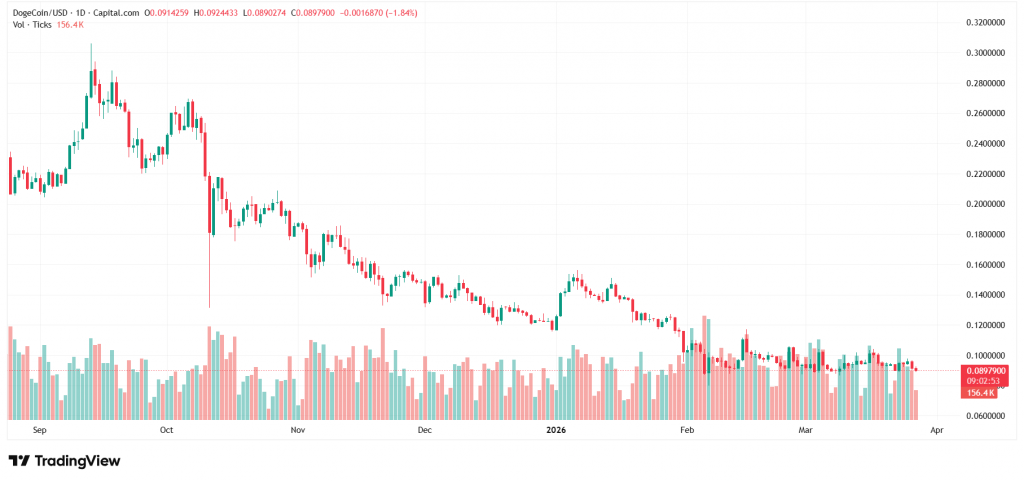
Introduced in 2013, Dogecoin began as a lighthearted experiment—a way to make crypto more approachable and fun. With its signature Shiba Inu mascot, it stood out from the start, attracting users drawn to its humor and sense of community.
What started as an internet joke soon evolved into a vibrant ecosystem, supported by a passionate community and boosted by public figures like Elon Musk and Vitalik Buterin, who helped propel Dogecoin from meme status to mainstream recognition.
The project’s source code draws inspiration from projects like Litecoin, and Lucky Coin. Transactions conducted with Dogecoin undergo verification through a process known as mining, with records stored on a publicly accessible ledger. Importantly, Dogecoin supply remains unrestricted, with approximately 10,000 new tokens generated every minute.
Dogecoin (DOGE) Technical Indicators
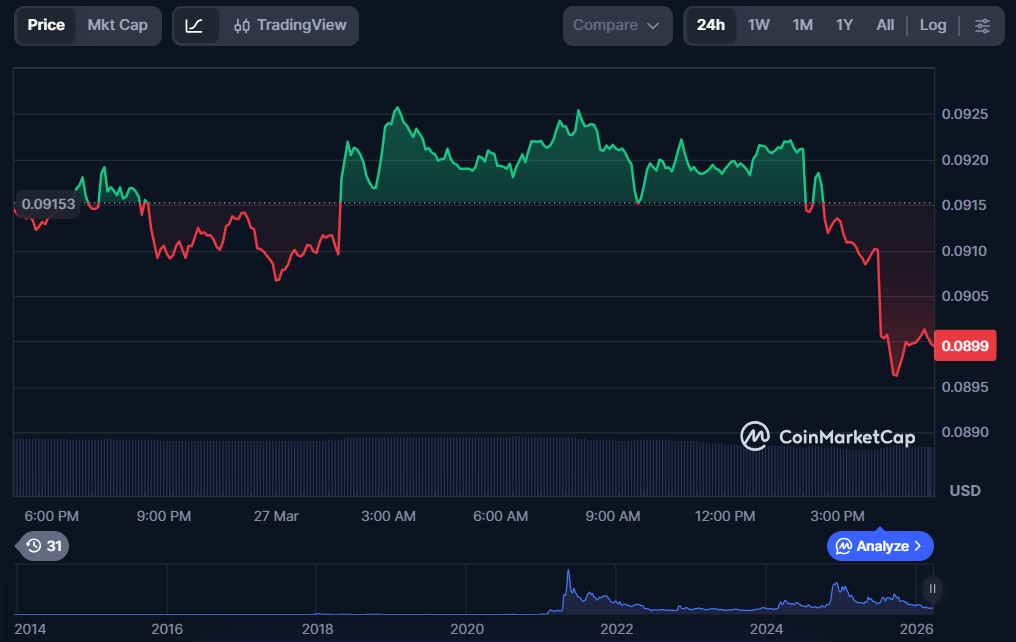
| Current Price | $0.08993 |
| Market Capitalization | $15.22 billion |
| 24-Hour Volume | $1 billion |
| 50 Day SMA (1 Day) | $0.09547 |
| 100 Day SMA (1 Day) | $0.11177 |
| 200 Day SMA (1 Day) | $0.15279 |
| 14-Day Relative Strength Index (1 Day) | 42.72248 |
| All-Time High | $0.48750 |
| Circulating Supply | 169.29 billion |
Also Read: Bitcoin Price Prediction
Key Factors That Influence Dogecoin Price Predictions
Supply and Demand Dynamics
One of the most fundamental drivers behind Dogecoin price predictions is the balance between supply and demand. Unlike many other crypto assets, Dogecoin has an inflationary supply model, meaning new coins are continuously introduced into circulation. While this ensures liquidity and accessibility, it can also influence long-term price appreciation. On the demand side, increased trading activity, new user adoption, and exchange listings can create upward pressure, making supply-demand analysis a key component in any price prediction for Dogecoin.
Community Support and Market Sentiment
Dogecoin’s value is heavily influenced by its strong and vocal community. Social sentiment, viral trends, and endorsements from public figures can significantly impact short-term price movements. Unlike traditional assets, memecoins often react quickly to online narratives, making sentiment analysis a crucial factor in Dogecoin price predictions. Positive momentum can drive rapid rallies, while shifts in sentiment may lead to equally sharp corrections.
Institutional and Merchant Adoption
Growing acceptance of Dogecoin among businesses and institutions plays an important role in shaping its long-term outlook. As more merchants accept DOGE as a payment method and institutional interest increases—such as through investment products—confidence in the asset strengthens. These developments often contribute to more optimistic price prediction for Dogecoin, as real-world utility and credibility expand.
Global Macroeconomic Conditions
Broader economic factors, including inflation, interest rates, and global financial stability, also impact crypto markets. During periods of economic uncertainty, investors may turn to digital assets as alternative investments, influencing demand for Dogecoin. Conversely, tighter monetary policies can reduce risk appetite. These macro trends are essential when forming realistic Dogecoin price predictions, as they shape overall market liquidity and investor behaviour.
Also Read: Decentralized Identifiers and the Shift Toward Self-Owned Digital Identity
Role of Technical Analysis in Dogecoin Price Forecasts
Moving Averages
Moving averages help traders identify trends by smoothing out price data over a specific period. Common indicators like the 50-day and 200-day moving averages are widely used to determine whether Dogecoin is in a bullish or bearish phase. Crossovers between these averages often signal potential entry or exit points, making them a core tool in forming a price prediction for Dogecoin.
Relative Strength Index (RSI)
The RSI measures the speed and magnitude of price movements to identify overbought or oversold conditions. Typically ranging from 0 to 100, an RSI above 70 may indicate that Dogecoin is overbought, while below 30 suggests it could be oversold. This indicator helps traders anticipate potential reversals, adding depth to Dogecoin price predictions.
MACD Indicator
The Moving Average Convergence Divergence (MACD) indicator tracks the relationship between two moving averages to identify momentum and trend changes. When the MACD line crosses above the signal line, it may indicate bullish momentum, while a downward crossover can signal bearish trends. This makes MACD a valuable component in technical-driven price prediction for Dogecoin.
Dogecoin Price Prediction Models Explained
On-Chain Analysis Models
On-chain analysis examines blockchain data such as transaction volume, wallet activity, and holding patterns. For Dogecoin, metrics like active addresses and transfer volume can provide insights into network usage and investor behaviour. These data points are increasingly used to support more data-driven Dogecoin price predictions.
Market Sentiment Indicators
Sentiment indicators analyse how investors feel about the market using tools like fear and greed indices, funding rates, and trading volume trends. Since Dogecoin is particularly sensitive to sentiment shifts, these indicators play a critical role in shaping short- to medium-term price prediction for Dogecoin.
Social Media Trends
Dogecoin’s origins as a meme-driven asset make social media a powerful influence on its price. Platforms like X (formerly Twitter), Reddit, and online communities can spark sudden interest and trading activity. Tracking mentions, engagement levels, and trending topics has become an essential part of modern Dogecoin price predictions, especially for capturing short-term market movements.
Price Predictions
2026
For 2026, Dogecoin price predictions suggest a potential move towards the $1 mark.
2027
Looking ahead to 2027, the price prediction for Dogecoin indicates it could reach highs of around $1.35.
2028
By 2028, Dogecoin price predictions point to a possible trading range near $1.75.
2029
In 2029, the price prediction for Dogecoin suggests it may cross the $2 level.
2030
By 2030, Dogecoin price predictions indicate a potential move beyond $2.50.
Risks and Uncertainties in Dogecoin Price Predictions
Predicting the future value of Dogecoin comes with inherent risks, as the crypto market is highly volatile and influenced by multiple unpredictable factors. One of the biggest challenges in forming reliable Dogecoin price predictions is its sensitivity to market sentiment and external triggers, such as social media trends or public endorsements. These can cause sudden price spikes or drops that are difficult to anticipate.
Additionally, Dogecoin’s inflationary supply model introduces long-term uncertainty, as continuous coin issuance may impact price stability over time. Regulatory developments, security concerns, and broader market downturns can further complicate any price prediction for Dogecoin. As a result, forecasts should always be viewed as probabilistic rather than definitive outcomes.
How Investors Use Price Predictions in Crypto Strategies
Investors often rely on Dogecoin price predictions as a reference point when building and refining their crypto strategies. While predictions are not guarantees, they help traders identify potential entry and exit levels, assess market cycles, and align their investments with broader trends.
For short-term traders, price prediction for Dogecoin—supported by technical indicators—can assist in timing trades and managing risk. Long-term investors, on the other hand, may use these forecasts to evaluate growth potential, accumulation strategies, or diversification within their portfolios. In both cases, predictions serve as a guiding tool rather than a sole decision-making factor, complementing research and market analysis.
Key Considerations Before Relying on Dogecoin Price Forecasts
Before depending on any Dogecoin price predictions, it is important to evaluate the credibility of the source and the methodology used. Different models—whether technical, on-chain, or sentiment-driven—can produce varying outcomes, and no single approach guarantees accuracy.
Investors should also consider their own risk tolerance, investment horizon, and market understanding. Since the price prediction for Dogecoin can change rapidly based on evolving conditions, staying updated with market news and trends is essential. Most importantly, relying solely on predictions without conducting independent research (DYOR) can increase exposure to risk.
A balanced approach—combining forecasts with fundamental analysis and prudent risk management—can help investors make more informed decisions in the dynamic world of crypto.
Is Dogecoin a Good Investment?
Dogecoin was born out of internet humor, inspired by the viral “doge” meme that once ruled social media. What began as a playful experiment quickly gained traction, fuelled by passionate online communities and endorsements from prominent tech leaders and celebrities. This mix of humor, collective enthusiasm, and cultural momentum helped Dogecoin earn a unique identity in the crypto world.
However, its journey hasn’t been without turbulence. Dogecoin’s price often reacts to social buzz and influencer activity rather than solid market fundamentals, resulting in high volatility. While these surges have brought moments of massive gains, they also underscore the challenges Dogecoin faces in becoming a reliable and enduring digital asset.
Also Read: Ethereum Price Prediction
Should I Invest in DOGE?
Investing in Dogecoin largely depends on how much emphasis you place on community support and cultural relevance. Unlike crypto assets built on innovative technology or concrete use cases, Dogecoin’s value is fueled by a dedicated online following, viral trends, and ongoing public attention. For investors who see this social momentum as sustainable, DOGE can present high-risk, high-reward opportunities.
However, for those prioritizing long-term stability, Dogecoin’s trend-driven nature and limited practical utility may be a drawback. In such cases, crypto assets with stronger fundamentals, wider adoption, and consistent performance could be more suitable. Ultimately, Dogecoin is a speculative asset, appealing to investors who view community-driven influence as an advantage rather than a limitation.
In the grand scheme of things, ZebPay blogs are here to provide you with crypto wisdom. Get started today and join 6 million+ registered users to explore endless features on ZebPay!
FAQs on Dogecoin Price Prediction
What factors influence Dogecoin price predictions?
Dogecoin price predictions are shaped by a mix of factors, including supply and demand dynamics, market sentiment, adoption levels, and broader economic conditions. The unique nature of Dogecoin also means that social trends and community activity play a larger role compared to many other crypto assets.
How reliable are Dogecoin price prediction models?
No prediction model is entirely accurate. While technical analysis, on-chain data, and sentiment indicators can provide useful insights, Dogecoin price predictions should be treated as estimates rather than guarantees. Market volatility and unexpected events can quickly change projected outcomes.
How does community sentiment impact Dogecoin price forecasts?
Community sentiment is a major driver behind Dogecoin price forecasts. Positive sentiment—often fueled by online discussions, memes, or endorsements—can lead to rapid price increases, while negative sentiment may trigger declines. This makes sentiment analysis a key component in any price prediction for Dogecoin.
How do analysts use technical indicators to forecast Dogecoin prices?
Analysts rely on tools like moving averages, RSI, and MACD to identify trends, momentum, and potential reversal points. These indicators help in forming short- to medium-term Dogecoin price predictions by analysing historical price patterns and trading behaviour.
Can celebrity or social media influence impact Dogecoin’s price?
Yes, celebrity endorsements and social media trends can significantly impact Dogecoin’s price. Mentions from influential figures or viral online activity often lead to increased trading volume and volatility, which can directly affect short-term price prediction for Dogecoin.
What risks should investors consider when relying on Dogecoin price predictions?
Investors should consider market volatility, regulatory uncertainty, and the influence of external factors like sentiment shifts. Since Dogecoin price predictions are not definitive, relying solely on them without proper research can increase investment risk.
How do macroeconomic trends affect Dogecoin price forecasts?
Macroeconomic factors such as inflation, interest rates, and global financial stability can influence investor behaviour. During uncertain times, demand for alternative assets like Dogecoin may rise, impacting overall Dogecoin price predictions.
Should investors rely solely on Dogecoin price predictions when making decisions?
No, Dogecoin price predictions should be used as a reference rather than the sole basis for decisions. A balanced approach—combining forecasts with research, risk assessment, and market analysis—can help investors make more informed choices.
Disclaimer:
Crypto products and NFTs are unregulated and can be highly risky. There may be no regulatory recourse for any loss from such transactions. Each investor must do his/her own research or seek independent advice if necessary before initiating any transactions in crypto products and NFTs. The views, thoughts, and opinions expressed in the article belong solely to the author, and not to ZebPay or the author’s employer or other groups or individuals. ZebPay shall not be held liable for any acts or omissions, or losses incurred by the investors. ZebPay has not received any compensation in cash or kind for the above article and the article is provided “as is”, with no guarantee of completeness, accuracy, timeliness or of the results obtained from the use of this information.



Be the first to comment