


Key Takeaways
- Standard Chartered set a $0.325 SKY target for the end of 2028.
- Sky agents have borrowed $5.9 billion in USDS since September 2024.
- Slower yield-bearing stablecoin growth is the bank’s main stated risk.
Standard Chartered Sets Fivefold SKY Price Target
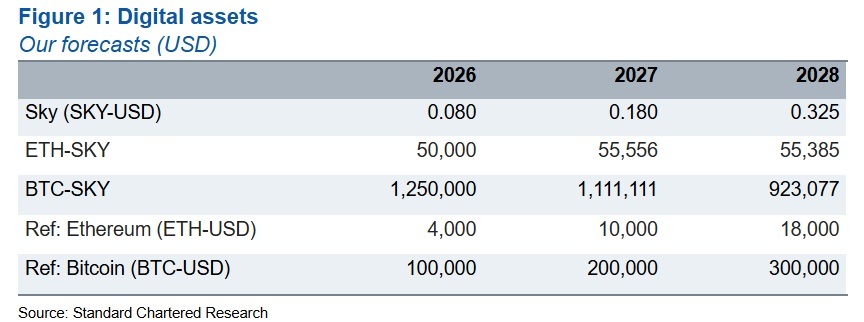
SKY token holders could capture substantially more value as the Sky ecosystem expands, according to Standard Chartered’s first formal assessment of the asset. In a research note dated Sept. 11, Global Head of Digital Assets Research Geoff Kendrick projected that SKY could reach $0.325 by end-2028, five times the $0.065 baseline stated in the note. SKY changed hands at $0.0628 on Sept. 12, slightly below the note’s starting point.
The Standard Chartered head of digital asset research linked the projected gain to a corresponding increase in the value distributed through staking rewards and token buybacks. Standard Chartered wrote:
“As the system scales up, we expect Sky to pass on 5x more value to token holders by the end of 2028.”
Sky’s position rests largely on USDS, its dollar-pegged cryptocurrency and principal source of liquidity for the protocol’s lending system. Unlike conventional stablecoins designed primarily for payments and transfers, USDS also provides access to savings and lending products. Kendrick stated:
“The Sky ecosystem is akin to a federal bank – it issues money (stablecoins), creates a governance framework and charges a wholesale rate of interest to borrowers.”
Agent Borrowing Drives Sky’s Revenue Thesis
The decentralized finance platform adopted the Sky name in 2024 while introducing USDS as an upgraded version of DAI and SKY as its new governance asset. The MakerDAO rebranding established the current token structure, including a conversion rate of 24,000 SKY for each MKR before applicable penalties. SKY holders now govern protocol parameters and can stake their tokens for rewards.

Sky’s agents serve as decentralized capital allocators that borrow USDS at wholesale rates and deploy it across approved yield strategies. Standard Chartered reported that agents had borrowed $5.9 billion since the model began in September 2024. A Sky Frontier Foundation monthly update separately placed agent deployments above $5.5 billion in June, including allocations involving Janus Henderson, Blackrock, Anchorage, Paypal, Securitize, and Galaxy.
USDS supply reached $10.04 billion in June, a 96.9% increase year over year, though the total slipped from $11.14 billion in May, according to the same update. The stablecoin had held a $7.54 billion market capitalization on March 7 after posting the largest weekly percentage gain among the 10 biggest stablecoins. Standard Chartered identified further expansion of USDS outstanding as the central driver of higher protocol revenue and token-holder distributions.
Buybacks and Staking Connect Growth to SKY
Protocol revenue reaches SKY holders through mechanisms designed to reduce circulating supply or reward token staking. Sky’s governance token structure uses treasury-funded open-market purchases rather than new issuance to finance staking rewards. Repurchased tokens can either be burned or redistributed to stakers under governance-controlled parameters, while maximum supply is capped at 23.46 billion SKY.
The ecosystem has also expanded its lending architecture through stUSDS, which provides capital for borrowing against staked SKY positions. The risk capital token debuted in October 2025 as a higher-risk product intended for sophisticated participants. These interconnected products create more channels for capital deployment, interest income, and protocol fees as USDS usage increases.
Kendrick expects the value transferred to token holders to at least double over the next 12 months, he said in a Sept. 11 email. The research note added:
“SKY price gains will broadly keep pace with ETH gains and outperform BTC through end-2028.”
The comparison reflects Standard Chartered’s separate 2028 targets of $18,000 for ETH and $300,000 for BTC. The bank named slower-than-expected growth in yield-bearing stablecoins as the principal risk to its SKY outlook.




Be the first to comment