



Despite Bitcoin failing to hold above $80,000 following the recent rally, the cryptocurrency is unlikely to revisit the lower price levels it has hovered near for much of this year, according to CoinMarketCap Head of Research Alice Liu.
“I think we might have already touched the bottom,” Liu tells Cointelegraph on Trade Secrets, referring to Bitcoin falling to around $59,000 in June this year, approximately 53% below its October all-time high of $126,100.
Bitcoin recently tapped $81,600 at the start of September, an approximate 28% rally since mid-August. It pushed the CoinMarketCap Crypto Fear & Greed Index, which measures overall sentiment in the crypto market, back up to Greed after posting Fear scores for most of the year.
However, Liu says some of the more interesting narratives are unfolding outside Bitcoin, particularly in the markets for tokenized real-world assets and perpetual futures. “For Hype [Hyperliquid], there are two things I want to mention. Number one is the activity, and number two is the price, because the network activity doesn’t necessarily translate to the price, and vice versa,” she says.

Hyperliquid ‘still leads’ says Alice Liu
“One interesting thing is I was looking at the RWA perps for the past two months, so the perpetrals backed onto tokenized stocks, tokenized ETFs, and tokenized indices,” she says. Liu said that while Hyperliquid currently holds market share, that might not always be the case as centralized exchanges swoop in.
“Tokenization of the perps, people normally traded on Hyperliquid. But since Binance started to launch the RWA perps, the volume and liquidity quickly moved to Binance,” Liu says.
“Binance takes about 50% of the market share. But when it comes to DEX, Hyperliquid still leads in that space,” she says.
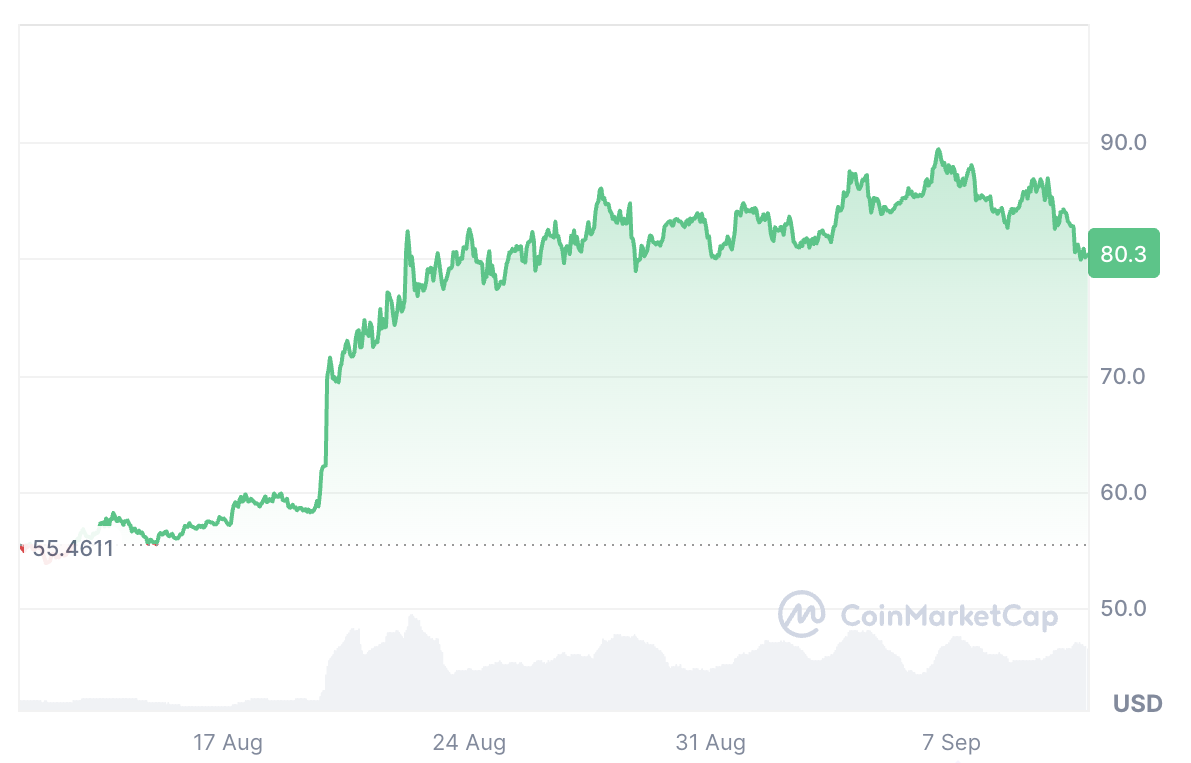
Hyperliquid is up 47.50% over the past 30 days. Source: CoinMarketCap
“Hyperliquid is still a venue where a lot of the liquidity is getting aggregated, and a lot of the product’s scale is created there.”
On the Hyperliquid token’s price, Liu points to a different driver. “Hype did hit an all-time high recently: $86. And what’s really interesting is the buybacks.” She explains that Hyperliquid is leading the pack in token buybacks, which is when a project uses its revenue to buy back its own tokens on the open market.
“Hype has spent over $400 million USD on token buybacks. So I think some of this price action momentum we’re seeing is supported by that as well,” Liu says.
She says that Hyperliquid only has a small amount of tokens unlocked, so we’ll continue to see the token unlocks gradually come out.
Alice Liu is more cautious on the AI-crypto narrative
Liu says that means the Hype price is dependent on revenue flowing in to support buybacks.
“So, will we have enough activity on the network to generate the revenue to continue with the buybacks to support the price level? I think that’s one of the key things to watch.”
While Liu remains bullish on Hyperliquid, she is more cautious on the AI-crypto narrative, particularly AI tokens with little or no utility that surged in popularity in late 2023.
“They are facing such big competition at the moment with the actual AI stocks, all the memory stocks, and all the AI companies. So I think that might be the competitor they’re facing,” Liu says
“For the previous cycle meme-ified AI tokens that do not have any utility or infrastructure, and are purely just backing onto a concept. I think those could potentially go to zero,” she says.
However, Liu emphasizes that there are “some really solid” AI infrastructure projects. “I think they will have utilities too. But even then, I think they’re likely to get a price discount,” she says.
Liu says Bitcoin and the broader crypto market are being underestimated as a place to park funds in the current economic environment, but she takes a more conservative view than Coinbase CEO Brian Armstrong and ARK Invest CEO Cathie Wood, who have both predicted Bitcoin will reach $1 million by 2030.
“Bitcoin to $500K by 2030,” Liu laughs.
“It’s not unlikely that we might hit one million, but I’ll give it a more conservative answer,” Liu adds.
Cointelegraph publishes long-form journalism, analysis and narrative reporting produced by Cointelegraph’s in-house editorial team with subject-matter expertise. All articles are edited and reviewed by Cointelegraph editors in line with our editorial standards. Some articles contain affiliate links, from which Cointelegraph may earn a commission. These relationships do not influence which products we review or our editorial conclusions. Content published in here does not constitute financial, legal or investment advice. Readers should conduct their own research and consult qualified professionals where appropriate. Cointelegraph maintains full editorial independence.


Be the first to comment