



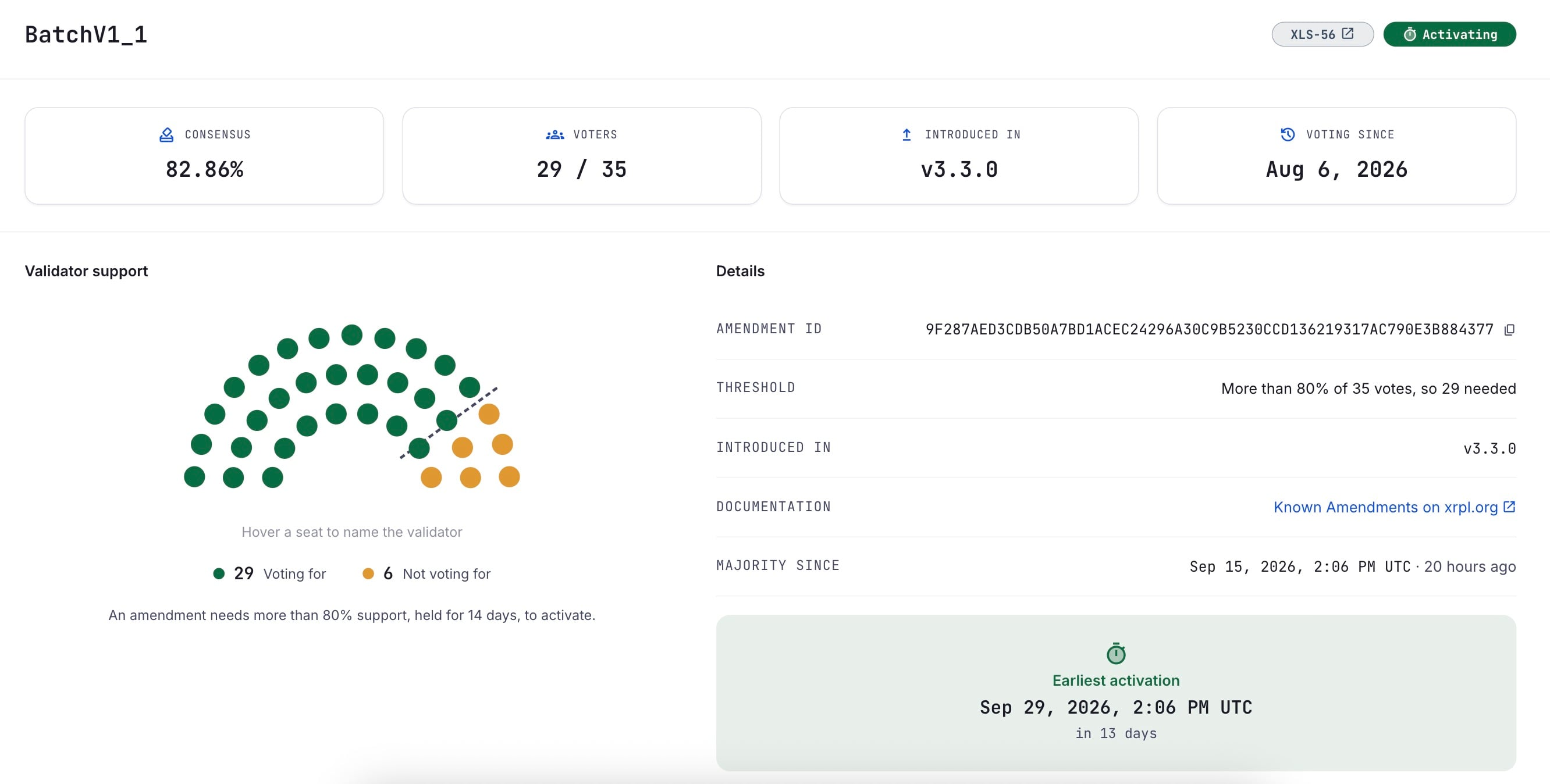
The countdown to a major technical upgrade has officially begun on the XRP Ledger (XRPL). Late yesterday evening, analytics platform XRPScan recorded the crossing of a critical threshold: the long-awaited Batch (XLS-56) amendment secured 82.86% of validator votes.
Under the network’s rules, reaching this threshold activates a strict 14-day timer. If consensus holds for two weeks, the upgrade will automatically take effect on September 29, 2026, at 14:06 UTC.
You Might Also Like

The implementation of XLS-56 marks developers’ second attempt to launch batch transactions. In February of this year, the first version of Batch was urgently suspended after auditors at Cantina AI discovered a vulnerability in the signature-validation logic that could potentially put the security of funds at risk.
The RippleX team did not try to hide the problem and instead completely reworked the architecture. After months of testing with specialists from Halborn and Common Prefix, as well as a public stress test at the Sherlock Attackathon, the secure code was packaged into the global xrpld v3.3.0 release. Validators gave the green light.
Why the “all-or-nothing” rule will change the lives of ordinary XRP holders
The Batch feature allows up to 8 entirely different transactions from different users to be combined into a single package and executed during one ledger close.
The uncompromising all-or-nothing principle applies here. If even one transaction in the sequence fails or encounters price slippage, the network instantly rolls back the entire package. This eliminates the risk of stuck transactions in which one party sends an asset while the other goes offline.
You Might Also Like
The upgrade opens the door to commercial use cases that previously required complex and expensive smart contracts:
- Institutional settlements: Institutional capital gets a ready-made tool for the repo and securities markets. The transfer of ownership of a tokenized asset and its payment take place within the same millisecond, following the “delivery versus payment” principle.
- Direct barter (NFT-for-NFT): Users will be able to exchange digital art directly, without intermediate conversion into XRP or other tokens.
- Commercial UX: Application developers will be able to build their fee directly into a user payment. The platform takes a cent for its services, while the main transaction proceeds simultaneously and seamlessly.
- Smart trading: On decentralized exchanges (DEXs), traders will be able to send bundles of several orders. The first successful order will execute, while the others will be canceled, protecting the trader from losses.
Less than two weeks remain before XLS-56 is activated. For long-term XRP holders, this date is a marker that the network is finally transforming from infrastructure for fast transfers into a mature, secure platform for complex business and DeFi.



Be the first to comment