


What to know:
- New draft bill aims to reshape how digital assets are taxed in the US.
- Small stablecoin payments under $200 may avoid taxes and reporting.
- Bitcoin excluded from key tax relief, drawing industry criticism.

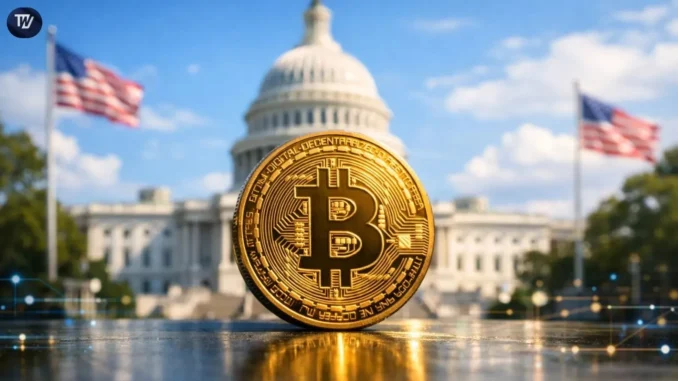
Bitcoin has once again entered the policy spotlight as US Representatives Max Miller and Steven Horsford released a discussion draft of the Digital Asset Protection, Accountability, Regulation, Innovation, Taxation, and Yields Act, also known as the Digital Asset PARITY Act.
The proposal outlines major changes to how digital assets are treated under the US tax code, with a focus on reducing uncertainty for investors and businesses.

The draft is a proposal for a change in the Internal Revenue Code of 1986, which will establish guidelines for digital assets.
These assets will be fungible tokens that are publicly priced for payments or value storage, excluding those related to ownership or debt, and will be on a blockchain system.
This is a draft, and it is awaiting feedback from lawmakers, industry stakeholders, and regulators. According to Digital Chamber CEO Cody Carbone, tax guidelines could bring crypto back to the US.

Source: Digital Chamber
Stablecoin Tax Relief and Transaction Thresholds Take Center Stage
One of the most interesting aspects of this draft is how stablecoins are being considered for taxation. It has been proposed that stablecoins tied to the US dollar will not be subject to any capital gains if their value does not vary by more than 1% of $1 or $0.01.
The proposal also includes a de minimis rule for small transactions. Stablecoin payments below $200 will not be subject to reporting requirements and will not incur capital gains tax. However, a limit for these de minimis rules has not yet been established.
In addition, fees associated with acquiring or moving regulated stablecoins will not be included in the cost basis; this will slightly alter how investors calculate their gains.
Apart from this, the draft has also considered income that is obtained through staking, lending, and validator activities.
Income that is obtained through these activities will be considered gross income and will be calculated using fair market value. There is also a clarification that passive staking is not a trade or business.
Also Read: US Government Shutdown Nears End: Bitcoin Price Recovers After House Approval
Bitcoin Exclusion and Wash Sale Rules Spark Debate
Although stablecoins are given due consideration, Bitcoin has been ignored in this de minimis exemption. This has raised various questions among the crypto community.
In this context, Pierre Rochard, CEO of The Bitcoin Bond Company, stated that Bitcoin should receive such tax relief instead of stablecoins.
The draft also proposes that the existing wash sale rules will be extended to include digital assets. This means that investors will not be able to claim losses on assets that they sell at a loss if they repurchase similar assets within 30 days.
These provisions were previously limited to stocks and securities. Other provisions include penalties for fraudulent reporting of donations of digital assets and the authority given to the US Treasury to make regulations regarding events such as a fork and an airdrop.
This article contains market analysis and price predictions. These are not guarantees. Crypto markets are volatile. Always DYOR. Not financial advice.
Also Read: Bitcoin Price Analysis: BTC Trades Near $69,000 as Daily RSI Slips Toward 30


Be the first to comment