


JPMorgan says Bitcoin could receive more support than gold if investors unwind the short positions and options used to protect Bitcoin ETF holdings. The claim is conditional: it assumes investors keep their underlying Bitcoin exposure rather than selling it.
JPMorgan says Bitcoin could receive more support than gold if ETF investors remove bearish hedges while keeping their underlying fund exposure. The idea is about how investors are positioned inside the two ETF markets, not a forecast that Bitcoin will replace gold in portfolios.
Key Takeaways
- JPMorgan links Bitcoin support to hedge unwinds.
- August Bitcoin ETF inflows were uneven.
- Closing a short differs from new buying.
- Earlier data showed heavier Bitcoin ETF protection.
- Yields and the dollar remain important.
Bitcoin ETF inflows returned, but not in a straight line
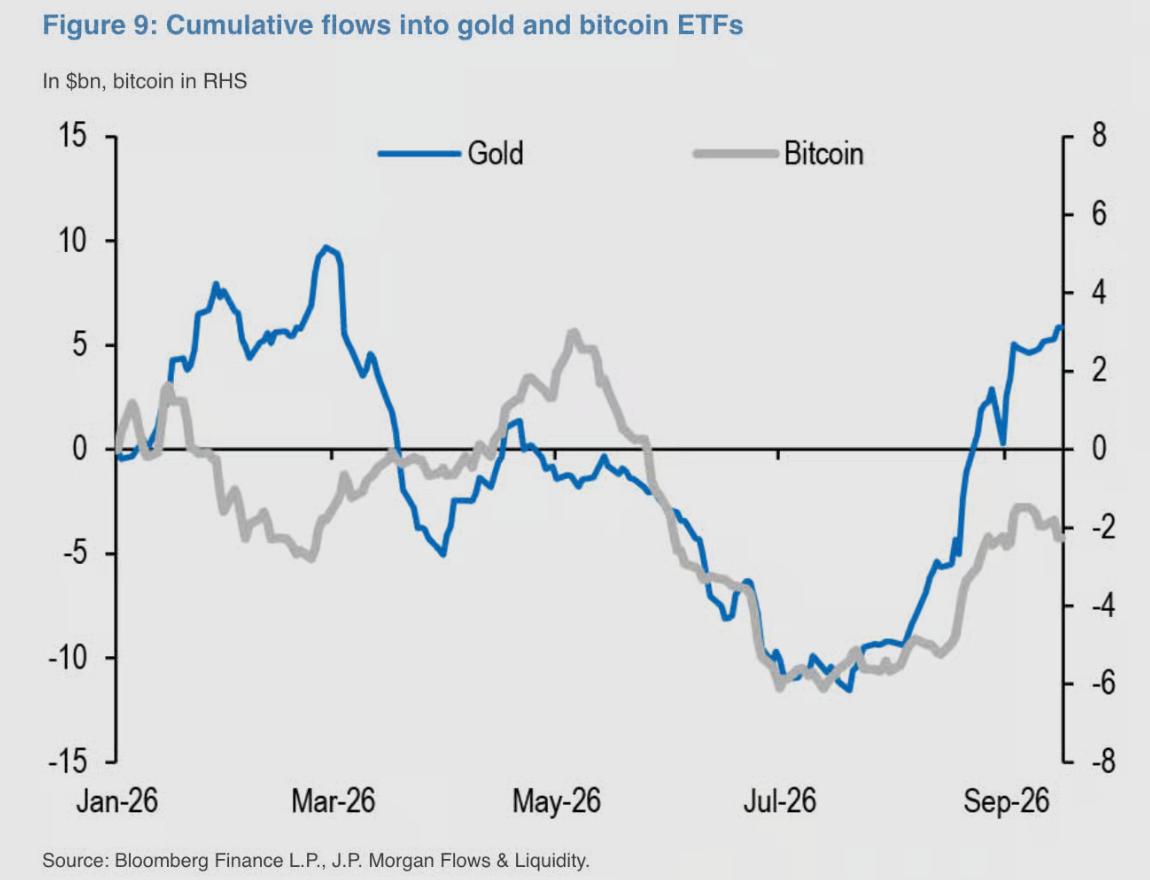
JPMorgan analysts led by Nikolaos Panigirtzoglou said in a note, reported by The Block, that Bitcoin and gold ETFs received inflows after the Federal Reserve’s July 28-29 meeting as the so-called debasement trade returned.
The Bitcoin figures support that as a broader August trend, rather than an immediate or uninterrupted move. SoSoValue’s weekly data show net inflows of roughly $4.23 billion between the readings dated July 31 and September 4. That total includes a $61.53 million outflow in the first reading after the meeting and another $389.71 million outflow in the week dated August 14.
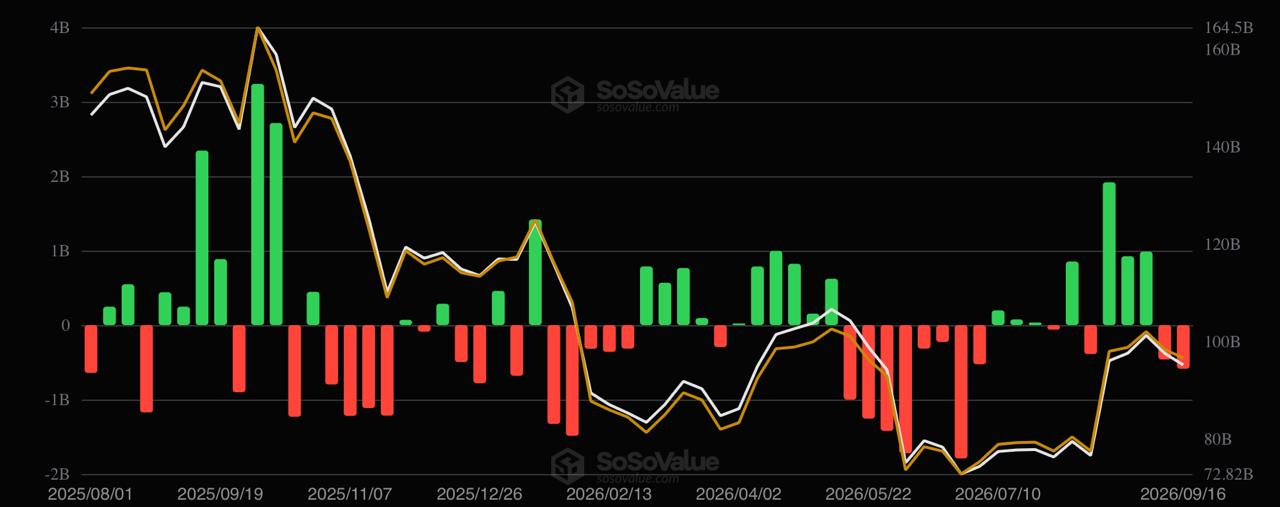
Demand then weakened again. The same series recorded net outflows of $462.73 million for the week dated September 11 and $586.27 million in the latest September 16 reading. The Block reported inflows for both Bitcoin and gold ETFs; the SoSoValue data reviewed here verify the Bitcoin side of that picture.
Investors use the term “debasement trade” when they add assets with limited supply because they are concerned about inflation, rising public debt or a weaker currency reducing cash’s purchasing power. Gold has traditionally filled that role. Bitcoin is increasingly part of the same trade, although its price still moves much more sharply.
Why removing a hedge can support Bitcoin
An investor can own shares in a spot Bitcoin ETF while limiting potential losses. They might buy put options, which increase in value if the ETF falls, or short ETF shares or related futures contracts.
For a simplified example, imagine a fund that owns $10 million of Bitcoin ETF shares while shorting $2 million of the same ETF. If it closes the short, it has to buy those shares back. That purchase can support the ETF’s price, even though the fund’s original $10 million long position has not increased.
Put options are less direct. When investors reduce them, market makers may adjust their own hedges, but that does not automatically result in an equivalent purchase of Bitcoin ETF shares. Less options protection should therefore not be treated as fresh ETF demand.
Why JPMorgan sees a possible Bitcoin advantage
The bank’s reasoning builds on a difference it identified earlier this year. In a March comparison of IBIT and GLD positioning, JPMorgan said short interest in BlackRock’s iShares Bitcoin Trust, known as IBIT, had risen while short interest in SPDR Gold Shares, or GLD, had declined.
The analysts also found that IBIT’s put-to-call open-interest ratio was above GLD’s. Put simply, Bitcoin ETF investors appeared to be using more insurance against a fall than investors in the largest gold ETF.
Those data points are not a live reading of every position in the market. They show why Bitcoin may have more defensive exposure to unwind if sentiment improves. A larger pool of shorts and put options can create a sharper response when investors stop protecting against the same downside risk.
Higher yields can still overpower the positioning case
ETF positioning is only one part of the market. Investors may close protective trades while still reducing exposure to risk assets if Treasury yields rise quickly or the dollar strengthens.
That is why the wider rate environment remains relevant. Bitcoin’s historical reaction to Fed rate hikes shows that the asset has behaved differently across tightening cycles. At times, investors have treated it as a scarcity hedge; at others, it has moved more like a higher-risk asset sensitive to liquidity conditions.
What would support JPMorgan’s case?
A single green day for Bitcoin would not answer the question. The more persuasive setup would combine steady ETF demand with evidence that investors are becoming less defensive.
- Spot Bitcoin ETF flows: Positive flows would show that the underlying exposure is holding up.
- IBIT short interest: A decline could be consistent with fewer short positions.
- IBIT put-to-call open interest: A lower ratio could signal less demand for downside insurance.
- Gold ETF flows: Continued demand would show that the move is not simply a rotation out of gold.
- Yields and the dollar: A sharp rise in either could offset favourable ETF positioning.
Short-interest data are reported with a delay and do not reveal why each position was opened. They become more useful when read alongside ETF flows, options activity and macro conditions.
The data to watch is beneath the flow headline
ETF flow totals can conceal different investor behaviour. A fund may be gaining new capital, while another market is merely seeing existing holders remove protection against a fall. Both can look constructive at first, but they do not carry the same message about conviction.
JPMorgan’s argument will gain force only if Bitcoin ETF holdings remain resilient as defensive positions decline. That combination would show that investors are not simply trading a short-term rebound; they are becoming more willing to hold the exposure without as much insurance.
This article is provided for informational purposes only and does not constitute financial or investment advice. ETF flows, short interest and options positioning can change rapidly.

Alex is Editor-in-Chief of Coindoo and co-founder of Millennial Media Group, with nearly a decade of experience covering financial markets – crypto first, then everything else.
It started in 2016 with Bitcoin. Like most people at the time, he didn’t fully understand it – so he kept digging. Blockchain, tokenomics, the projects, the cycles. That curiosity never stopped, and eventually pulled him into traditional markets too: equities, commodities, macro. Not because he left crypto behind, but because you can’t properly understand one without the other.
What drives him is straightforward: he wants to know why something is happening, not just that it’s happening. Most market coverage stops at the headline – price up, price down, here’s a chart. Alex finds that kind of reporting actively unhelpful. If you walk away from an article without understanding the mechanism behind the move, what did you actually learn?
He holds a degree in Tourism from New Bulgarian University – not the most obvious path into financial markets, but markets have a way of pulling in people who are simply too curious to stay out. He has authored over 200 in-depth analyses and more than 10,000 articles across crypto and traditional finance. He still thinks every day in markets teaches him something new. That’s probably why he hasn’t stopped.



Be the first to comment