



Financial data and rating agency S&P Global is doubling down on the crypto market. On the 17th of September, the giant announced a planned acquisition of OpenZeppelin, a smart contract security and assessment firm.
It’s this security assessment expertise that S&P Global seeks to leverage as digital asset (including tokenization) and traditional finance integration deepens. In fact, Yann Le Pallec, President of S&P Global, reiterated this as the main reason for the move.
Our digital assets strategy centers on bringing trusted data, benchmarks, and transparent risk assessment to markets as they move onchain.
Pallec added,
OpenZeppelin’s technology and expertise will complement our smart contract and onchain technology risk assessment capabilities.
According to him, S&P Global’s expanded crypto and DeFi risk assessment capabilities will help tradFi institutions build confidence and transact in this fast-evolving space.

S&P Global crypto bets
Reacting to the acquisition agreement, OpenZeppelin billed it as a major win for onchain finance. The firm noted that onchain finance is “growing from an emerging market into core financial infrastructure.”
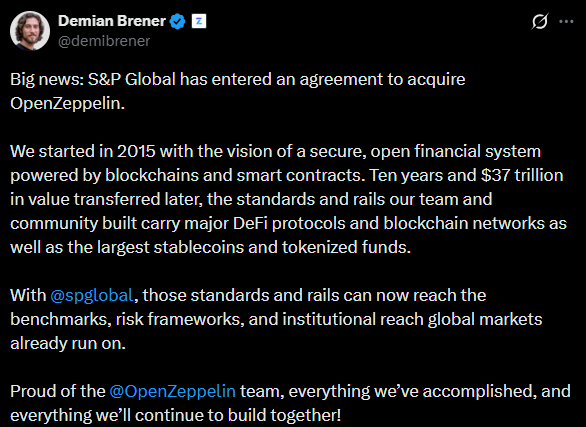
For his part, Demian Brener, OpenZeppelin CEO, said the update was ‘big news’ and marked new institutional reach in global markets.
The announcement comes just three days after S&P Global made a $110M strategic investment into Kaiko, a crypto-native data firm.
And the motive is the same: invest in the future of financial data. This conviction and bet reinforce crypto and blockchain as the future of global financial rails, as noted by Kaiko CEO Ambre Soubiran.
This investment from S&P Global is a powerful endorsement of Kaiko’s mission and the role trusted data and data infrastructure will play in tokenized markets.
For his part, Matthew Sigel, head of digital assets research at VanEck, called the back-to-back bets “aggressive moves.”
That said, the firm has begun offering risk assessments of stablecoins, tokenized products, and DeFi protocols.
In 2025, it issued a B- issuer credit rating for Sky Protocol (formerly MakerDAO). It also downgraded USDT’s rating to ‘weak’ last November, sparking backlash from Tether CEO Paolo Ardoino.
Overall, increased risk frameworks and assessments for the sector are warranted given the ongoing mass adoption and tokenization push by the SEC.
However, this will not sweep all underlying DeFi risks under the carpet. In fact, most rating agencies, including S&P Global, Moody’s, and Fitch, failed to stop the 2008 global financial crisis due to conflicts of interest, as they are paid by issuers for the ratings.
If the flawed issuer-pays model is carried into DeFi and crypto, their ongoing risk frameworks may make no difference at all as far as DeFi risks are concerned.
Final Summary
- S&P Global to acquire OpenZeppelin to expand risk assessment frameworks in crypto and DeFi
- Despite the aggressive moves to enhance institutional trust in the DeFi sector, ratings agencies come with their own risks.


Be the first to comment