


All news is rigorously fact-checked and reviewed by leading blockchain experts and seasoned industry insiders.
Summary
- Arbitrum, Uniswap and NEAR top today’s gainers board.
- A fresh SEC exemption for tokenized stocks is powering the DeFi bid.
- Uniswap and Arbitrum sit closest to the onchain-equities flow.
- All five leaders trade in overbought territory on short timeframes.
The five biggest gainers in the market today are decentralized exchange and Layer-2 tokens, not the usual large-cap majors, and they are moving together for a reason. Arbitrum (ARB) leads on a 24-hour basis at $0.2145, up 30.26%, followed by Uniswap (UNI) at $8.73 and NEAR Protocol (NEAR) at $3.47, with Raydium (RAY) and Aptos (APT) rounding out the group. The common thread behind most of the board is a regulatory decision made the day before: on September 17 the US Securities and Exchange Commission granted a temporary exemption that lets tokenized US stocks trade through permissioned automated market makers, the exact plumbing these protocols operate.
1
Arbitrum ARB

Market cap $1.45B
$0.2145
24h +30.26%
7d +47.83%
2
Uniswap UNI
Market cap $5.42B
$8.73
24h +27.98%
7d +42.91%
3
NEAR Protocol NEAR
Market cap $4.53B
$3.47
24h +27.14%
7d +38.04%
4
Raydium RAY
Market cap $458.57M
$1.70
24h +16.90%
7d +4.68%
5
Aptos APT
Market cap $577.94M
$0.6639
24h +16.23%
7d +3.80%
Why the SEC’s tokenized-stock order sits behind the board
The SEC’s “Innovation Exemption” releases so-called Tokenized Securities Venues from the definition of an exchange under the Securities Exchange Act of 1934, and it does so for five years on a temporary, conditional basis. In plain terms, a venue can now bring buyers and sellers of tokenized US stocks together through permissioned AMMs and liquidity pools without first registering as a national securities exchange. The relief is narrow by design. It covers real, 1:1 backed shares that carry full shareholder rights such as dividends and voting, and it explicitly leaves out the synthetic stock tokens that have driven much of the recent onchain equity trade. The order also requires the smart contracts involved to be auditable and deployed on a public, permissionless chain, which rules out private bank networks and quietly favors the public DeFi venues already running this infrastructure.
Permissioned pools are the mechanism that makes the exemption workable. Rather than gating access at a website or through an offchain check, the pool itself verifies whether a wallet has been approved by the asset issuer before a swap or a liquidity deposit clears. The issuer keeps the allowlist and the compliance controls that securities law demands, while the approved trader gets standard AMM liquidity. That single piece of engineering is why the market treated a regulatory notice as a direct catalyst for specific token prices instead of a distant policy headline.
Uniswap already built the venue the exemption describes
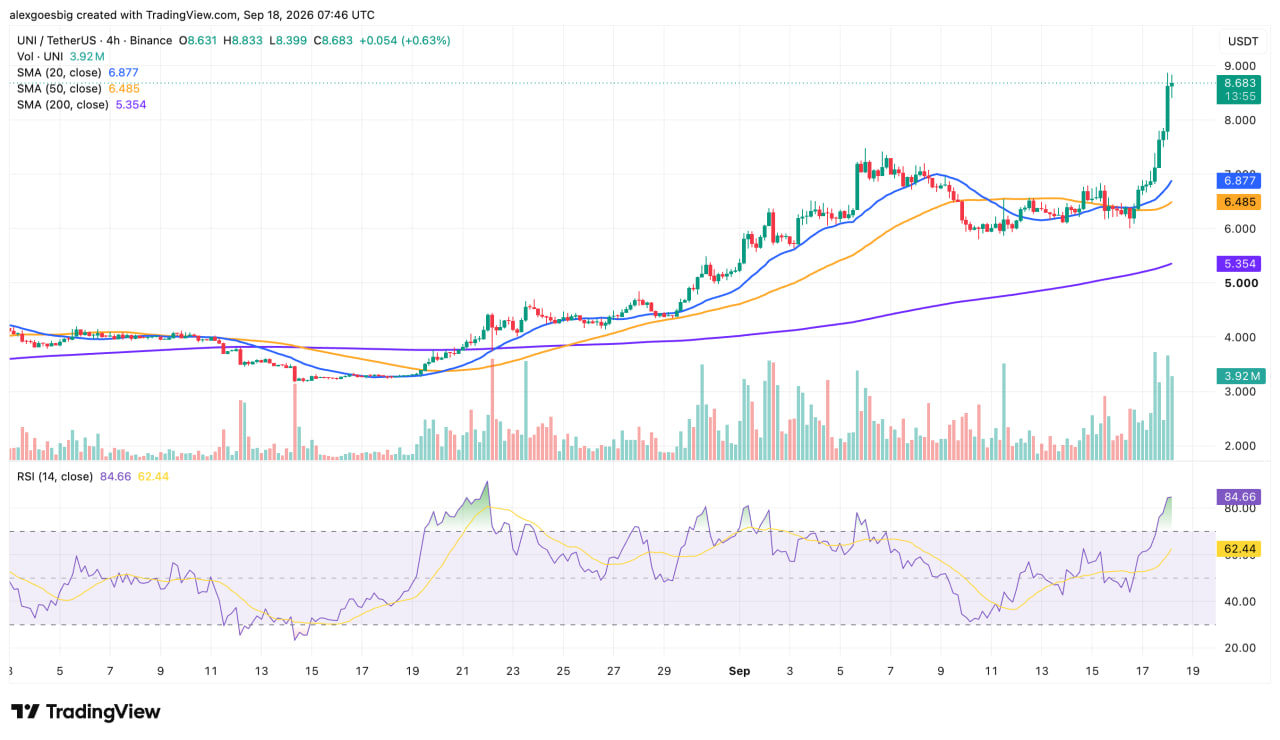
Uniswap is the clearest beneficiary because it already shipped the product the SEC’s language points to. Its Permissioned Pools framework, built as a Uniswap v4 hook and launched in July, lets regulated assets tap AMM liquidity while the issuer enforces eligibility on every trade. Launch partners included tokenization firms Securitize and Superstate, and Superstate has since confirmed it is routing tokenized equities onchain through that hook. The protocol has also become the default liquidity engine for Robinhood’s Stock Tokens, handling close to 99% of tokenized-stock liquidity on Robinhood Chain and passing $10 billion in cumulative stock-token volume.
80% of all Robinhood Stock Token volume is traded on Uniswap
That translates to $10B (and counting) pic.twitter.com/AUL7kTjBAq
— Uniswap (@Uniswap) September 18, 2026
UNI trades at $8.73, up 27.98% on the day and 42.91% over the week, a move that lines up with the market pricing Uniswap as the toll booth for onchain equities rather than as a generic DeFi token.
Arbitrum runs underneath Robinhood’s stock-token chain

Arbitrum tops the 24-hour board at $0.2145 and leads the group over seven days with a 47.83% gain, and its position in the tokenized-stock stack explains the strength. Robinhood Chain, the network where most of that stock-token volume settles, runs on Arbitrum Orbit technology, making it an Ethereum Layer-2 built on Arbitrum’s stack. Every dollar of tokenized-equity flow that benefits Uniswap is also flowing across Arbitrum’s infrastructure. Traders who bought the Uniswap thesis extended it one layer down. Worth noting for anyone chasing the candle: ARB had already printed a sharp intraday reversal, with the latest four-hour candle down 6.41% from a local high near $0.229, a reminder of how fast these repricings run in both directions.
Raydium carries the same trade onto Solana

Raydium carries the Solana side of the story. As the network’s leading AMM, it stands to absorb tokenized-equity flow that the exemption opens up on public, permissionless chains, and that pipeline is already forming. Backpack’s tokenized stocks now route through Raydium, StonkFun has moved all new launches to Raydium’s LaunchLab, and the protocol reported its largest buyback to date, roughly $640,000 on September 9, funded by 12% of trading fees. RAY sits at $1.70, up 16.90% on the day. Its weekly gain of 4.68% is far smaller than the leaders’ double-digit weekly runs, which marks this as a fresher breakout rather than the tail end of a week-long trend.
NEAR and Aptos moved on catalysts unrelated to stocks

Not every name on the board is a tokenized-stock play. NEAR rose 27.14% to $3.47 on a separate development: the launch of confidential perpetual futures on near.com, with execution running on Hyperliquid. The setup lets traders access more than 50 perpetual markets at up to 40x leverage while NEAR Intents handles the funding route and works to keep a deposit from being publicly linked to a wallet. The positions themselves stay visible at the market level, so this is confidential funding and wallet attribution rather than fully private trading. The protocol also reported confidential total value locked reaching $70 million and took a snapshot for a milestone incentive program, both of which fed the bid.
near.com MILESTONE: Confidential TVL has reached $70 million.
The snapshot for the [email protected] milestone incentive program has been taken. pic.twitter.com/ER1fYaQCxS
— NEAR Protocol (@NEARProtocol) September 15, 2026
Aptos, up 16.23% to $0.6639, moved on tokenomics instead of a product launch. The network burns APT on every transaction, and it reported 159.6K APT burned over the past 30 days and 1.8 million burned since mainnet, with an average transaction fee of $0.0005 following a tenfold fee increase and an annualized burn rate near 1.9 million APT. Against a market already bidding altcoins, a clean deflation narrative was enough to trigger a sharp single-candle reclaim of its major moving averages.

RSI above 80 on two of the five names
Reading the charts is where caution enters. On the four-hour timeframe every token in this group trades above its 20, 50 and 200-period moving averages, which is the technical signature of an uptrend across short, medium and longer windows. The catch is momentum. The relative strength index, which measures how quickly price has risen relative to its recent range, is stretched well into overbought territory across the board, and readings above 70 typically signal a move that is due for a pause or a pullback rather than one with fresh room to run.
Four-hour RSI, with the 70 overbought line marked
The dark line at 70 is the overbought threshold. Every bar clears it, and NEAR and UNI push past 84, the sign of a move that has run fast and may need to cool before it continues.
Why the exemption’s fine print decides who keeps the gains
The open question is whether trading volume actually follows the regulation. The SEC framed the exemption as a testbed, and it asked for public data and comment before deciding on permanent rules, which means the framework can still tighten. Several conditions cap its reach today. It applies only to genuine 1:1 backed stocks and not to the synthetic products that dominate current onchain equity trading, it carries limits on the number of tradeable symbols and aggregate volume, and Robinhood’s Stock Tokens remain off-limits to US persons, so the largest retail audience for these assets is still fenced out. The tokens that hold their gains will likely be the ones where issuers actually deploy under the exemption and route real order flow, rather than the ones that simply share a sector with the headline. For traders, the split the SEC drew between real tokenized shares and synthetics is the line to watch, because it may quietly decide which venues inherit the next wave of listings and which get left with the memecoin-stock pairs that seeded this market in the first place.



Be the first to comment