



Coinbase CEO Brian Armstrong has distanced himself from claims by the Wall Street Journal (WSJ) that he was responsible for the CLARITY Act’s failure.
The much-awaited and crucial crypto legislation hit a snag earlier in the week after it failed to clear a procedural vote to advance to the Senate floor debate.
No Democrats supported the bill, citing limited ethics provisions. A handful of Republicans also withheld support, bringing the vote tally to 49 (Yes)-50 (No), which fell short of the 60 votes needed to advance the bill.
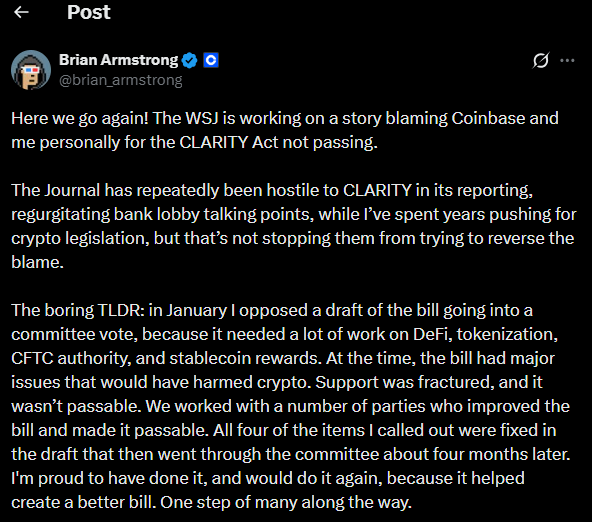
However, the WSJ is reportedly planning to pin the failure on Armstrong. In response, Armstrong stated,

In January, I opposed a draft of the bill going into a committee vote because it needed a lot of work on DeFi, tokenization, CFTC authority, and stablecoin rewards. At the time, the bill had major issues that would have harmed crypto.
At the time, even the White House scolded his opposition and warned that he’s not the crypto industry. However, he insisted that he’s “proud” of his opposition because it led to a “better bill.”
On the revised version, which had a stablecoin yield compromise, Armstrong added,
The final draft of CLARITY that went to the Senate was great, and I strongly supported it. It’s a shame that the WSJ takes direction from bank lobbyists.
On the contrary, some industry insiders blamed Trump’s $1.4B crypto profits as largely responsible for the ethics stand-off and the bill’s failure.
SEC, CFTC advance crypto clarity via rulemaking
Here, it’s worth pointing out that the bill stalled on Tuesday. However, by Thursday, the regulators (SEC and CFTC) had begun rolling out rulemakings.
Notably, the CFTC issued no-action relief for passive software providers, effectively allowing players like self-custodial wallets such as Phantom to avoid registering as brokers to offer derivative trading.
Additionally, the CFTC submitted a new crypto market structure proposal for White House review. If approved, it would allow existing and unregistered crypto platforms to get approval for leveraged trading. This is the regulated pathway that Hyperliquid is betting on to gain U.S market entry.
Separately, the SEC also made similar moves. It published a 5-year tokenization exemption program, allowing crypto platforms to facilitate tokenized stock trading. This would exempt some firms from registering as full securities exchanges.
Still, the rulemaking approach can be reversed by the next administration if the rules aren’t codified by Congressional legislation. For his part, ETF expert Nate Geraci views the rulemaking as a “legitimate window” for the crypto industry to build.
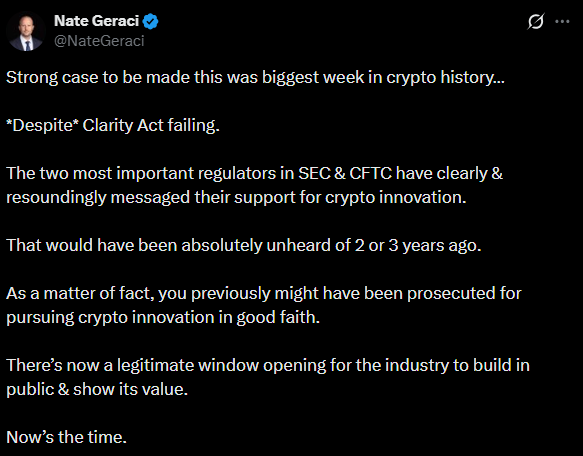
However, others believe that there are still regulatory risks for investors and developers if the next regime is anti-crypto.
Final Summary
- Coinbase CEO slammed WSJ for linking him to the CLARITY Act’s failure.
- Analysts are split on regulatory risks associated with SEC and CFTC’s rulemakings.




Be the first to comment