



AI Summary
- The CFTC has reportedly submitted proposed rules covering crypto asset transactions and markets for White House review.
- The filing indicates that agency rulemaking could continue despite the Clarity Act failing to advance.
- Longer stock market sessions would increase pressure on liquidity, settlement and tokenized cash infrastructure.
- Claims about Tether owning silver go beyond the narrow storage arrangement described in the supplied source material.
- Our analysis sees regulatory progress, not confirmation of an immediate crypto bull market.
The common crypto narrative is that stalled legislation leaves the United States trapped in policy paralysis. The concrete sourced development is narrower and more consequential: the CFTC has reportedly prepared rules for crypto asset transactions and crypto asset markets, then submitted them to the White House Office of Information and Regulatory Affairs for review.
That does not establish what the rules contain, when they could take effect or whether they will survive legal and political scrutiny. It does show that regulatory work can continue outside the legislative path that recently faltered with the Clarity Act. In our view, this is best understood as an institutional process signal, not confirmation that every token or tokenization platform will benefit.
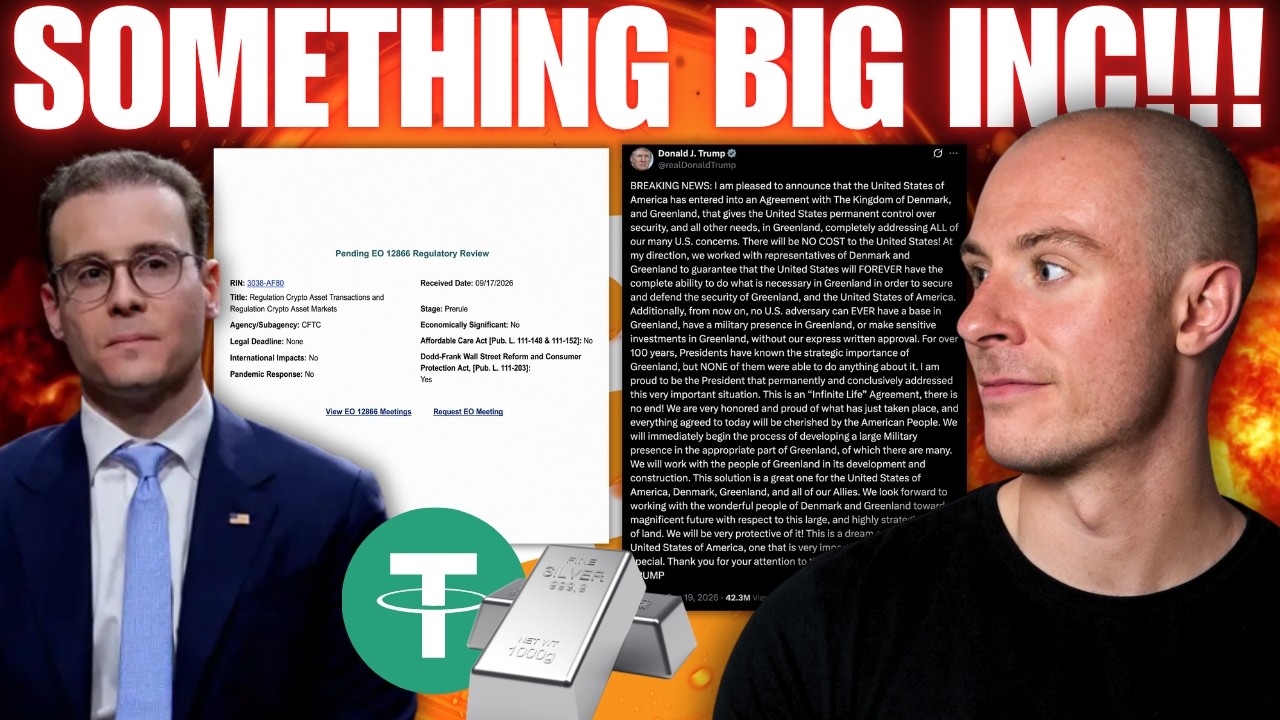
CFTC Preparing Something BIG…. Nasdaq/NYSE 23/5 Inc! Tether Buying Silver!?! Trump Greenland……
Regulatory action moves beyond stalled legislation
The reported submission matters because it separates two questions that are often conflated. Congress can decide whether to create a broad statutory framework, while agencies can still interpret and administer authority they believe they already possess. The failure of one legislative vote therefore does not automatically stop every federal crypto initiative.

“The federal agencies like the CFTC have said they would take their own action to write rules for crypto after the Clarity Act failed.”
The parallel track is already visible in the supplied context. The SEC innovation exemption initiative concerns onchain tokenized stock trading, while the CFTC filing reportedly addresses crypto transactions and markets. These are distinct processes, but together they indicate that agencies are examining how existing market structures might accommodate digital assets.
- What is supported: A proposed CFTC regulatory package was reportedly sent for executive review.
- What remains unknown: The supplied material does not provide the rule text, implementation schedule or affected product definitions.
- What should not be assumed: Agency review is not equivalent to enactment, judicial approval or congressional consensus.
A filing is not a finished rule
The review stage is important, but its limitations are equally important. No primary regulatory document was supplied with the transcript, so we cannot independently assess definitions, exemptions, compliance obligations or the division of responsibility between the CFTC and SEC. The filing should therefore be treated as evidence of active rulemaking rather than proof of a particular policy outcome.
This distinction matters for market analysis. A workable framework could reduce uncertainty for exchanges, brokers and infrastructure providers. A contested or narrowly written rule could instead leave substantial ambiguity. Even apparently favorable relief may apply only to specified activities or intermediaries rather than the entire crypto market.
The more defensible conclusion is that regulatory momentum has not disappeared with the Clarity Act setback. Our analysis does not support the stronger claim that the legislation was deliberately allowed to fail so agencies could bypass Congress. That interpretation appears in the source commentary as speculation, with no corroborating evidence supplied.
Tokenization turns trading hours into a systems question
A second theme concerns plans for stock trading across 23 hours on five days each week. The source material associates Nasdaq and the New York Stock Exchange Arca venue with preparations for expanded access, while describing a one hour daily maintenance interval. It also states that the conventional session would remain unchanged.
Those claims do not by themselves prove that public blockchain settlement is required. Exchanges can extend sessions using conventional systems. Tokenization becomes relevant because near continuous trading increases pressure to coordinate execution, funding, collateral movement, recordkeeping and settlement across time zones. A tokenized asset is only one component of that broader operating model.
- Asset representation: Securities need controlled issuance and accurate ownership records.
- Payment: Trading requires dependable cash or cash equivalent settlement infrastructure.
- Compliance: Identity, transfer restrictions and reporting must remain enforceable.
- Interoperability: Venues, custodians and settlement networks need compatible instructions and finality standards.
This helps explain why institutions are testing multiple layers at once. Stellar joined S&P Global and Nasdaq in the supplied KO tokenization funding context, while DTCC connected Ondo Finance to its Fund/SERV distribution network. Neither development proves that one public chain will dominate securities infrastructure, but both illustrate the institutional search for usable rails.
Longer sessions shift risk toward liquidity and settlement
Extended trading changes the distribution of market activity. More hours do not guarantee more depth. If participation is concentrated during the conventional session, overnight order books may remain thin, increasing the cost of immediacy and making prices more sensitive to relatively small orders.
“While thinner liquidity could mean wider spreads and greater volatility, you’ll need to also tokenize money for this.”
The first part of that statement identifies a credible market structure risk. The second is better treated as a thesis rather than a settled requirement. Tokenized money could support faster coordination between the asset and payment legs, but the source does not establish which instrument, network or legal structure would be used.
Token economics also require restraint. Transaction fees can create demand for a network asset, while trust lines, smart contracts or collateral requirements may create additional utility. Yet institutional adoption does not automatically translate into durable token value. Fee levels, supply design, validator economics and the ability to abstract the native asset all matter. The supplied context on Ethereum and Solana as prospective tokenized market rails reinforces that institutions are evaluating competing architectures rather than converging on a single winner.
Silver and macro claims require restraint
The supplied material also advances a claim that Tether owns silver. The quoted disclosure described an affiliate of a selling stockholder storing gold and silver under a precious metal storage agreement with a company identified in the commentary as gold.com. That wording is materially narrower than proof that Tether directly owns a disclosed quantity of silver.
No primary filing URL, balance sheet amount or chain of ownership was supplied. We therefore cannot verify the stronger ownership claim from the available material. At most, the excerpt supports the existence of a reported storage relationship involving an affiliate and two precious metals. Corporate affiliation, custody and beneficial ownership are not interchangeable concepts.
The surrounding macro thesis links precious metals, Treasury yields, energy costs and monetary change to crypto demand. These relationships can influence risk appetite, but they do not establish a single direction for Bitcoin or altcoins. Higher yields can tighten financial conditions even when investors are concerned about currency debasement, while energy shocks can amplify inflation and policy uncertainty.
“bulls make money, bears make money but pigs get slaughtered.”
That caution is more defensible than forecasts of an inevitable historic bull market. Regulation and institutional experimentation may strengthen crypto’s long term infrastructure without preventing severe volatility, failed projects or uneven adoption.
What this means
- Agency activity is continuing. The reported CFTC submission means the legislative setback should not be interpreted as the end of US crypto rulemaking, although the substance and timing remain unknown.
- Market structure matters more than slogans. Longer trading sessions increase the importance of liquidity, funding, compliance and settlement. Blockchain networks must demonstrate operational value within that complete system.
- Token selection remains highly uncertain. Institutional interest in tokenization can validate the technology category without guaranteeing demand for every associated token. Network usage, value capture and legal design must be evaluated separately.
Bigger picture
The recent AllinCrypto context shows several parts of this transition developing simultaneously. The Clarity Act has struggled politically, the SEC is considering narrower relief, market operators are extending digital asset experiments and established financial institutions are testing blockchain based distribution and settlement.
Stellar is one visible participant, but the evidence supports a competitive infrastructure landscape rather than a predetermined chain hierarchy. Separate work has included DTCC’s phased tokenized asset plans involving Stellar and a clearing test against Bank of England RTGS. These developments provide context for the tokenization thesis without proving that the reported CFTC rules will endorse any network.
We see the White House review as one step in a longer institutional process. It may eventually clarify how regulated crypto markets operate, but it does not settle questions about congressional authority, agency jurisdiction, market demand or token valuation. Investors should distinguish infrastructure progress from price certainty.
Sources
This article is for informational purposes only and does not constitute financial advice.



Be the first to comment