



POL price outlook is gaining attention as the token holds a key technical support zone while Polygon moves forward with changes designed to reduce its circulating supply. Crypto analysts highlighted that POL is defending the confluence of a rising trendline and horizontal support on the daily chart, creating a potential base for another move higher.
The setup comes as POL trades around $0.10. CoinMarketCap data shows POL at about $0.104 on September 19, after closing at $0.1069 on September 18. The token has also gained from the $0.0979 close recorded on September 17, although the latest session has seen some pullback.
For traders watching the POL price, the technical structure now intersects with a major change in Polygon’s token economics. Polygon Foundation CEO Sandeep Nailwal has announced that contracts are being prepared to permanently burn 100 million POL, subject to final Security Council signatures before deployment on mainnet.
POL price holds key technical support
According to Alpha Crypto Sign’s analysis, POL’s daily chart is holding the meeting point between an ascending trendline and a horizontal support zone. The analyst views this area as a strong base where buyers have continued to defend the token.

If this support remains intact, the next focus shifts toward the recent highs. A sustained recovery from the current area could bring those previous highs back into view, although confirmation would require POL to maintain the support structure and build buying pressure.
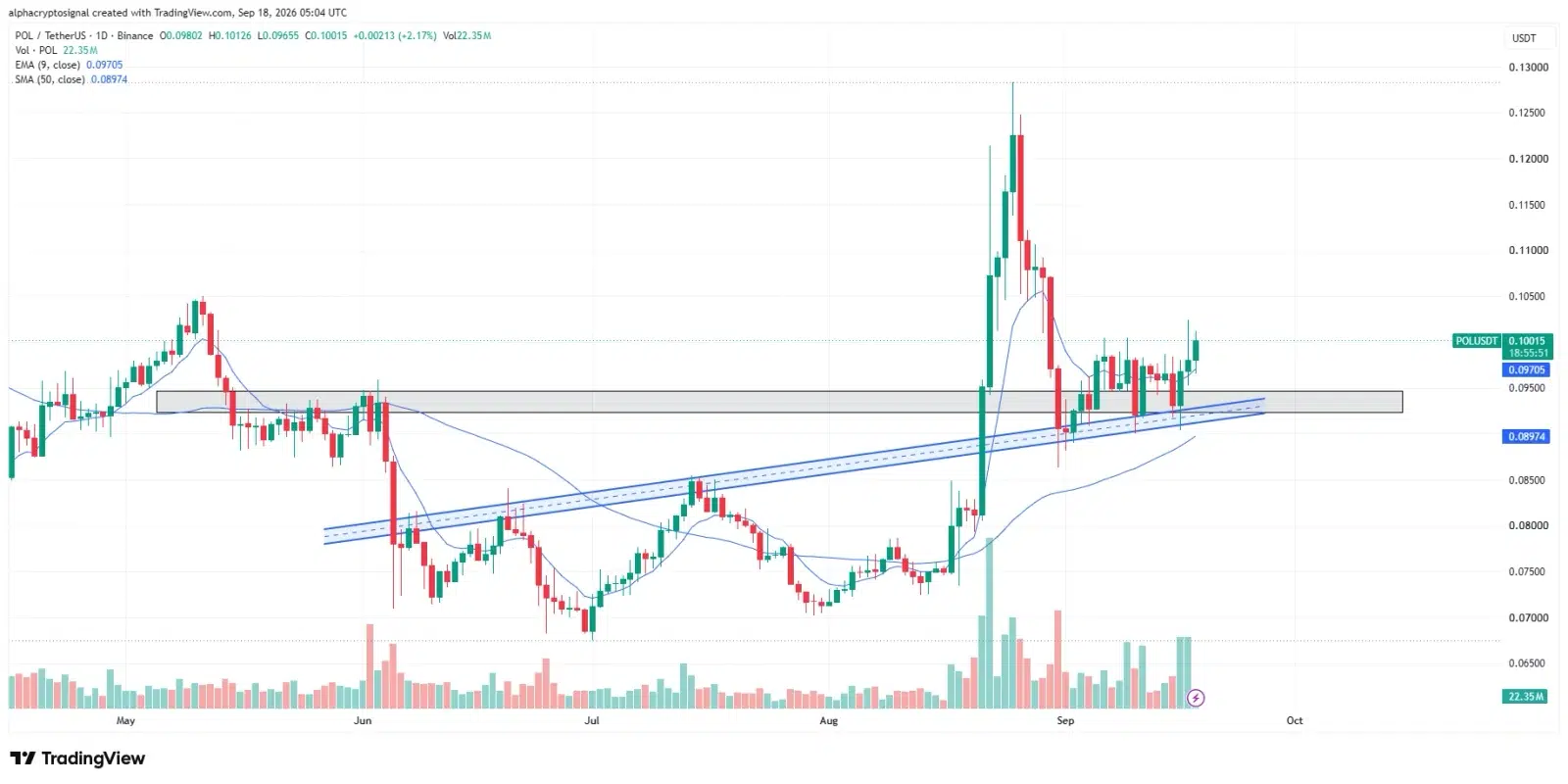
Source: Alpha Crypto Signal X Post
The setup is particularly relevant after POL’s recent price action. CoinGecko’s historical data shows the token closed at $0.0902 on September 1 before moving above $0.10 later in the month. POL closed at $0.09799 on September 17 and $0.10718 on September 18, showing a sharp short-term recovery before the latest consolidation.
Polygon prepares 100M POL burn
Along with the technical deployment, there is another important tokenomic announcement coming up. Sandeep Nailwal confirmed that Polygon has ready the contracts, which will enable the burning of 100 million POL tokens. The contracts have been tested on the testnet and need the final signatures of the Security Council. After that, a community member would be able to start the first burn process, whereas the subsequent burns are scheduled for every quarter using POL generated from fees.
The proposed burning process is related to the fee collection process of Polygon. According to Nailwal, the collector has collected 121 million POL, out of which 100 million has been planned to be burnt initially.
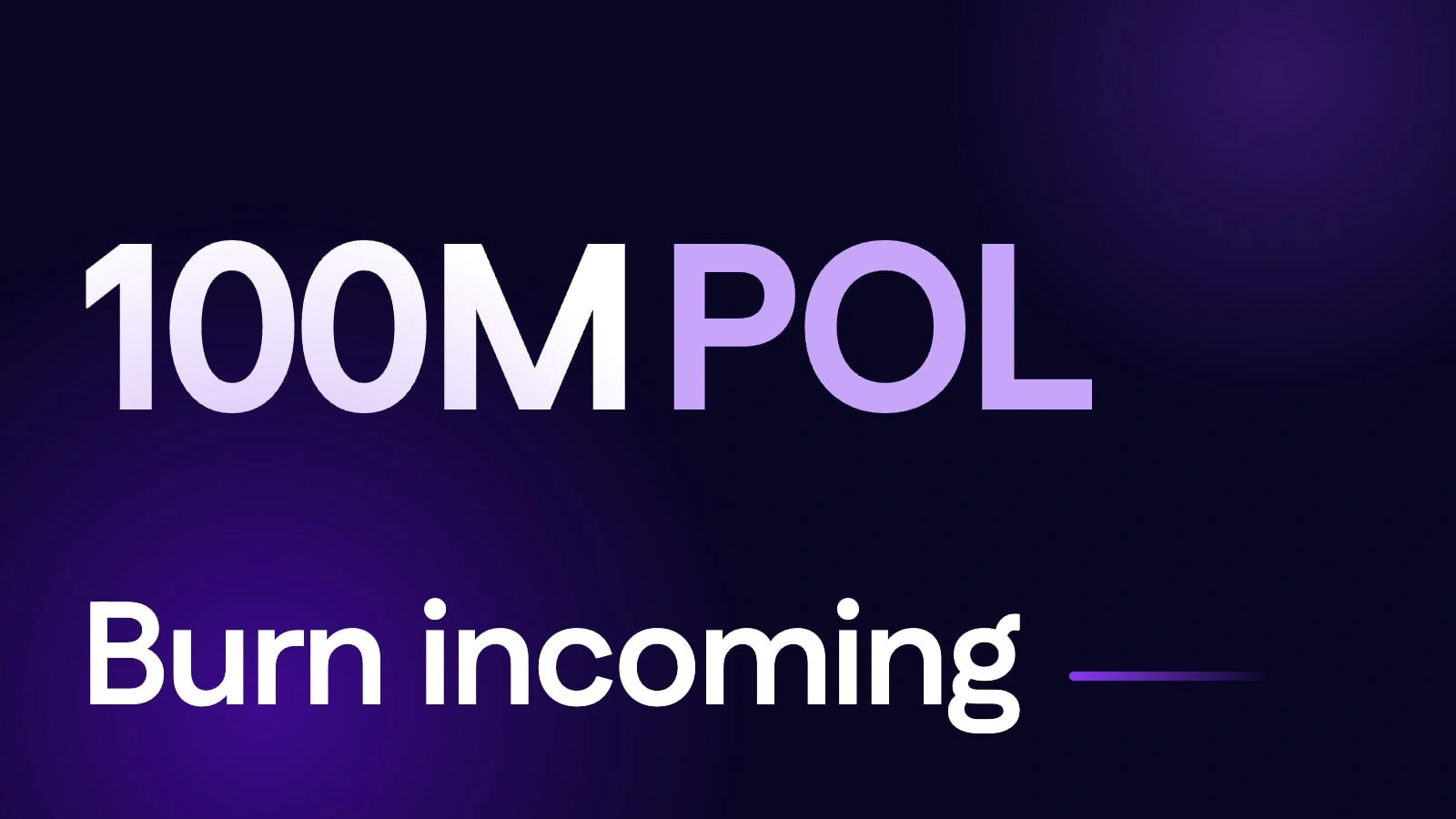
Source: Sandeep Nailwal X post
The operation would alter the way in which network activity is captured by the POL token supply. Instead of network activity merely driving transactions, a certain amount of POL collected over time would eventually be burned out of circulation.
Additionally, Nailwal also gave numbers for Polygon’s 2026 year-to-date income at $24.5 million as opposed to $8.41 million of Arbitrum and $5.6 million of NEAR, according to the statistics provided in his article. These are the numbers he gave as comparisons and must not be taken as an independent comparison of network economics.
Also Read: Polygon Price Prediction: POL Targets $0.185 Amid Revolut’s EURR Launch
Polygon network activity adds context
Polygon’s recent infrastructure upgrades provide another part of the POL price story.
In June, Polygon revealed that its network had achieved the maximum number of 5,000 transactions per second after an upgrade that brought about a limit of 160 million block gas while maintaining 1.5 seconds of blocks. Polygon claimed that this upgrade was geared towards processing more transactions without increasing transaction fees.
Source: Polygon
Increasingly, the network has become concentrated more on payments, stablecoins, and other financial applications in the real world. The Polygon Open Money Stack is built to enable stablecoin payments, fiat on and off ramps, wallets, and cross-chain payment routing.
Polygon has also kept integrating new payment-related features on its platform. The latest official announcements from Polygon in September involve the integration of Stable.com, which enables stablecoins to be transferred directly to banks through Polygon, in addition to Polygon’s completion of the SOC 2 Type 1 audit of the Open Money Stack.
These innovations provide POL a utility story in addition to being the native gas token of Polygon. POL became the native gas token of Polygon PoS in September 2024 in place of MATIC, and Polygon has expanded the use of the token in its ecosystem.
What happens next for the POL price?
The POL price outlook in the coming days is dependent on whether the token will be able to continue forming above the uptrend line and horizontal level drawn by Alpha Crypto Sign. Sustained resistance against the downtrend could help maintain the recent high levels as the next technical level.
Furthermore, the planned burning of 100 million POL is set to act as another catalyst for the supply side. This event has not happened yet on the mainnet, and thus, the immediate market response will rely on this step being completed.
In addition to the burn, the ability of Polygon to handle 5,000 transactions per second, payment infrastructure, and the growing Open Money Stack offer more insight on the long-term use of POL tokens. However, network expansion does not mean that the price will automatically appreciate, and hence investors have to monitor market demand, liquidity, and whether the token breaks past resistance levels.
Currently, with a technical support level that is well defended, a reduced supply of tokens, and increasing network activity, the POL price is at an important crossroads where fundamentals and technicals are meeting.
Also Read: Polygon Revenue Tops $1.3 Million as Low Fees Drive Network Activity
This article contains market analysis and price predictions. These are not guarantees. Crypto markets are volatile. Always DYOR. Not financial advice.



Be the first to comment