



Crypto held directly on a major exchange is generally not covered by FDIC or SIPC protection.
Those programs are designed for different kinds of financial failures. What many crypto exchanges offer instead is a protection fund: a corporate reserve intended to absorb certain losses or security incidents.
That can still be valuable, but it is not the same thing as statutory deposit or brokerage protection.
The key distinction is not simply how large a protection fund is. It is what the fund covers, who controls it, how transparently it is maintained, and whether users have a legal right to a payout.

Are Funds on a Crypto Exchange FDIC Insured?
Not when the asset in question is crypto.
The
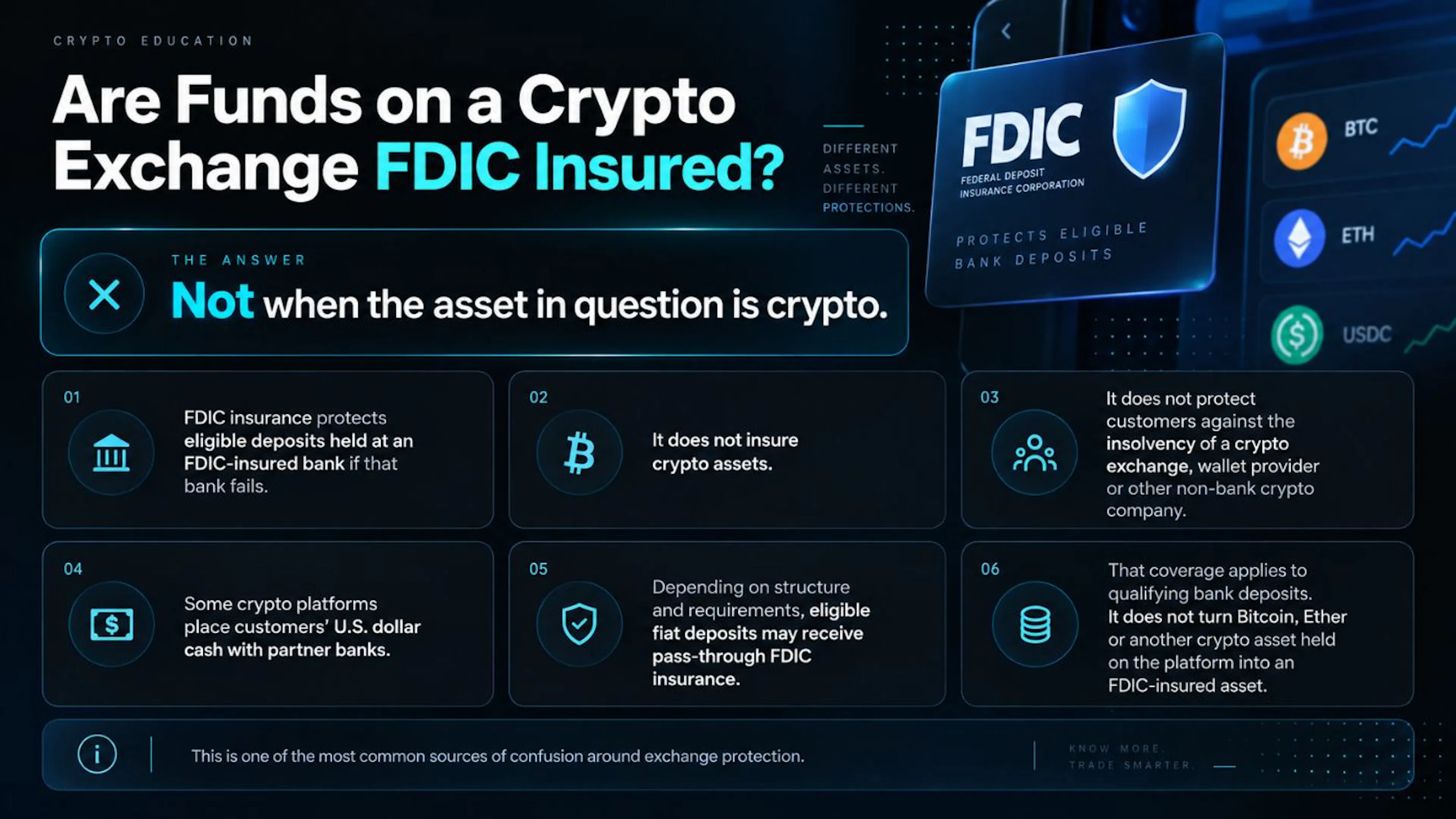
That distinction matters because some crypto platforms place customers’ U.S. dollar cash with partner banks.
Depending on how those arrangements are structured and whether the applicable requirements are satisfied, eligible fiat deposits may receive pass-through FDIC insurance.
But that coverage applies to qualifying bank deposits.
It does not turn Bitcoin, Ether or another crypto asset held on the platform into an FDIC-insured asset.
This is one of the most common sources of confusion around exchange protection.
Is Crypto Covered by SIPC?
SIPC operates under a different framework.
The
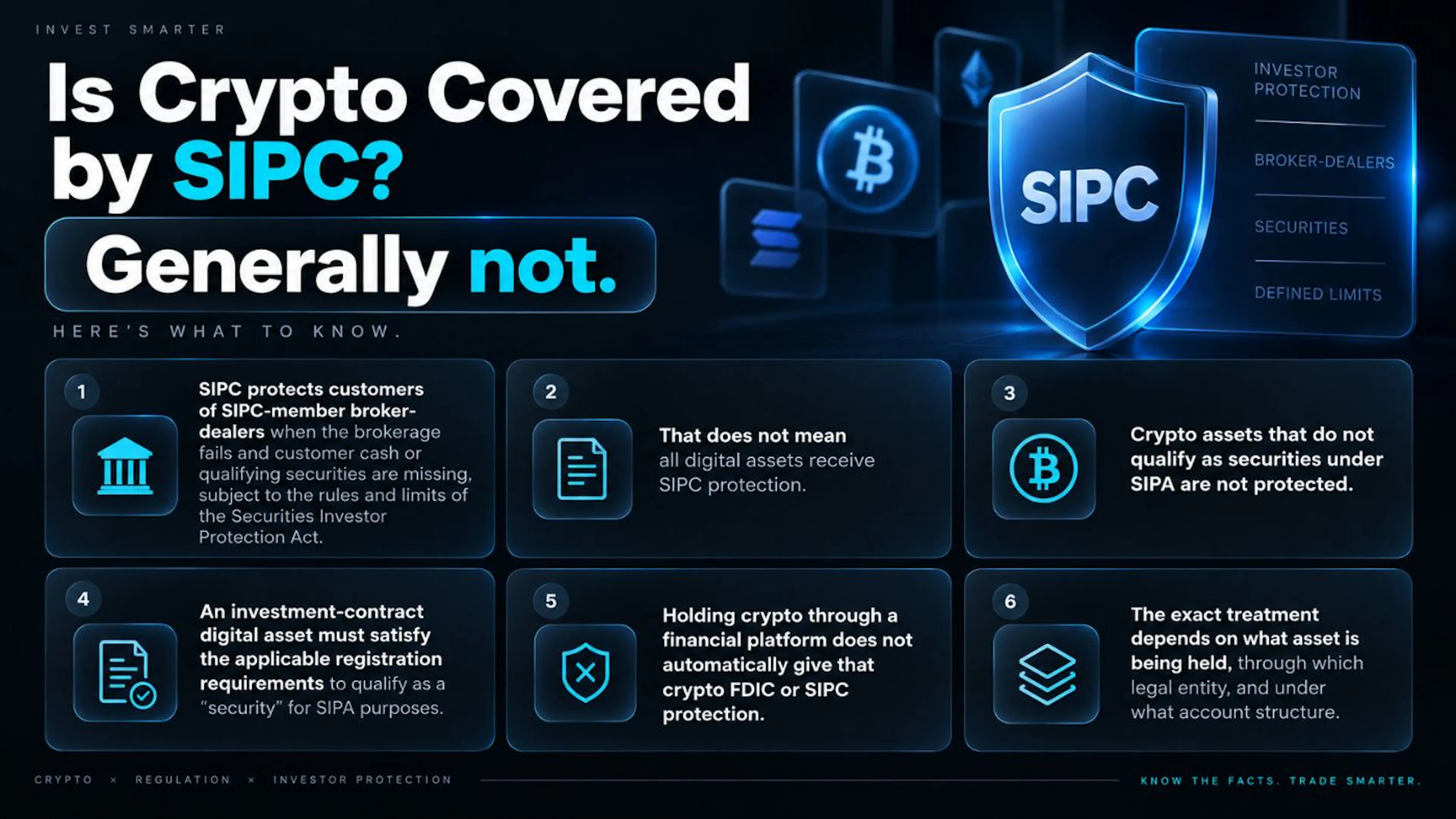
That does not mean all digital assets receive SIPC protection.
SIPC states that crypto assets that do not qualify as securities under SIPA are not protected. It also explains that an investment-contract digital asset must satisfy the applicable registration requirements to qualify as a “security” for SIPA purposes.
So the broad answer is:
Holding crypto through a financial platform does not automatically give that crypto FDIC or SIPC protection.
The exact treatment depends on what asset is being held, through which legal entity, and under what account structure.
What Is the Difference Between a Protection Fund and Insurance?
A crypto-exchange protection fund is usually a pool of assets the exchange or an affiliated entity has set aside to respond to defined security incidents or losses.
FDIC and SIPC protections are different.
They operate under statutory frameworks with defined eligibility rules, triggering events and claims or recovery procedures.
An exchange protection fund does not automatically create the same legal entitlement.
That means two statements can both be true:
“The exchange maintains a large protection fund.”
and:
“Users do not have the same statutory protection they would receive from FDIC-insured deposits or eligible SIPC-protected brokerage assets.”
A protection fund can still provide a meaningful financial backstop.
But its credibility depends on factors such as:
-
where the assets are held,
-
whether the wallets or holdings are disclosed,
-
how frequently the fund’s value is reported,
-
which events it is designed to cover,
-
who decides when it is used,
-
and whether it has actually been used during a real loss event.
How Does Binance’s SAFU Fund Work?
Binance operates the Secure Asset Fund for Users, or SAFU.
According to
The fund has evolved over time in both custody structure and asset composition.
What makes SAFU particularly useful as an example is that it has not existed only on paper.
Binance says the fund was used after its 2019 security breach to cover the loss rather than pass it on to users.
That gives SAFU something many protection claims do not have: a historical example of the reserve being used during an actual exchange-level security incident.

But SAFU still should not be described as the crypto equivalent of FDIC deposit insurance.
It is an exchange-established emergency reserve operating under a different legal and governance framework.
How Does Bitget’s Protection Fund Work?
Bitget maintains a separate Protection Fund alongside its proof-of-reserves program.
According to
The exchange also publishes recurring valuation reports.
For example, Bitget reported that its Protection Fund had an average valuation of $346 million in June 2026, with the monthly value ranging from $322 million to $392 million.
The fund and Bitget’s proof-of-reserves program serve different purposes.
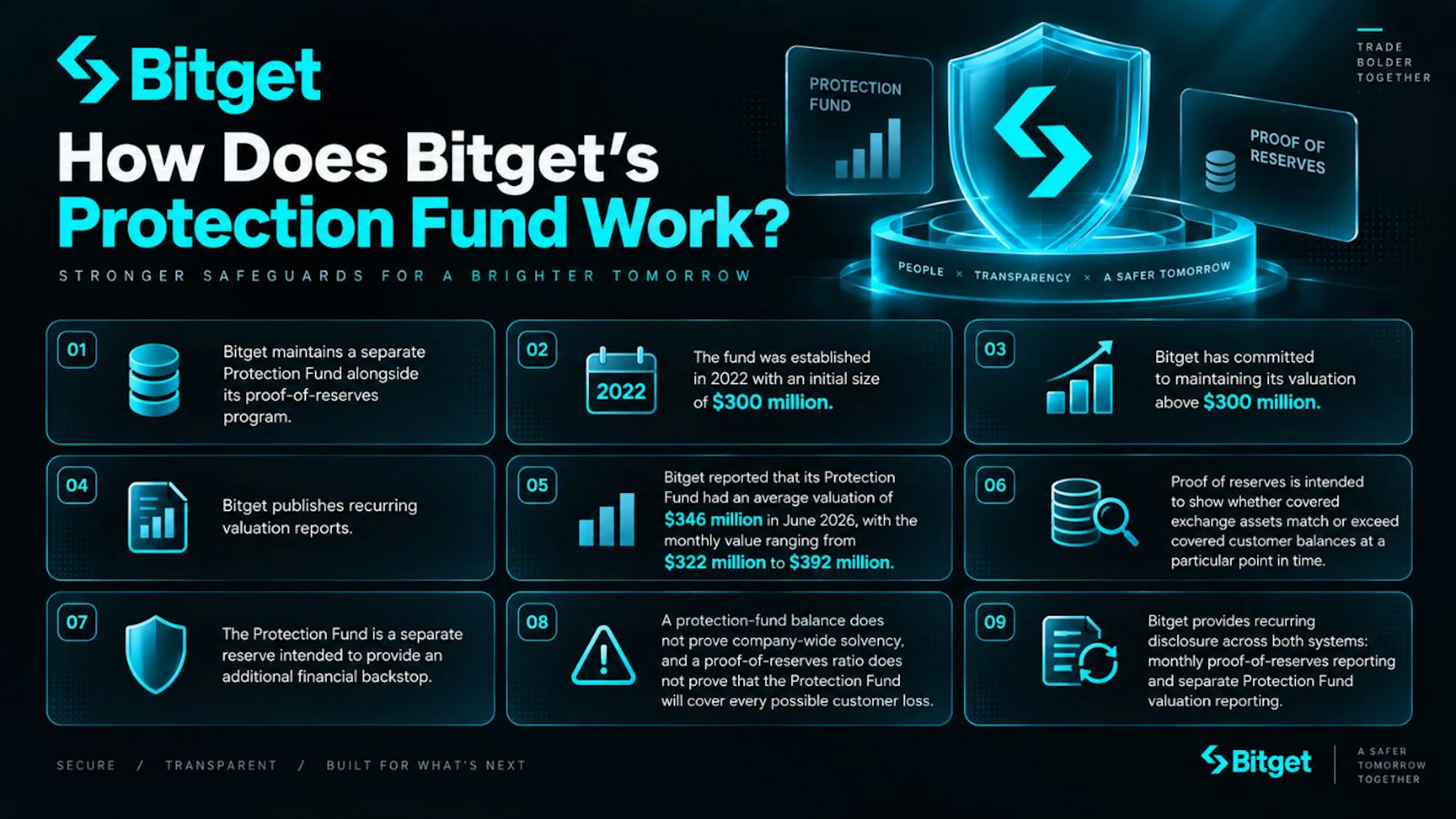
Proof of reserves is intended to show whether covered exchange assets match or exceed covered customer balances at a particular point in time.
The Protection Fund is a separate reserve intended to provide an additional financial backstop.
Neither should be used as evidence for something it does not establish.
A protection-fund balance does not prove company-wide solvency, and a proof-of-reserves ratio does not prove that the Protection Fund will cover every possible customer loss.
What Bitget does provide is recurring disclosure across both systems: monthly proof-of-reserves reporting and separate Protection Fund valuation reporting.
That makes the fund easier to track than a one-time headline commitment.
How Is Coinbase Different?
Coinbase provides a useful comparison because its transparency model is different.
Rather than relying on a named exchange protection fund in the same mold as Bitget’s Protection Fund or Binance SAFU, Coinbase is a publicly listed company that files audited financial statements with the U.S. Securities and Exchange Commission.
Its 2025 consolidated financial statements and internal control over financial reporting were audited by Deloitte, as shown in Coinbase’s
That does not mean every Coinbase customer asset is “insured.”
It means investors and counterparties receive a different form of financial transparency: audited company-wide financial reporting under public-company disclosure requirements.

These approaches should not be collapsed into a single ranking.
A protection fund addresses one type of loss-absorption question.
Proof of reserves addresses asset backing.
Audited financial statements provide a broader view of the company’s finances.
FDIC and SIPC protections operate under separate statutory frameworks again.
They answer different questions.
Does a Bigger Protection Fund Mean an Exchange Is Safer?
Not necessarily.
A headline number is only one part of the picture.
A $1 billion reserve with little information about its custody, governance or use may be harder to evaluate than a smaller fund with transparent wallets, regular valuation reporting and clear historical evidence.
Four questions are especially useful.
1. Is the fund separated from ordinary operating assets?
A dedicated reserve is more meaningful if it can be distinguished from the exchange’s day-to-day treasury.
2. Is the fund disclosed regularly?
Recurring reports provide more information than a number announced once several years earlier.
3. Is there evidence the fund can actually be used?
A historical payout or published response to a security incident provides evidence that the fund is operational rather than purely promotional.
4. What exactly does the fund promise?
Terms such as “insurance,” “protection” and “guarantee” should not be treated as interchangeable.
The important question is what users are actually entitled to under the applicable terms and legal structure.
What Should You Check Before Trusting an Exchange Protection Claim?
Before relying on a protection fund, insurance statement or reserve figure, check:
-
What is actually covered?
Crypto, fiat deposits, securities and exchange losses can all fall under different frameworks. -
Who controls the assets?
Is the reserve controlled by the exchange, an affiliated entity, an insurer, a bank or another custodian? -
Is the fund segregated?
Can it be distinguished from ordinary operating capital? -
Can its value be verified?
Are wallet addresses, asset composition or recurring valuation reports available? -
Who decides whether users receive compensation?
Is there a statutory claims process, contractual entitlement or discretionary decision? -
Has the mechanism ever been tested?
Historical use can reveal more than a headline fund size. -
Is the platform using precise language?
A discretionary reserve should not be assumed to provide the same rights as statutory insurance.
What Actually Protects Crypto Held on an Exchange?
There is no single protection mechanism that answers every risk.
A useful framework is to separate them:
|
Protection mechanism |
What it primarily tells you |
|---|---|
|
Proof of reserves |
Whether covered reserve assets match covered customer balances at a snapshot date |
|
Exchange protection fund |
Whether a separate reserve exists to absorb certain losses |
|
Audited financial statements |
Broader information about a company’s financial position |
|
FDIC insurance |
Protection for eligible deposits at an insured bank if that bank fails |
|
SIPC protection |
Protection for eligible customer cash and securities when a SIPC-member brokerage fails |
This is why asking:
“Is this exchange insured?”
is often too broad.
A better set of questions is:
Which assets are protected, against which event, under which legal framework, and who is obligated to pay?
For crypto assets held directly on an exchange, FDIC and SIPC protections generally do not apply to the crypto itself.
What varies between exchanges is the additional protection they choose to provide and how transparent those mechanisms are.
Bitget’s recurring Protection Fund reports, Binance’s SAFU reserve and Coinbase’s audited public-company financial reporting are three different examples of how major platforms approach that problem.
None is equivalent to the others.
And none should be described as government-backed protection for crypto assets.
FAQ
Is crypto held on an exchange FDIC insured?
No. The FDIC does not insure crypto assets. Eligible fiat deposits held at an FDIC-insured bank may qualify for deposit insurance under the applicable rules, but that does not extend FDIC protection to crypto held on an exchange.
Is crypto held on an exchange SIPC protected?
Generally not. SIPC protection applies to qualifying cash and securities held through SIPC-member broker-dealers under the Securities Investor Protection Act. Crypto assets that do not qualify as SIPA securities are outside that protection.
What is the difference between a protection fund and deposit insurance?
A protection fund is typically an exchange-established reserve intended to absorb certain losses. FDIC deposit insurance operates under a statutory framework and protects eligible deposits at insured banks when the bank fails.
Does Bitget have an insurance fund?
Bitget maintains a Protection Fund rather than government-backed deposit insurance. Bitget says the fund has a committed minimum valuation of $300 million and publishes recurring valuation reports.
Is Binance SAFU the same as FDIC insurance?
No. SAFU is an emergency reserve established by Binance. It can provide an additional loss-absorption mechanism, but it does not provide the same statutory rights or coverage as FDIC deposit insurance.
Does a larger protection fund automatically make an exchange safer?
No. Fund size is only one factor. Segregation, transparency, asset composition, governance, recurring disclosure and evidence of actual use can all be just as important.
Don’t forget to like and share the story!
Vested Interest Disclosure: HackerNoon has reviewed the report for quality, but the claims herein belong to the author. #DYOR.


Be the first to comment