



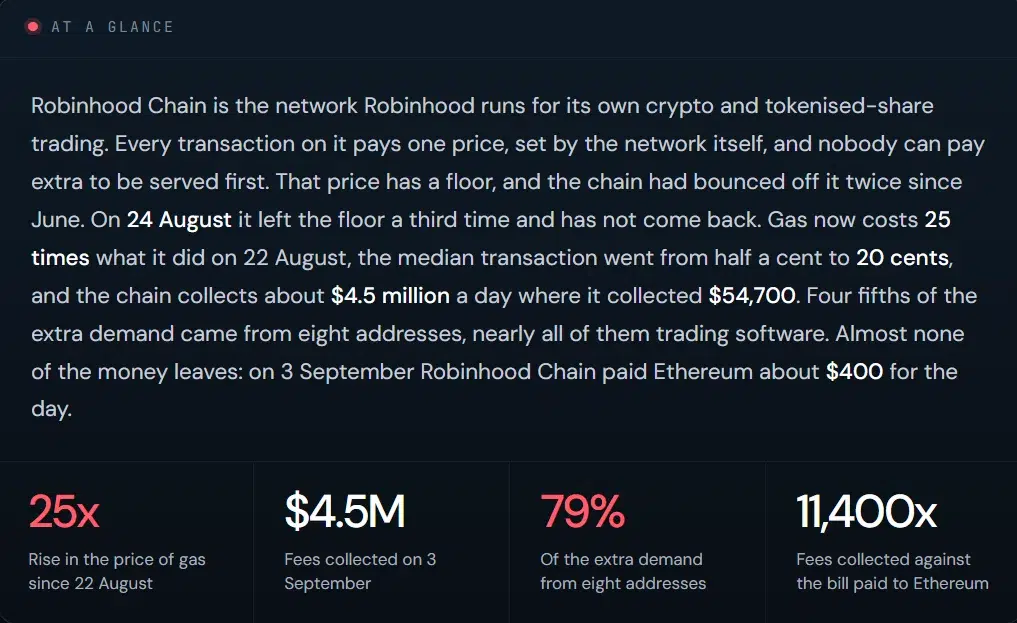
Robinhood Chain fees have recently emerged as a hot topic within the cryptocurrency industry amid reports of the Layer 2 network having accumulated close to $4.5 million worth of transaction fees in just one day, whereas Ethereum earned roughly $400 from data submission and validation services. This shows how quickly Layer 2 networks can earn money while returning little of it to Ethereum.
As per an analysis by Bitquery, the Robinhood Chain earned about $4.5 million worth of transaction fees on September 3rd. In contrast, the network spent only about $396 for storing its data in Ethereum, while it cost $2 for the proofing process. It indicates a huge disparity between the fee paid by users and the fees charged by Ethereum.
Also Read | SUI Price Breakout Gains Momentum as $1.35 Resistance Comes Into Focus
Robinhood Chain Fees Reach Millions in Daily Revenue
The recent figures help shed some light on the economics of Layer 2 solutions on Ethereum. Fees generated by Robinhood Chain amounted to $4,503,000 on September 3rd, according to Bitquery analysis.

Only a tiny percentage of the total was paid out to Ethereum. As reported by Bitquery, about $398 was paid for posting and proof fees on Ethereum.
This, however, doesn’t imply that all the difference is profit generated by Robinhood Chain. The network itself has its own costs of infrastructure, development, operation, and so on. But the figures demonstrate well how Layer 2 networks generate high fees from users and pay relatively small amounts to Ethereum.
This discrepancy poses a question of how Ethereum can benefit from the growing number of blockchain networks using its underlying blockchain infrastructure.
Robinhood Chain Fees Challenge Ethereum
Since its creation, Robinhood Chain has seen rapid growth with rising activity in decentralized trading and tokenized assets.
According to an analysis published in September, as cited by The Block, the total value locked on Robinhood Chain reached roughly $1.5 billion, with DEX volumes exceeding $50 billion. In addition, the platform earned between $2 million and $4 million per day in trading fees.
The statistics on Bitquery demonstrate how rapidly the fees on Robinhood Chain grew as its network was being used. It has been revealed that the fees were at the level of about $54,700 per day until they reached $4.5 million by September 3.
Such an increase is caused by the fact that more transactions are made through the network now.
This phenomenon is essential for the Ethereum network since Layer 2 networks are supposed to conduct transactions outside of the main Ethereum network, after which the transaction is sent back to the Ethereum network.
Why Ethereum Receives Much Less Than Robinhood Chain
It lies in the way transaction volume is handled by Layer 2 networks and Ethereum.
Robinhood Chain takes care of the execution of the transactions for users, and therefore transactions happen inside the Layer 2 ecosystem. The users pay fees for using the platform, but Ethereum acts as the settlement and data availability layer.
It implies that a higher transaction volume on Robinhood Chain does not mean that the income of Ethereum increases proportionally.
Robinhood Chain Fees Rise as TVL Hits $1 Billion
Robinhood Chain’s rapid growth has also been emphasized by Crypto Rover, a crypto market analyst.
Based on his report, within less than three months, Robinhood Chain grew from practically zero TVL on June 30th to $1 billion, and it has a nearly $1.5 billion daily DEX volume.
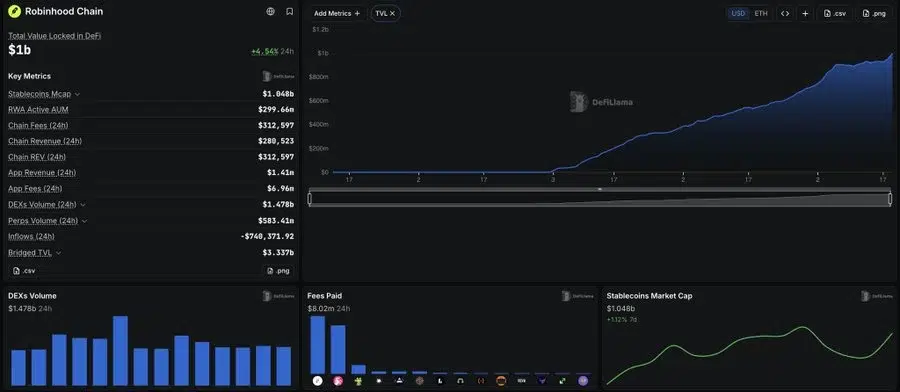
This clearly shows the quick progress made in terms of activities related to the blockchain.
If such a pace is to be maintained, then the fees collected by Robinhood Chain would continue to serve as an indicator of economic value produced by the Layer 2. The proportion of that economic value produced by Ethereum would also depend on the amount of information and settlement capability it needs.
Also Read | AERO Price Targets $12.50 as Whale Activity and Buybacks Strengthen Outlook


Be the first to comment