



Circle is doubling down on Binance after USD Coin (USDC) stablecoin customer balances on the exchange nearly quintupled since their first agreement.
On Sept. 22, the companies announced a new five-year commercial agreement alongside Binance’s $100 million equity investment in Circle, extending a relationship that has turned the world’s largest crypto exchange into one of USDC’s most important distribution channels.
The agreement focuses on expanding USDC access, particularly in emerging markets, and replaces arrangements signed in November 2024 and August 2025.
Binance bought 1.237 million Circle Class A shares at $80.84 each, a 5% discount to Circle’s Sept. 17 closing price, and agreed to a two-year restriction on selling, pledging, or hedging the shares. The commercial agreement runs through September 2031, although either company can terminate it earlier under specified circumstances.

The longer commitment follows a sharp expansion in USDC’s presence on Binance. Customers held about $1.5 billion of USDC on Oct. 1, 2024, shortly before Circle entered into its original Binance agreement in November.
Binance’s latest Sept. 1 Proof-of-Reserves snapshot shows customer USDC balances at about $7.1 billion, up roughly 376%, or almost fivefold.
USDC itself has not grown nearly as quickly. Circle reported $39.7 billion of USDC in circulation on Nov. 29, 2024, around the time it struck the first Binance agreement. DeFiLlama currently puts circulating USDC at roughly $74.4 billion, up about 87%.
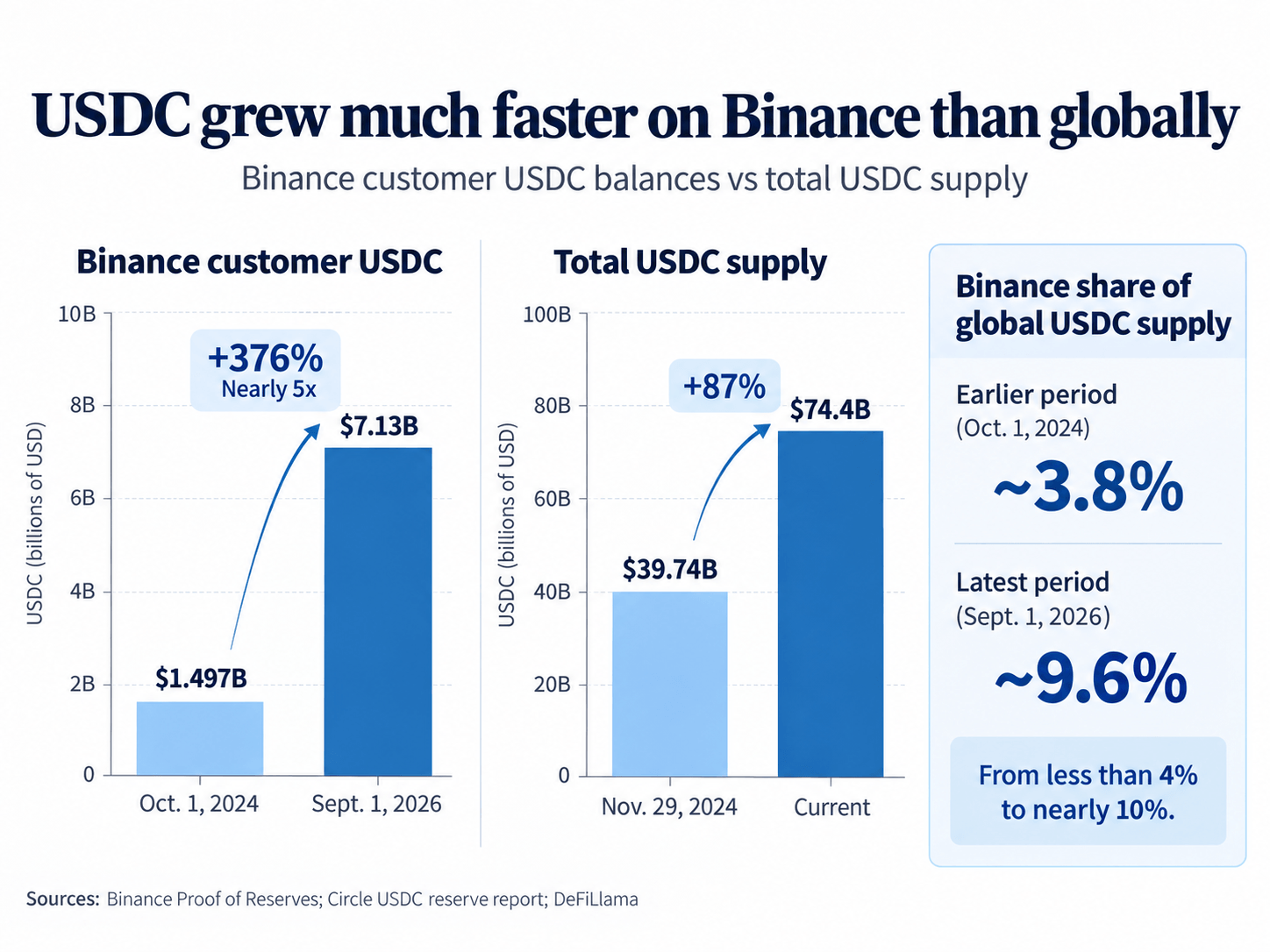
That means Binance customer balances have grown from the equivalent of less than 4% of global USDC supply at the start of the partnership to almost 10% today.
USDC closes part of Tether’s Binance lead
USDC’s expansion on Binance has also substantially outpaced Tether’s growth on the platform.
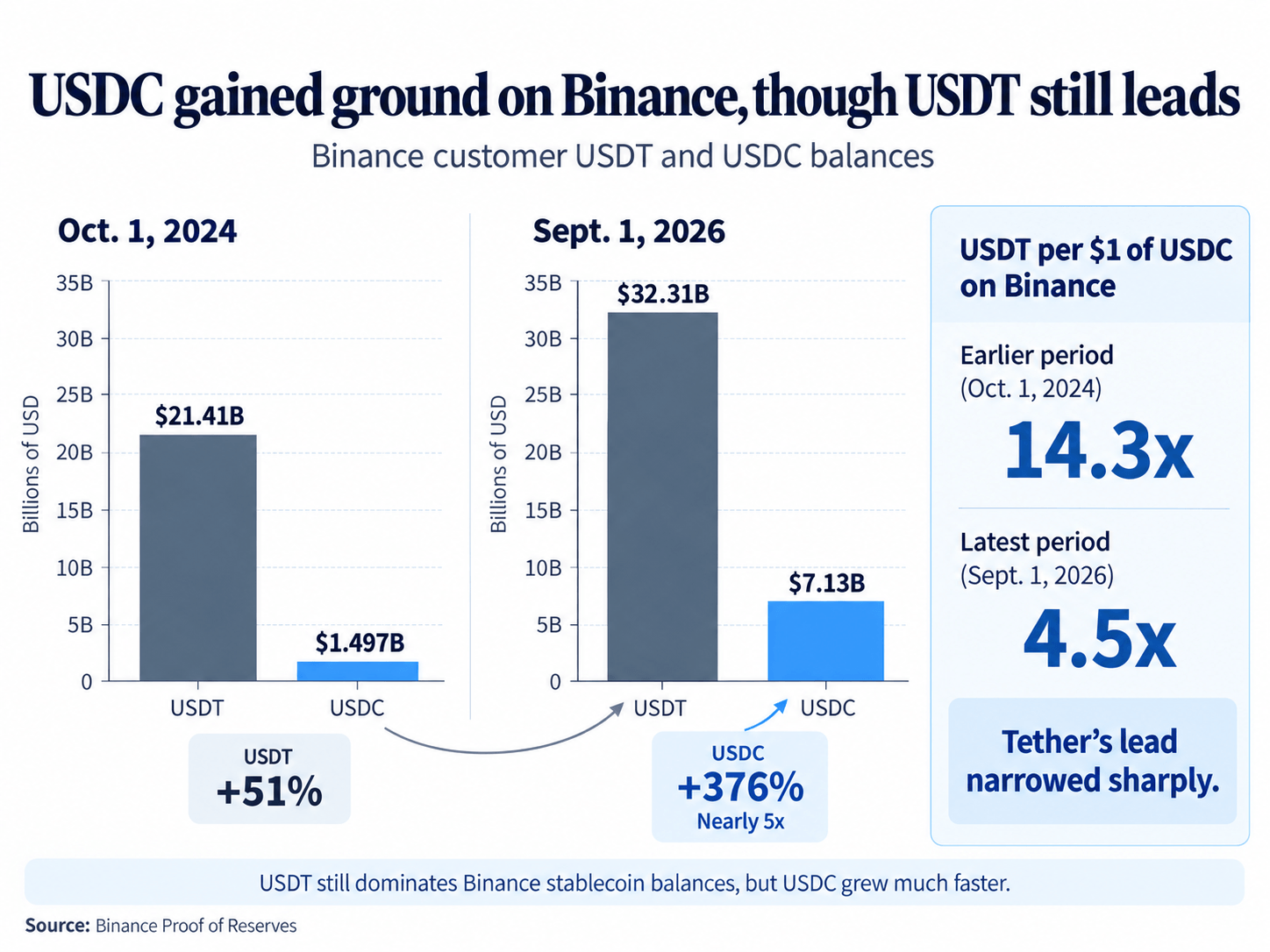
Binance customers held $21.4 billion of USDT in the Oct. 1, 2024 reserve snapshot, compared with $1.5 billion of USDC. That left roughly $14.30 of USDT on Binance for every dollar of USDC.
By Sept. 1 this year, customer USDT balances had risen to $32.3 billion, while USDC reached about $7.1 billion. The ratio had narrowed to approximately 4.5-to-1. USDT customer balances increased about 51% over the period, compared with USDC’s roughly 376% increase.
Circle’s regulatory filings show the shift gathering pace after the original deal. USDC represented 5% of stablecoins held on Binance on July 1, 2024, 10% by Jan. 1, 2025, and 22% by July 1, 2025.
The figures show that Binance became a substantially larger USDC distribution channel during the partnership, even as Tether remained the dominant dollar token on the exchange.
Circle CEO Jeremy Allaire said the latest agreement was designed to push that distribution further.
He wrote on X:
“As the world’s largest and most widely used wallet for stablecoins and onchain finance, the partnership will accelerate global and emerging market preference and adoption of USDC. The internet financial system is expanding everywhere and this partnership will help to expand access to this new financial system to hundreds of millions of people and businesses around the world.”
Circle has paid heavily for that distribution
The growth on Binance has come at a high cost, leaving the economics behind the renewed partnership as the bigger unanswered question.
Under the November 2024 agreement, Circle paid Binance a $60.25 million upfront fee and agreed to monthly incentive payments based on USDC held on the platform and in Binance’s treasury.
Those payments ranged from an annualized mid-double-digit to high-double-digit percentage of a fixed rate reset quarterly at a discount to three-month SOFR. Binance also agreed, subject to certain exceptions, to keep $3 billion of USDC in its treasury, with treasury incentive payments requiring at least $1.5 billion to remain there.
Circle expanded the relationship again in August 2025 around USDC held through its Modular Smart Contract Wallet infrastructure. The agreement provided for incentives equal to a high-double-digit percentage of a fixed rate tied to three-month SOFR.
The new five-year contract consolidates and replaces both previous arrangements, with Circle continuing to pay Binance a monthly incentive tied to USDC held in the wallet. Neither the new fee rate nor any minimum balance commitments have been disclosed.
In a note shared with CryptoSlate, Clear Street analysts Owen Lau and Nikhil Vijay said the agreement improves Circle’s visibility over one of its largest distribution channels outside Coinbase but leaves its net economics unclear.
An additional $1 billion of USDC at a 3.5% reserve return would produce about $35 million in gross annual reserve income. If Binance receives a high-double-digit share, as in earlier terms, Clear Street estimates Circle could retain only about $4 million to $7 million.
The issue is increasingly important for Circle’s margins. The company generated about $668 million of reserve income in the second quarter while reporting roughly $410 million of distribution and transaction costs, equivalent to about 61% of reserve income. Non-Coinbase distribution costs also increased as activity expanded across new and existing partnerships.
Binance was already a significant contributor to that bill. Circle said distribution costs specifically related to Binance increased by $152.1 million in 2025 as the relationship expanded.
Binance becomes a shareholder
The latest agreement changes the relationship again by making Binance an investor in the company whose stablecoin it is paid to distribute.
The $100 million investment gives Binance an equity interest in Circle while preserving the balance-linked incentive structure. Clear Street compared the arrangement with Circle’s distributor-shareholder relationship with Coinbase, although Binance’s roughly 0.5% stake is much smaller.
Meanwhile, Binance CEO Richard Teng framed the investment as a longer-term commitment to the stablecoin. He noted:
“Trust in this industry is earned through regulation, transparency, and delivery. Today, in recognition of all three, Binance commits $100M to Circle and extends our partnership for five years. This partnership is about bringing a stable, reliable digital dollar within reach of anyone with a phone.”
The next test will come from the balances and costs behind those ambitions. Clear Street said it will watch reported Binance USDC holdings and Circle’s non-Coinbase distribution expenses when third-quarter results arrive.
With Binance customers now holding more than $7 billion of USDC, those disclosures could show how much Circle is paying to preserve a channel that has grown from less than 4% of global USDC circulation to almost 10% in under two years.


Be the first to comment