



Key Takeaways
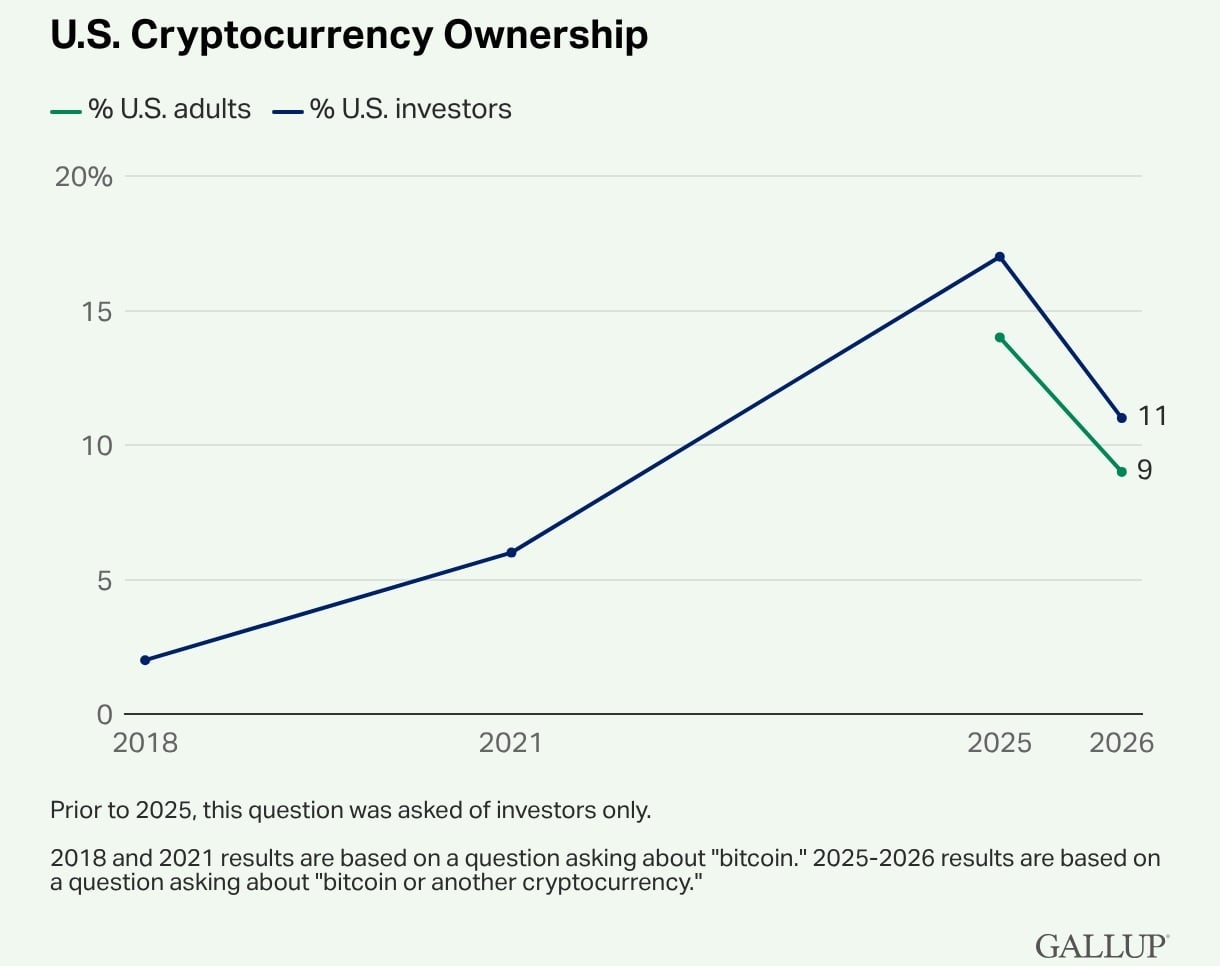
- Gallup found crypto ownership fell to 11% among U.S. investors.
- Younger men remained the most likely investor group to own crypto.
- Nearly two-thirds of investors classified cryptocurrency as very risky.
Investor Ownership Retreats From Its 2025 Peak
U.S. investors pulled back from cryptocurrency after ownership reached a record level in 2025. Gallup, the Washington-based research and analytics company, released its latest survey on Sept. 21, placing crypto ownership at 11% among investors with at least $10,000 in investable assets, six percentage points below last year’s 17% reading.
The June 1-15 poll of 2,043 U.S. adults, including more than 1,000 investors, also placed ownership among all adults at 9%, down from 14% in Gallup’s initial measurement last year. Even after the decline, the investor rate remains above the 6% recorded in 2021 and the 2% measured in 2018. The results also showed that 66% of investors had no interest in crypto, while 19% were intrigued or planned to buy.
Crypto investing also represented a minority activity in the Federal Reserve’s 2025 Survey of Household Economics and Decisionmaking, with 9% of adults having bought or held cryptocurrency as an investment during the preceding year. Only 2% used it for payments or transfers. Those measures cover prior-year activity rather than current ownership, making them distinct from Gallup’s June snapshot.
The Pullback Is Broad, but Not Even
Younger men continued to stand apart from every other investor group even as their ownership rate fell sharply. Twenty-four percent of male investors ages 18 to 49 reported holding cryptocurrency, down from 33% a year earlier but still more than double the rate in any other age and gender category.

Income separated crypto owners from nonowners as well. Fifteen percent of upper-income investors reported owning cryptocurrency, compared with 7% of middle-income investors and 4% of lower-income investors. Ownership among upper-income investors declined four percentage points, a smaller drop than the eight-point declines recorded for the two lower-income groups.
Risk concerns extended across both participants and those outside the market, rather than belonging exclusively to nonowners. Gallup recorded 63% of investors calling cryptocurrency very risky and 31% calling it somewhat risky. Even 47% of current owners applied the highest-risk label, while that assessment rose to 68% among investors who had no interest in the asset class.
Differences in expected returns and perceived risk help explain who participates, according to a July working paper published by the Federal Reserve Bank of Cleveland. Its researchers identified household investment expectations as important factors associated with ownership. Younger men were disproportionately represented among holders, while nonowners commonly cited limited knowledge or negative views of crypto as an investment.
Different Surveys Capture Different Markets
The varying ownership estimates reflect who each survey measures and what it asks, rather than a single interchangeable count of U.S. holders. Gallup surveys adults and a defined investor group, while the Federal Reserve tracks use during the previous year. A National Cryptocurrency Association study estimated more than 67 million U.S. crypto holders through a survey designed around identified holders and extrapolated to the broader population.
The divergence also appears in research centered on people already using crypto wallets. A separate U.S. survey of wallet users recorded 31% of male respondents citing privacy as their main reason for using crypto for everyday tasks, illustrating how motivations within the active user base differ from those of investors who remain outside the market.
Knowledge gaps further distinguish existing holders from nonowners, according to the Cleveland Fed researchers’ household evidence. Insufficient information ranked as the most common reason for not owning cryptocurrency, followed by negative assessments of its investment merits. Holders, by contrast, most frequently cited expected profits and portfolio diversification as their reasons for participating.
Those expectations connect household participation to crypto’s market cycles and investment risk through the returns people anticipate and the losses they consider possible. In an experiment embedded in the Cleveland Fed research, information about past crypto returns increased respondents’ desired allocations and their subsequent cryptocurrency purchases.





Be the first to comment