



AI Summary
- Hedera is being positioned as an audit and governance layer for AI systems rather than as the intelligence powering them.
- Equity Labs links trusted hardware execution to timestamped records on the Hedera Consensus Service.
- Agentic commerce could expand demand for programmable payments, stablecoins and machine-readable tokenized assets.
- Enterprise relationships support Hedera’s credibility, but they do not establish future transaction volumes or HBAR demand.
- The investment case depends on real deployments converting technical utility into sustained network use.
The popular narrative around autonomous artificial intelligence is that smarter agents will naturally create demand for crypto networks. The concrete case is narrower: agents that buy services, consume data or execute financial instructions need payment, identity and accountability infrastructure. Hedera is positioning its public network as one component of that stack, particularly where enterprises need verifiable records of machine activity.
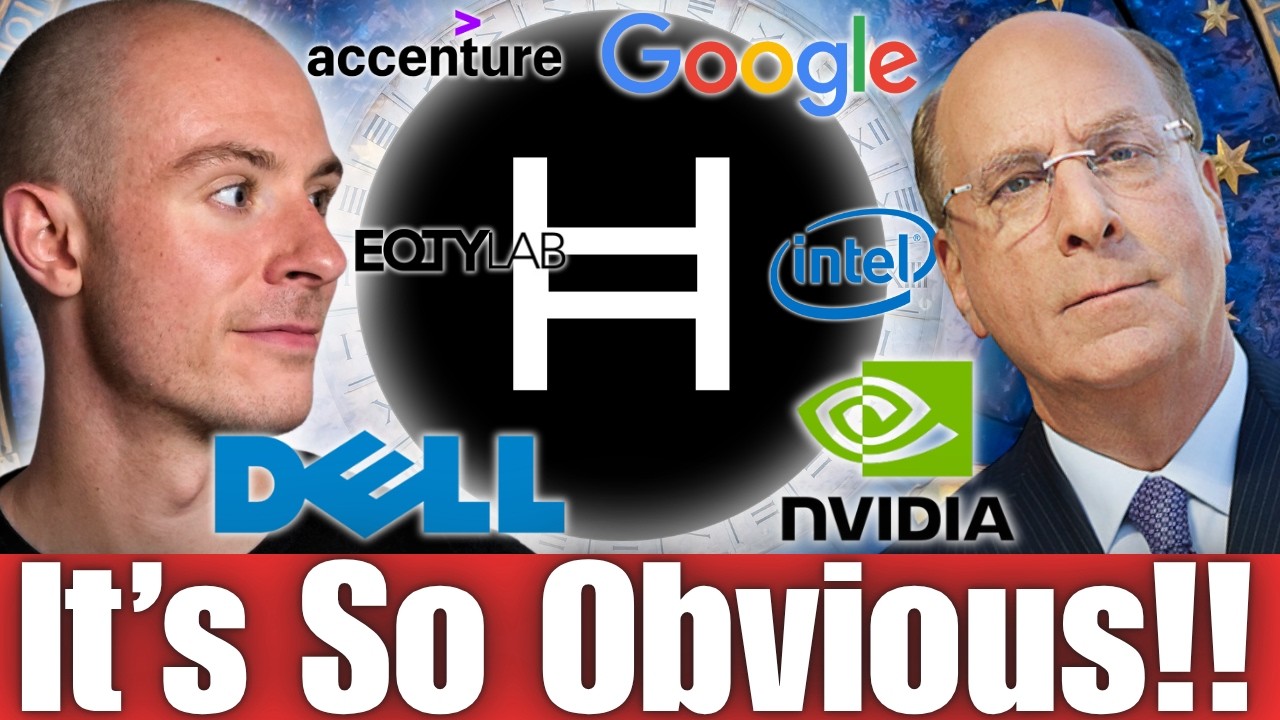
The supplied material connects BlackRock‘s research on AI and digital assets with work involving Equity Labs, Accenture, Google, IBM, Dell, Intel and Nvidia. The strongest supported thesis is not that Hedera will capture the entire AI economy. It is that the network could provide low-friction timestamping, governance records and machine-readable infrastructure for specific enterprise workflows.
That distinction matters for HBAR. Technical suitability and institutional participation can strengthen Hedera’s position, but neither proves commercial adoption, transaction volume or token demand. Our analysis therefore separates the emerging infrastructure opportunity from the investment conclusions that still require evidence.
Hedera Hashgraph HBAR Is Ready To Enable BlackRocks Predicted Ai Agent Explosion….
Agentic AI creates an infrastructure problem
Generative AI primarily produces information. Agentic AI goes further by planning and executing multistep tasks through external systems with limited human intervention. Once software can initiate purchases, request computing resources or move financial value, it requires infrastructure that can express authority, settle obligations and preserve evidence of what occurred.
The extraordinary growth in artificial intelligence is the defining technology theme of this era.
The transcript attributes that statement to BlackRock’s paper and presents AI and digital assets as previously parallel technologies that are beginning to converge. Its central conceptual distinction is between machine intelligence and programmable value:
AI represents machine native intelligence while digital assets represent machine native money.
This framing is useful, but it should not be treated as proof that every autonomous agent needs a public blockchain. Conventional databases and payment systems can handle many closed or centrally controlled applications. Public infrastructure becomes more relevant when several organizations need to coordinate without assigning complete control of the shared record to one participant.
- Payments: agents may need to purchase data, computing capacity or services without waiting for manual intervention.
- Ownership: tokenization can give machines standardized representations of financial assets and collateral.
- Accountability: audit trails can preserve evidence of actions, approvals and system outputs.
- Interoperability: shared protocols can reduce bespoke connections between agents, merchants and financial infrastructure.
Hedera’s role is verification rather than intelligence
Hedera does not train AI models or replace the hardware on which they run. Its prospective role is to receive compact records generated elsewhere and establish their ordering and timestamps through the Hedera Consensus Service. That can create a shared reference point without placing an entire model, private dataset or computational workload on a public network.
The architecture described in the source combines Equity Labs software with trusted execution environments on Intel processors and Nvidia graphics processors. These protected hardware environments generate cryptographic certificates for AI operations. The resulting annotations are then timestamped and anchored through Hedera, producing an immutable record intended to support governance, auditability and compliance.
- Execution layer: AI operations occur on supported computing hardware.
- Proof layer: Equity Labs generates cryptographic evidence about the operation.
- Record layer: Hedera orders and timestamps the associated annotations.
- Governance layer: an organization can use the record when reviewing behavior or demonstrating compliance.
The transcript also says IBM helped author the Hedera Consensus Service white paper. That statement adds institutional context, although it does not establish that IBM endorses every AI application subsequently built with the service. Likewise, references to a Dell and Equity Labs paper indicate technical exploration, not a disclosed production-scale rollout.
Verifiable compute connects hardware proofs with audit trails
Verifiable compute is the most concrete part of the Hedera AI infrastructure thesis. The objective is to make an AI operation more accountable by pairing evidence from protected hardware with an external record that is difficult for one organization to alter retroactively.
This structure could be useful when an institution needs to answer practical questions: Which approved model performed an operation? When did it run? Was the code executed within an expected hardware environment? What record was created before a later audit or dispute? Hedera can help preserve the sequence of evidence, but the reliability of the full system still depends on the software producing the proof, the hardware trust model and the organization’s controls.
- What the ledger can support: consistent ordering, timestamping and shared access to submitted records.
- What hardware proofs can support: evidence that specified operations occurred within a protected environment.
- What neither guarantees alone: that an AI model is accurate, unbiased or acting under a valid business mandate.
That final limitation is essential. A tamper-resistant record can prove that an event was logged without proving that the event was desirable. Governance policies, authorization rules and human accountability remain necessary even when the underlying evidence is cryptographically secured.
Machine payments broaden the opportunity beyond AI audits
BlackRock’s research, as quoted in the transcript, identifies payments as another point of convergence:
Machine native transactions require purpose-built agentic payment protocols.
Agents operating continuously may need to pay for individual API requests, data access or consumption-based computing. These transactions could be small, frequent and global. Traditional payment systems will remain important where agents interact with established merchants and consumers, while crypto rails may be better suited to programmable settlement and around-the-clock machine activity.
The opportunity extends across machine payments, stablecoins and tokenized real-world assets. Machine-readable instruments could allow an agent to identify an asset, check conditions and initiate a permitted transaction through software. This is related to the wider institutional shift covered in our analysis of BlackRock’s map of AI demand across digital asset infrastructure.
The transcript attributes a projection of a $1 trillion annual compute market by 2030 to the BlackRock paper. Even if that market reaches the cited scale, it should not be read as a forecast for Hedera revenue or HBAR value. Networks would compete with conventional billing systems, private ledgers and other public chains for only the portions of activity that benefit from programmable settlement or shared verification.
Enterprise governance gives Hedera a route to deployment
Hedera’s enterprise-oriented governance is relevant because regulated users often care about operational accountability as much as technical throughput. The source states that Accenture joined the Hedera Council and would work with Hedera and other council members on trust-based solutions for financial institutions, government agencies and large enterprises.
It also describes a public-sector framework involving Hedera, Accenture and Equity Labs. Under that model, AI actions and decisions would be logged through the Hedera Consensus Service, Equity Labs would provide runtime cryptographic proof, and Accenture would develop implementation playbooks and pricing models for integration with public-sector enterprise resource planning systems.
Google offers a separate but complementary signal. A speaker identified in the transcript as Google’s global head of strategy for its web3 business said the company had joined the Hedera Council in 2022 and was working on protocols for interactions among agents. The speaker also described a developing preference:
agents are uh already starting to prefer open and decentralized rails for things like payments
The same remarks identify Google’s ADA protocol for agent-to-agent interaction and AP2 and UCP for commerce-related interactions. These initiatives support the broader proposition that autonomous software will need common rules. They do not, however, show that those protocols will settle transactions on Hedera. Council participation creates access and alignment, not an exclusive infrastructure commitment.
The HBAR thesis still faces adoption and value capture tests
The case for Hedera rests on a plausible technical fit: predictable public records can complement protected computing environments and enterprise governance. The case for HBAR is more demanding because network utility must translate into sustained paid usage.
- Deployment risk: demonstrations and frameworks may not become production systems.
- Competition risk: enterprises can use private databases, conventional audit systems or competing distributed networks.
- Data risk: recording a certificate does not establish that the underlying model or input was trustworthy.
- Value capture risk: low fees may help adoption while limiting revenue generated by each operation.
- Governance risk: institutional participation does not guarantee that members will build significant workloads on the network.
Low transaction costs are therefore both an advantage and a challenge. They can make frequent machine activity economically viable, but substantial aggregate demand would be needed for that activity to become material. Investors should look for disclosed production deployments, recurring transaction patterns and evidence that applications need Hedera’s public consensus rather than merely using it as an optional timestamping component.
What this means
-
Hedera has a credible place in the AI accountability stack. The combination of trusted hardware proofs, Equity Labs software and Hedera Consensus Service records addresses a specific enterprise requirement: preserving evidence about automated actions across organizational boundaries.
-
Agentic commerce could create several forms of network demand. Payments, tokenization and audit records are separate workloads, and Hedera does not need to execute AI models to serve them. The opportunity is strongest where machines require continuous settlement or independently verifiable records.
-
HBAR value remains an execution question. Partnerships and council relationships improve access to potential users, but our analysis requires evidence of live workloads before treating the institutional network as proof of durable token demand.
Bigger picture
Hedera’s AI proposition sits within a broader move toward shared institutional infrastructure. Our coverage of Ownera connecting tokenized asset orchestration to Hedera illustrates how the network is also being positioned within digital asset workflows. Separately, the UK Finance tokenization initiative involving Hedera and Stellar places the network in a wider conversation about regulated market infrastructure.
These developments matter because autonomous agents will need assets and systems they can interpret programmatically. If institutional tokenization produces standardized digital instruments, AI agents could eventually interact with them under predefined controls. That remains a scenario rather than a confirmed deployment path, but it connects the AI audit thesis with Hedera’s existing focus on enterprise tokenization.
FAQ
What is Hedera’s proposed role in agentic AI?
Hedera is positioned as a record and consensus layer. AI operations can occur on external hardware, while proofs or annotations about those operations are timestamped and ordered on the public network.
What does verifiable compute mean in this context?
It refers to generating cryptographic evidence about an AI operation performed in a protected hardware environment. Equity Labs is described as producing this evidence on Intel and Nvidia hardware before related records are anchored through Hedera.
Why might AI agents use digital assets?
Digital assets can provide programmable instruments for paying for data, computing or services. Stablecoins and tokenized assets may also give software standardized, machine-readable representations of value and ownership.
Does a Hedera record prove that an AI decision was correct?
No. A record can help demonstrate when evidence was submitted and preserve its order, but it cannot independently prove that a model’s input, reasoning or outcome was accurate or appropriate.
Do institutional relationships guarantee demand for HBAR?
No. Relationships with council members and technology providers can support development and access, but demand depends on production applications generating recurring network transactions.
What evidence would strengthen the Hedera AI thesis?
The strongest evidence would be named production deployments, measurable recurring use of the consensus service, disclosed integration requirements and a clear explanation of why a public network is necessary for each workload.
Sources
This article is for informational purposes only and does not constitute financial advice.



Be the first to comment