



While Bitcoin moves through a period of consolidation, the structural debate around crypto is increasingly shifting toward a question that goes far beyond BTC’s price. The convergence of artificial intelligence, stablecoins, and blockchain infrastructure is creating the foundations for an economy in which machines could also become economic participants. Rather than simply responding to prompts, AI agents can plan tasks, access services, purchase data, and execute operations with progressively less human intervention.
Crypto analyst and YouTuber Ran Neuner, known as Cryptoman Ran, has been advancing precisely this thesis. In his view, an important part of the next expansion of crypto could come from autonomous agents that require financial infrastructure capable of operating continuously. The thesis gained additional institutional relevance after BlackRock published The Machine-Native Economy in September 2026. The report argues that AI adoption could become an underappreciated source of demand for digital assets, particularly stablecoins, programmable blockchains, and tokenized computing markets.
An Agent-Dominated Market And A New Source Of Demand
The potential scale of this transformation can be seen in forecasts for agentic artificial intelligence. IDC projects that 1.2 billion AI agents could be operational by 2029, carrying out approximately 217 billion actions per day. These actions do not directly represent financial transactions, but they illustrate the potential scale of activity generated by autonomous software across the digital economy.

There is also an interesting data point concerning how AI models themselves respond when presented with different monetary instruments. A Bitcoin Policy Institute study examined 36 AI models and collected 9,072 responses. In long-term store-of-value scenarios, Bitcoin was selected in 79.1% of responses, while stablecoins were selected in 53.2% of everyday payment scenarios. The result should be understood as an experiment involving language models rather than evidence that autonomous agents are currently using Bitcoin or stablecoins at that scale.
The significance of these figures lies in the possibility of different assets serving different functions. Bitcoin could potentially serve as a reserve asset within a digital economy, while stablecoins could be used for transactions where price stability is essential. An agent economy would not necessarily require a single currency, but rather infrastructure capable of combining different assets according to the economic function involved.
BlackRock And The Rise Of A Machine-Native Economy
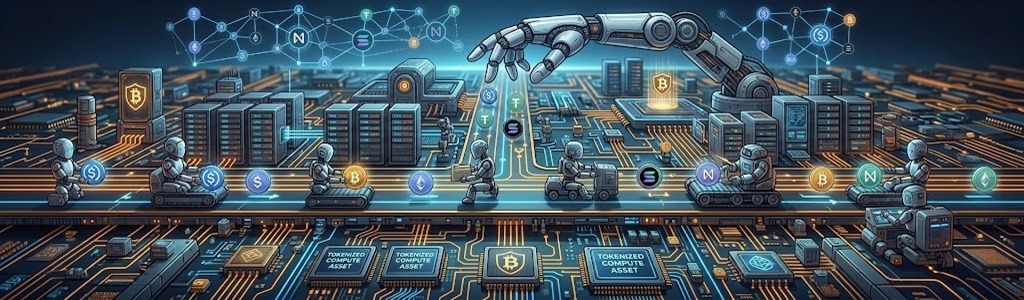
BlackRock takes this thesis further by arguing that financial systems designed primarily around human users may not be optimized for agents that need to make small, frequent, and programmable payments. Its research suggests that stablecoins could become important instruments for machine-to-machine payments, while computing capacity could increasingly become a tokenized asset that can potentially be financed, exchanged, or used as collateral.
The report also cites adjusted stablecoin transaction volume of more than $11 trillion during 2025, while noting that the figure cannot be directly compared with traditional payment-network volumes because of methodological differences. Even with that limitation, the figure shows that programmable digital money already operates at considerable scale before autonomous AI agents reach mass adoption.
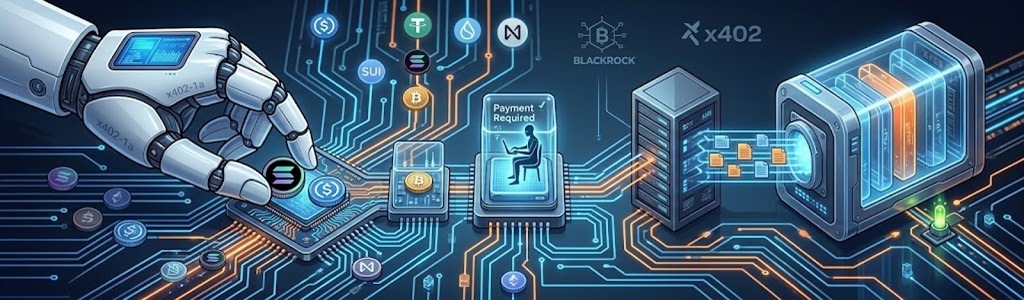
The technical infrastructure is also moving beyond theory. Coinbase developed x402, a protocol built around the HTTP 402 “Payment Required” status code that allows digital services to request payments directly from agents or applications. Solana, meanwhile, reports that x402 has processed more than 35 million transactions and over $10 million in volume on its network since launch, although these figures still represent an early stage of adoption.
From Carbon To Silicon: Agents Are Entering Payments
The emergence of this infrastructure is accompanied by moves from major financial and technology companies. Circle launched Circle Agent Stack in May 2026, offering tools that include agent wallets, marketplaces, and micropayment infrastructure designed to allow autonomous software to hold funds, discover services, and conduct programmable transactions using USDC.
Visa is also developing infrastructure for agentic commerce. In June, the company announced a collaboration with OpenAI to bring its payment network into AI-powered commerce experiences. The project is part of Visa Intelligent Commerce, an initiative designed to support transactions in which AI agents can participate with increasing levels of automation.
These developments reshape the discussion around altcoins. Networks such as Solana, Sui, and NEAR could potentially benefit if agent activity creates additional demand for settlement, blockspace, and on-chain services. Protocols connected to decentralized storage, computing, and intelligence could also gain new use cases. However, greater network activity does not automatically translate into a higher token value. Value capture will depend on fees, staking economics, blockspace demand, competition, and each protocol’s ability to convert economic activity into sustainable demand for its native asset.
Final Reflection: Could The Next Crypto User Be A Machine?
The thesis presented by Ran Neuner, Cryptoman Ran, points toward a fundamental change in how crypto infrastructure could be used. Until now, much of the sector’s activity has been initiated directly by people. The agentic economy introduces a scenario in which an increasing share could be executed by software capable of purchasing data, hiring services, acquiring computing resources, and settling payments autonomously.
The moves by BlackRock, Coinbase, Solana, Circle, and Visa suggest that the infrastructure required for this economy is already beginning to take shape, even though adoption remains at an early stage. The emergence of x402, agent wallets, programmable stablecoin payments, and tokenized computing markets provides tangible examples of how the pieces could fit together.
The key question, therefore, is not simply whether artificial intelligence will expand, but how much of that activity will ultimately rely on blockchain infrastructure. If millions of agents begin conducting economic transactions autonomously, blockchains could evolve from networks used primarily by humans into financial infrastructure for machines as well. That possibility does not guarantee another altcoin boom, but it introduces a potential source of crypto demand that is fundamentally different from traditional human speculation.
Disclaimer: This article has been written for informational purposes only. It should not be taken as investment advice under any circumstances. Before making any investment in the crypto market, do your own research.



Be the first to comment