


The THORChain Bitget Hack dispute has intensified debate over how decentralized protocols should respond when stolen assets move through permissionless infrastructure. Bitget confirmed that its initial investigations revealed an attempted breach where stolen assets were valued at $351.6 million before being revised to $387.5 million. THORChain’s business model is once again under scrutiny due to the hack.
Bitget stated that, through its preliminary investigation, it found correlations between the suspicious activity and the use of VPNs that are known to be used by a North Korean hacking team. However, these findings are not sufficient to attribute the hack. The key issue here is whether THORChain should blacklist the addresses involved in the hack.
Also Read | Blockchain Association Leadership Changes as CLARITY Act Faces Senate Setback
THORChain Rejects Blacklisting Pressure
Gracy Chen of Bitget announced a public request that THORChain ban the addresses associated with the incident, since the decentralized infrastructure should not be used as a channel for sending funds that have already been proven to be stolen. The THORChain representatives have chosen not to do it, stressing that permissionless transactions cannot be controlled by a central authority.

The THORChain Bitget hack reminds us of the incident at Bybit, where the stolen assets were moved to THORChain after a massive security incident happened to the exchange. Unlike centralized exchanges, THORChain is designed in such a way as to allow cross-chain swaps without controlling accounts, but blockchain transactions are public anyway.
The current situation brings up the issue of balance between censorship resistance and necessary actions. The users of decentralized infrastructure state that adding restrictions based on address may result in transaction censorship. Meanwhile, opponents of decentralized systems doubt that protocols should interfere when there is a need to ban a specific wallet that has been identified as the holder of the stolen assets.
THORChain has an interesting history. THORChain admitted that the ability to blacklist specific addresses using the administrative key was retired in February 2025. Also, the pause was made due to a security incident in May.
Ethereum Moves Toward Cryptographic Computing
Whereas the THORChain Bitget Hack dispute focuses on the problem of control, Ethereum co-founder Vitalik Buterin has presented his own vision for the development of decentralized architecture. In his September 27 essay, he defined Ethereum as a combination of blockchain, cryptography, privacy methods, verification techniques, and decentralization beyond the blockchain.
According to the architect’s plan, the future infrastructure will depend greatly on the use of zero-knowledge proofs and distributed computing. Instead of requiring every participant to repeat extensive calculations, separate computers could perform work and provide cryptographic proofs showing that the results are valid. Other participants could then verify those proofs without reproducing the entire computation.
Some other elements in this roadmap include recursive STARKs, formal verification automation, and quantum-resistance. Buterin said that the Hegota, scheduled for next year, could become the last “normal” fork of Ethereum before the introduction of all those technologies.
ETH Technical Setup Adds Market Context
Ethereum’s technological roadmap comes as ETH faces an important technical test. Crypto With Gopal identified $2,680 as a key support area after ETH broke down from a triangle pattern. The analyst said a move below that level could expose $2,560, while a recovery above $2,720 could encourage renewed buying activity. These are analyst-defined levels.
Market data showed ETH trading near the $2,650 area on September 28, placing the asset below the $2,680 level highlighted in the technical analysis. ETH had also reached an intraday high above $2,700, showing that the 2,680-2,720 area remained relevant to short-term price action.
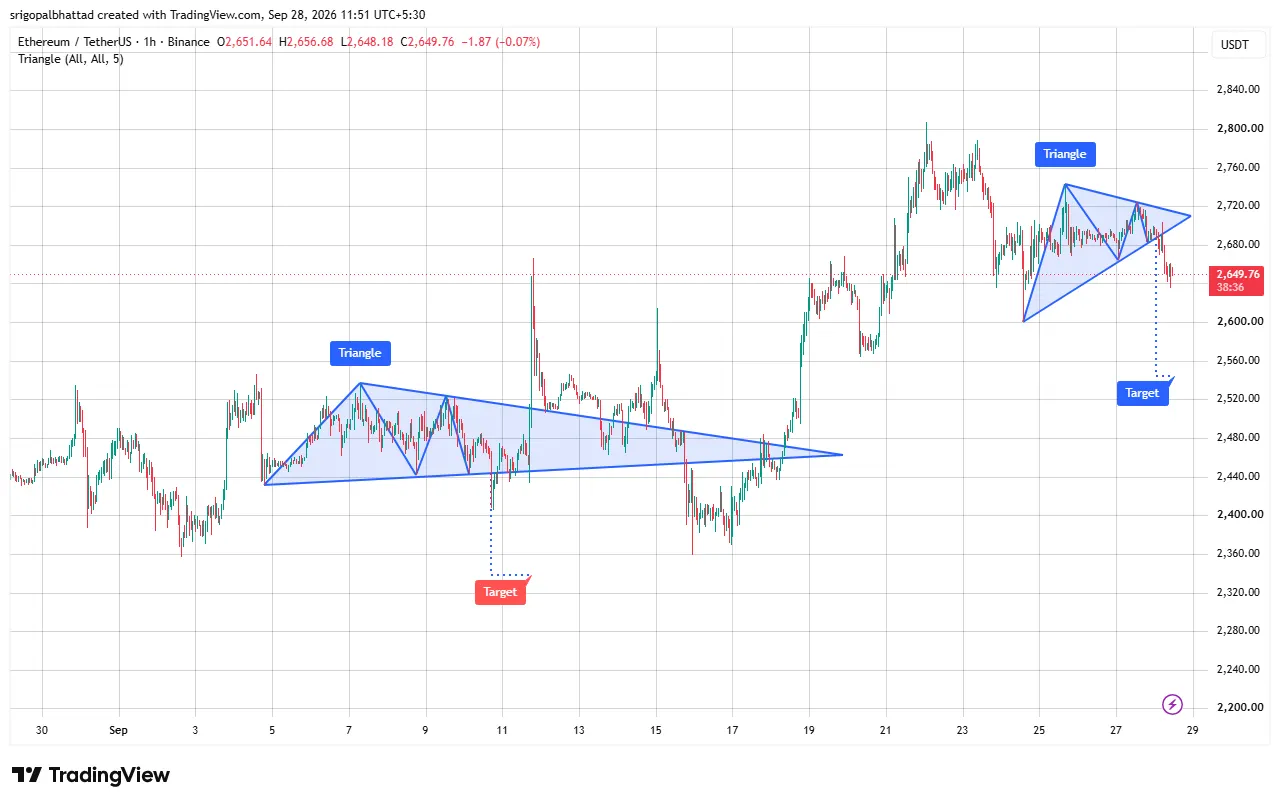
The technical setup provides a separate market dimension to Ethereum’s broader development story. Reuters previously identified 2,560-2,565 as an important downside area in its September 22 technical analysis, while noting that ETH had earlier broken above $2,661.52. This places the levels Crypto With Gopal cited within a wider range of recently observed market support and resistance.
The immediate takeaway from the THORChain Bitget Hack is that decentralized infrastructure still faces tough questions about security responses without centralized control. Ethereum’s roadmap shows another side of that evolution, with cryptographic verification increasingly positioned as a way to improve scalability and privacy. Both developments point toward a more complex decentralized ecosystem.
What happens next will depend on how Bitget tracks the stolen assets, whether additional protocols or exchanges respond to identified addresses, and how THORChain maintains its permissionless design. For Ethereum, developers must still make advanced proofs efficient and coordinate increasingly distributed computation. The coming upgrades will determine how quickly that cryptographic architecture becomes practical at scale.
Also Read | Bitcoin Hashrate Falls as Miner Reserves Drop 1,530 BTC in One Week



Be the first to comment