




TLDR
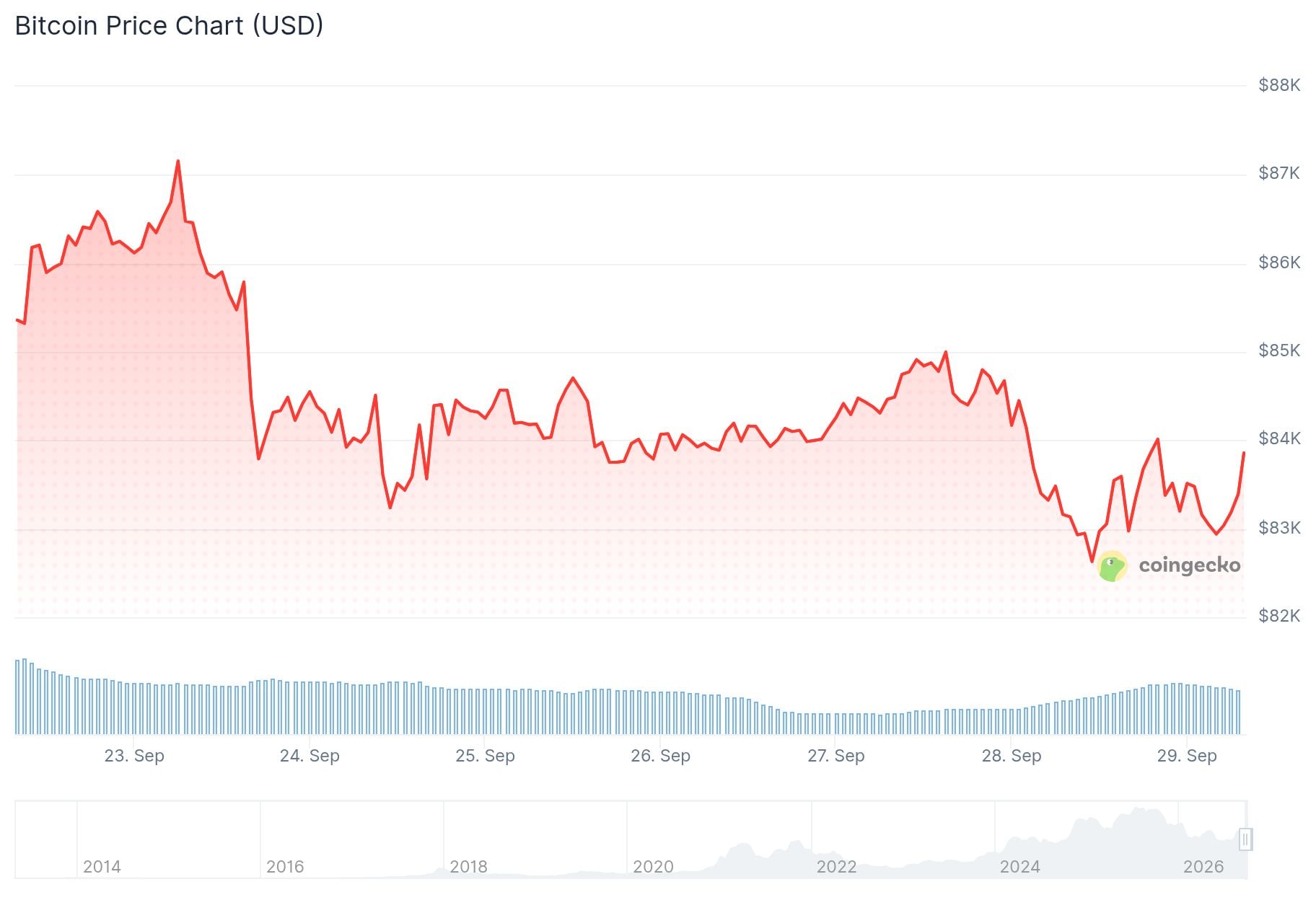
- Bitcoin fell 1.5% to $83,416 on Monday, dropping below $83,000 amid a global bond sell-off.
- The 10-year U.S. Treasury yield climbed past 5%, its highest level since 2007.
- U.S.-Iran tensions continued after President Trump rejected Tehran’s latest ceasefire offer.
- Markets now see a 70.3% chance of a Fed rate hike in October, up from 57.7% last week.
- Bitcoin is still up more than 40% for Q3, its best third-quarter performance since 2017.
Bitcoin dropped 1.5% on Monday, falling to $83,416 as investors pulled back from risk assets. The decline followed a strong two-week run built on hopes for friendlier U.S. crypto rules.
The pullback wasn’t limited to Bitcoin. Ethereum, Cardano, XRP, Dogecoin, and Solana also gave back some of their recent gains.
Government bond yields rose sharply across major economies. The 10-year U.S. Treasury yield pushed past 5%, a level last seen in 2007, while Japanese bond yields hit 30-year highs.
Higher yields make government debt more attractive than speculative assets like crypto. Both the Federal Reserve and the Bank of Japan raised rates in September and signaled more increases could follow.
Iran Conflict Keeps Oil and Inflation in Focus
Rising energy prices tied to the U.S.-Iran conflict have been a driver of inflation this year. Over the weekend, President Trump declined to rule out further military action against Iran after rejecting a ceasefire proposal from Tehran.
Oil prices responded by climbing back toward $95 a barrel, up 3% on Monday. Hamad Hussain, a commodities economist at Capital Economics, told Reuters that supply concerns remain the bigger factor even as shipping through the Strait of Hormuz has improved.
BREAKING: U.S. official says President Trump is ready to ease sanctions on Iran and unfreeze assets in exchange for progress on its nuclear program.
Oil is crashing on the news, down -3.60% in just the last 30 minutes. pic.twitter.com/TEUmiHyBVG
— Bull Theory (@BullTheoryio) September 28, 2026

Fighting between Yemen’s Houthi forces and Saudi Arabia added further support to oil prices. Analyst Ali Charts weighed in on the technical picture, posting that Bitcoin had broken out of a double bottom pattern and was retesting the $82,000 neckline, adding that holding this level could offer a buying opportunity before a move toward $100,000.
BITCOIN: BULLISH RETEST!?$BTC appears to have broken out of a double bottom pattern and is now moving back toward the $82,000 neckline.
If this level holds as support, the retest could offer a buying opportunity before the rally resumes toward the pattern’s $100,000 target. https://t.co/YA0DGPjiYk pic.twitter.com/SXE7VeA9SN
— Ali Charts (@alicharts) September 28, 2026
Despite Monday’s drop, Bitcoin remains up more than 40% for the third quarter. That marks its strongest Q3 since 2017, well above the average Q3 gain of 8.6% since 2013.
Bitcoin also posted its highest weekly close since late January at $84,450 before slipping to one-week lows of $82,557. Thin order book liquidity played a role, with $30 million in sell orders clustered near $85,700 on Monday.
Fed Rate Odds Climb Ahead of Key Data
Markets are pricing in a 70.3% chance of a 0.25% Fed rate hike in October, up from 57.7% a week earlier. The August PCE inflation report, the Fed’s preferred inflation gauge, is due Wednesday and expected to show 3.6% annual growth.
69% Chance of another Rate Hike in October…
Bond Market is screaming, again. https://t.co/dGlKWypgAZ pic.twitter.com/vdWzJYjfzd
— Manz🌪 (@ManzTrades) September 28, 2026
September’s nonfarm payrolls report follows on Friday. August’s jobs number came in far above forecasts at 162,000, and estimates for September sit at 83,000.
Trader Rekt Capital pointed to $82,500 as a level Bitcoin needs to hold. He compared the current setup to the 2022 bear market recovery, when Bitcoin built a base above a similar support zone before its next rally phase.
Rekt Capital said holding $82,500 would confirm an inverse head-and-shoulders pattern on the weekly chart. He added that failing to hold it could send Bitcoin back into the $60,000 to $80,000 range.
Above the current price, the 2026 yearly open sits at $88,700, and the average cost basis for spot Bitcoin ETF investors is near $86,000. Below it, corporate treasury holders have an average cost basis of $80,500.



Be the first to comment