




Author
Ahmed Barakat
Author


Share

Fact Checked by
CryptoNews Editorial Team
Author

The Commodity Futures Trading Commission, or CFTC, registered Coinbase Clearing LLC as a derivatives clearing organization last night, handing Coinbase in-house control over a function it previously outsourced to a third party. Coinbase is billing the entity as the first USDC-native derivatives clearinghouse in the United States.
A clearinghouse sits between the two sides of a futures or options trade and guarantees each party gets paid regardless of what happens to the other. Traditionally, that guarantee runs on dollars moving through the banking system, which means collateral transfers and margin calls are bound to bank operating hours and settlement windows.
Coinbase says its version replaces that dollar plumbing with USDC settling on blockchain rails, allowing collateral to move and margin calls to be met around the clock rather than waiting for a bank to open. For institutional desks managing risk across time zones, that removes a scheduling constraint that dollar-based clearing has always imposed.
This is also a claim tied directly to stablecoins’ expanding role in institutional settlement infrastructure rather than to any explicit CFTC mandate. The framework builds on a digital-assets pilot program the CFTC launched in December 2025, which first opened the door to Bitcoin, Ether, and USDC as acceptable collateral in regulated derivatives markets.
Earn $50 and Enter $300K Prize Draw on EdgeX
How Coinbase Clearing Works After CFTC Registration?
Per the CFTC registration order, Coinbase Clearing is permitted to clear fully collateralized futures, options on futures, and swaps. That scope is narrower than a blanket derivatives-clearing license as it covers products backed one-to-one, which carry counterparty risk that fully collateralized structures are designed to avoid.
Before this registration, Coinbase Derivatives, the company’s CFTC designated contract market, routed trades through Nodal Clear as an external clearinghouse. Coinbase Clearing converts that arrangement into an in-house operation, giving Coinbase direct control over the clearing process rather than routing it through an outside firm.
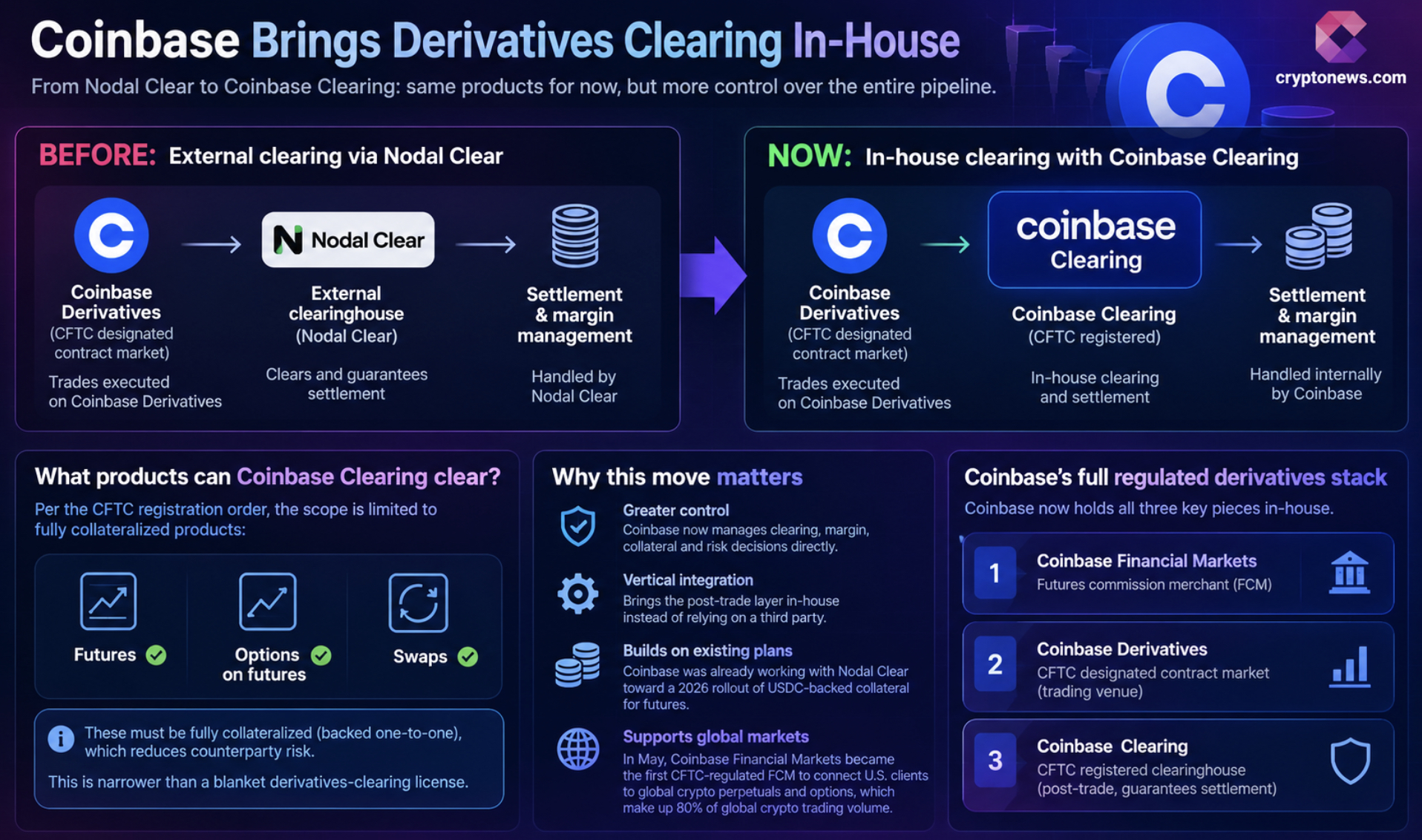
The company is known to have already been working with Nodal Clear toward a 2026 rollout of USDC-backed collateral for futures before securing its own registration.
The practical shift is one of control rather than product breadth. Coinbase now holds three pieces of its own regulated derivatives stack: Coinbase Financial Markets as the futures commission merchant, Coinbase Derivatives as the trading venue, and Coinbase Clearing as the post-trade layer that guarantees settlement.
That stack already extends beyond domestic products. In May, Coinbase Financial Markets became the first CFTC-regulated futures commission merchant connecting U.S. clients to global crypto perpetuals and options markets, instruments that account for 80% of global crypto trading volume.
So now, owning the clearing function in-house gives Coinbase a tighter grip on margin, collateral, and risk decisions across that entire pipeline instead of splitting them with a third-party operator.
Trade crypto on Bybit and Get a Chance to Win Our $1,000 USDT Airdrop
CFTC Registration and Its Limits
What the CFTC actually approved is worth stating plainly: registration by Commission order to clear fully collateralized futures, options on futures, and swaps. The order does not name USDC as a mandatory settlement asset for every product cleared through the entity, and it does not extend to leveraged crypto derivatives.
The question of how far U.S. digital-asset oversight will stretch remains unsettled in Washington, where the CLARITY Act’s path through the Senate is still pending.
Coinbase Clearing’s registration is a concrete regulatory milestone within that uncertain landscape, but the size of its eventual footprint depends on how much product volume actually migrates to fully collateralized, USDC-settled structures once the service goes live.
Discover: The Best Token Presales



Be the first to comment