



The LINK price remained in focus on Tuesday, September 29, 2026, as traders tracked Chainlink’s technical structure, derivatives activity, and ecosystem developments, while analysts outlined key support zones and potential upside targets after recent weekly gains.
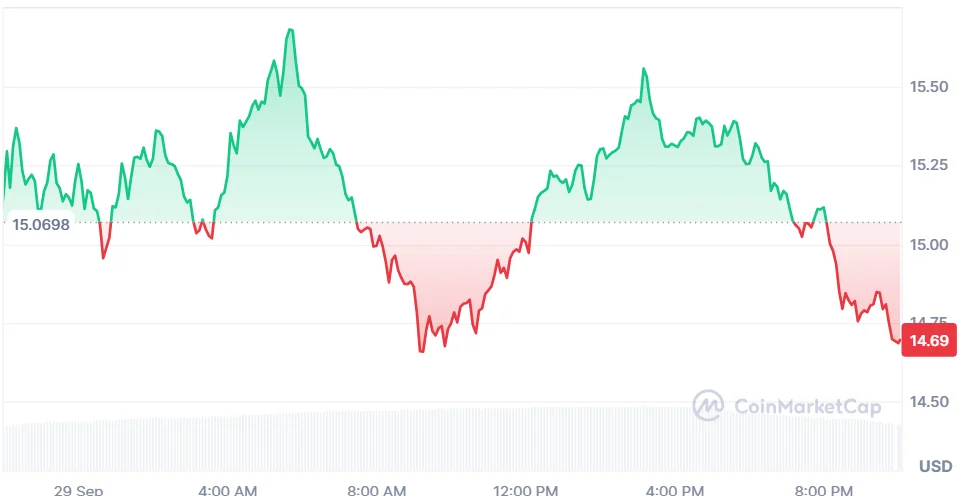
As of writing, Chainlink (LINK) is trading at $14.69, showing a decline of 3.51% in the past day. The trading volume has gone up by 3.71% and is currently standing at $1.02 billion. Over the last week, the coin price has increased by 12.99%, according to CoinMarketCap.
Also Read: Aster Price Holds at $0.71 While Grid 2.0 Offers 140K ASTER
How LINK’s Breakout Structure Supports Higher Targets
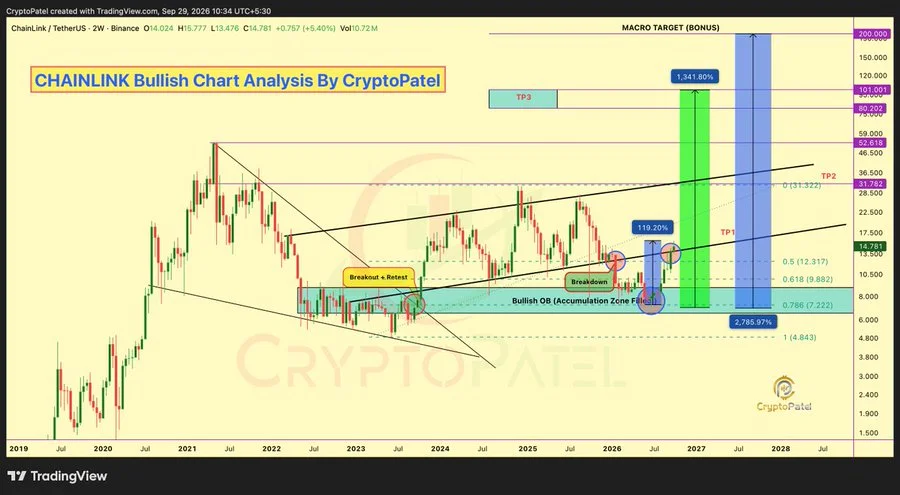
Popular analyst Crypto Patel highlighted that LINK price had rallied around 120% from his previous range estimate of the $7-$8 accumulation area. He noted that LINK had regained its breakout pattern on a higher time frame, breaking through above its bullish order block formation.

Patel outlined the first target at $18, $32, $50, and $100. A $200 figure represented the macro-level target level, with his demand zone positioned between $10.50 and $8.50.
Patel argued that the bullish configuration will sustain itself so long as LINK sustains above this demand zone. A break below this region will weaken the structure.
Why $6.99 Matters for LINK’s Bullish Wave Setup
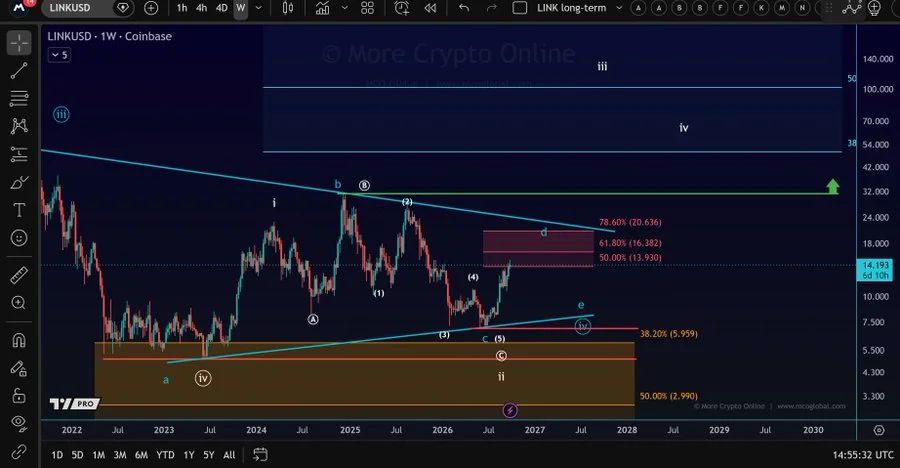
Furthermore, another analyst, More Crypto Online, mentioned a different Elliott Wave view on the LINK market structure. This analyst believes that the token is approaching the strong resistance, and also it is confined within a wide sideways range since the 2021 high.
The dominant scenario is a larger one-two-wave scenario. In that perspective, the low in June may have been wave two, and the five-wave rally from that low may have created the conditions for further gains in wave three.
The analyst further noted that, as long as LINK is above $6.99, the bullish wave scenario is still in play. A break below that level would lead to the weakening of the Elliott Wave structure outlined by the analyst.
Further upside is possible with the five-wave advance from the June low, the analyst said. The anticipated wave-3 advance requires the price to remain within the given invalidation level.
LINK Open Interest Fell as Volume Increased
According to CoinGlass data, the future volume has risen 9.11% to $1.55 billion. Open interest has decreased by 5.82% to $832.27 million, showing that contract positions were decreasing despite increased trade volumes.
The LINK OI-weighted funding rate is recorded at 0.0023%, indicating a mild positive trend bias within the perpetuals.
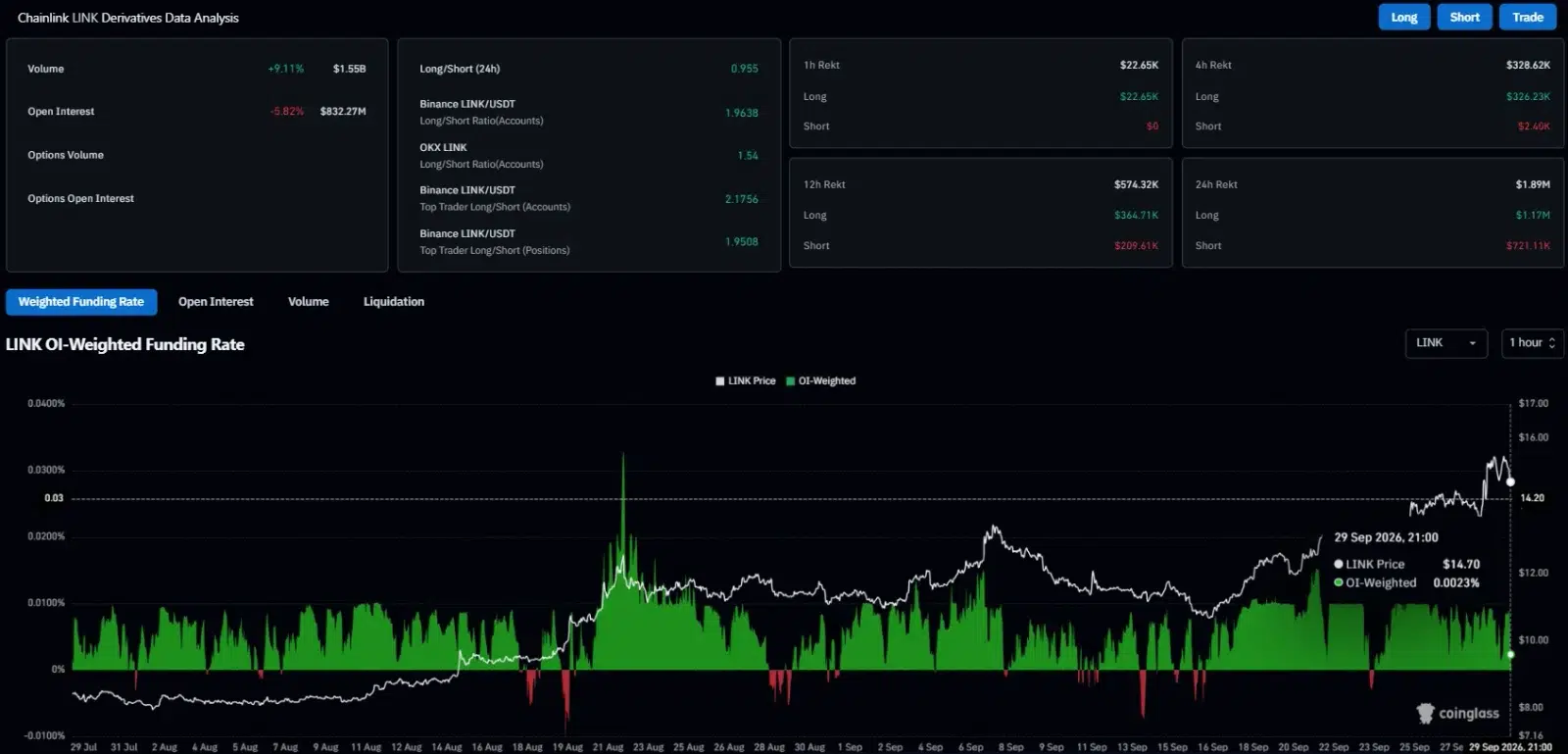
Total liquidations were reported at $1.89 million in the last 24 hours, with long liquidations amounting to $1.17 million and short liquidations totaling about $721,110.
Increased volume coupled with declining open interest indicated positioning activity by traders, while LINK’s exposure to short-term volatility increased significantly.
Why Does LINK Price Technical Structure Matter?
According to TradingView data, LINK is trading at $14.731, trading above all four of its key Exponential Moving Averages (EMAs). Its 20-day EMA stands at $13.042, with the 50-day EMA at $11.762.
Its longer-term averages also remain below current market prices. The 100-day EMA stands at $10.707, with its 200-day EMA at $10.451.
The moving average order is bullish with the 20-day EMA above the 50-day, 100-day, and 200-day averages. The technical configuration revealed that the retracement did not drive the LINK below trend levels.
The Bollinger Band (BB) indicator positioned the midline level at $12.591, the upper level at $15.181, and the lower level at $10.001. The LINK price approached the upper level, positioning the cryptocurrency at the upper extreme of its volatility level.
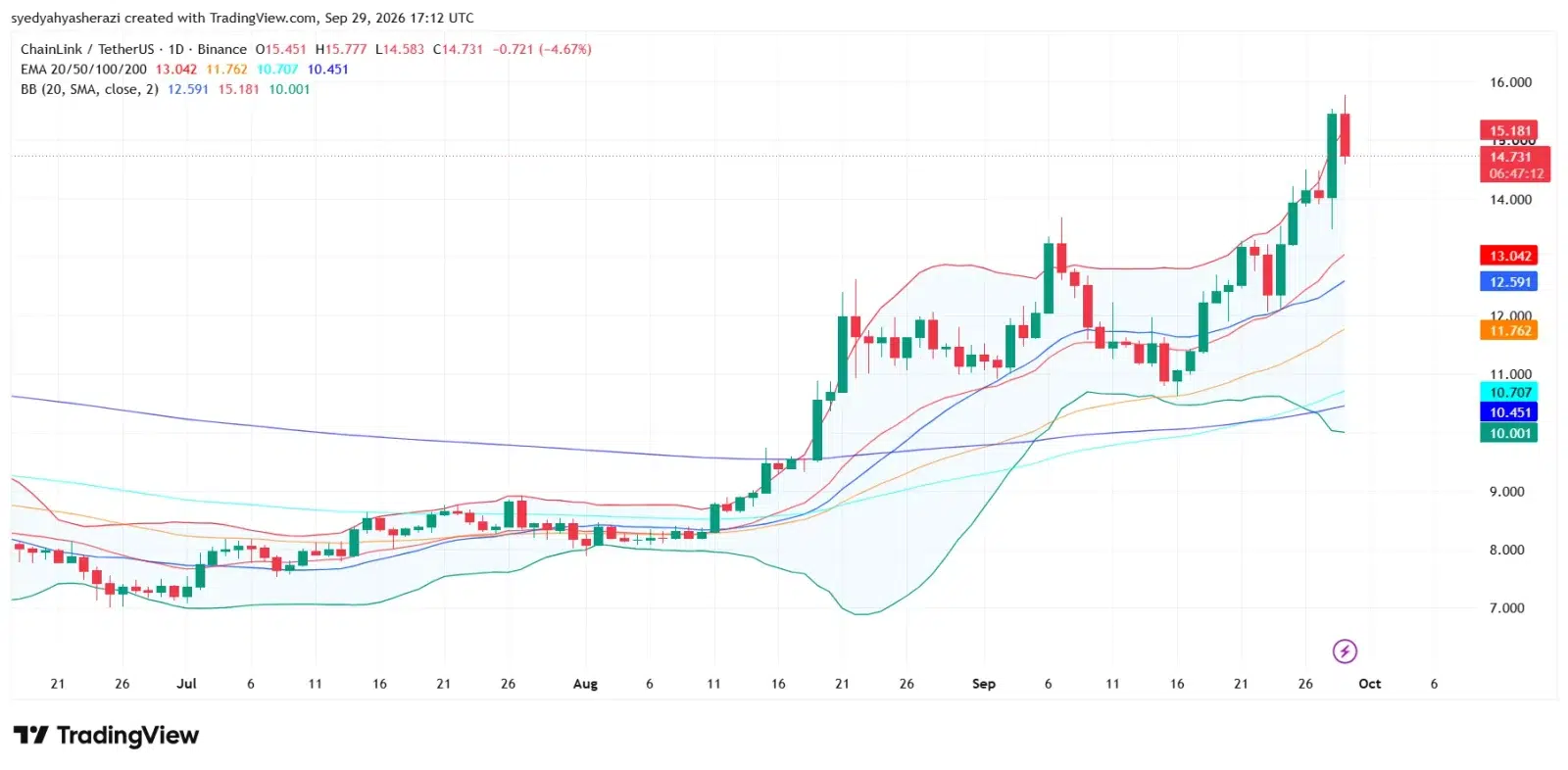
A breakout beyond the $15.181 level will drive the LINK above the upper resistance line, with rejection of this area likely to contain the LINK within the volatility range, focusing on the mid-line level of $12.591.
What CCIP 2.0 Means for Chainlink’s Verification Model
Chainlink launched CCIP 2.0 on Monday, representing an important development in its cross-chain ecosystem. According to the press release, enterprises can now include custom verification checks beyond Chainlink’s existing pool of 16 independent verifiers.
These verification checks could be carried out either internally by companies or via service providers like Infosys and Nethermind. These verification checks will be added over the baseline 16-operator quorum required by Chainlink and do not replace the base network. Existing CCIP integration will remain unaffected.
CCIP 2.0 comes just five months after the collapse of Kelp DAO due to a bridge exploit attack that saw losses totaling around $292 million. According to the report, the failed configuration used only a single verifier as opposed to a distributed verification network.
How CCIP 2.0 Changes Chainlink’s Security Model
Chainlink’s previous Risk Management Network has ceased functioning separately as an independent safety layer. Instead, Chainlink claims that the same safety checks can now be provided by voluntary additional verifiers under CCIP 2.0.
Without voluntary additional verifiers, users will fall back onto the quorum of Chainlink nodes. The earlier structure comprised both the main Chainlink quorum and a distinct Risk Management Network.
Notably launched partners are AWS, Google Cloud, Infosys, Ethereum, Base, BNB Chain, and Avalanche. No organization has confirmed utilizing the optional verifier function.
Aave and Maple have begun implementing other parts of the update. Chainlink Labs Chief Business Officer Johann Eid said that legacy cross-chain bridges have lost billions of dollars due to insecure cross-chain architecture, and building an internal security solution can become extremely expensive and time-consuming.
Also Read: XRP Price Rebounds Above $1.50: Can Bulls Push Toward $1.70?
This article contains market analysis and price predictions. These are not guarantees. Crypto markets are volatile. Always DYOR. Not financial advice.



Be the first to comment