

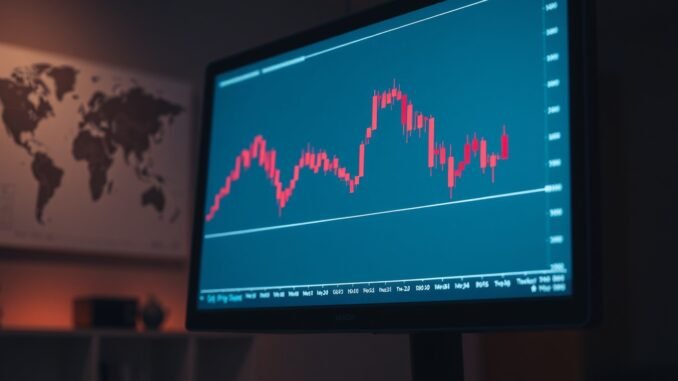

LONDON, March 2025 – The British Pound Sterling (GBP) has experienced a pronounced decline against the US Dollar (USD) in global forex trading, with analysts directly linking the sell-off to escalating geopolitical tensions and confirmed reports of US ground invasion plans. This movement underscores a rapid shift toward a risk-off mood among institutional investors, who are flocking to traditional safe-haven assets. Consequently, the USD index has rallied, pressuring major currency pairs and reshaping short-term market dynamics.
Pound Sterling Faces Sustained Pressure Against the Dollar
Forex markets reacted swiftly to the emerging news cycle. The GBP/USD pair, a key benchmark for global capital flows, broke below several critical technical support levels. Market data from major trading hubs shows the pair falling from a pre-news level near 1.2800 to test lows around 1.2650 within a single session. This represents one of the most significant single-day drops in recent months. Furthermore, trading volumes spiked to more than 150% of the 30-day average, indicating broad-based participation in the move. The sell-off was not isolated to cable; the Euro and commodity-linked currencies like the Australian Dollar also weakened against the greenback.
Several interrelated factors are driving this currency movement. Primarily, the US Dollar benefits from its status as the world’s primary reserve currency during periods of global uncertainty. Additionally, market participants are reassessing the interest rate differential outlook. The Federal Reserve’s potential response to inflationary pressures from geopolitical instability may differ from the Bank of England’s more domestically focused mandate. This recalibration of expectations is exerting further downward pressure on the Pound.
Geopolitical Catalyst: How Military Plans Reshape Market Sentiment
The immediate catalyst for the risk aversion is the confirmation of advanced US military planning. While operational details remain classified, credible reports from multiple defense and intelligence sources have outlined the scope and potential scale of the proposed actions. Historically, markets treat such escalations as precursors to prolonged uncertainty, which disrupts global trade, energy supplies, and economic growth forecasts. For instance, analysts immediately revised their Q2 2025 global GDP growth estimates downward by an average of 0.3 percentage points.

Expert Analysis on Flight-to-Safety Dynamics
Dr. Anya Sharma, Chief Strategist at Global Macro Advisors, contextualizes the move: “Currency markets are acting as a real-time barometer for geopolitical risk. The Pound’s decline is less a reflection of the UK’s economic fundamentals and more a function of capital reallocation. Investors are reducing exposure to assets perceived as risky, including European equities and currencies, and increasing holdings of US Treasuries and the Dollar. This is a classic, albeit sharp, flight-to-safety episode.” Sharma’s assessment is supported by concurrent rallies in US government bond prices and gold.
The risk-off sentiment manifests across multiple asset classes. A comparative table illustrates the synchronous moves:
| Asset | Performance | Reason |
|---|---|---|
| US Dollar Index (DXY) | +1.2% | Safe-haven demand |
| GBP/USD | -1.1% | Risk-off outflow from Sterling |
| Gold (XAU/USD) | +2.5% | Alternative safe-haven asset |
| FTSE 100 Index | -2.8% | Equity sell-off and stronger GBP headwind for exporters |
Economic Impacts and Forward-Looking Scenarios
The currency shift carries immediate implications. For the UK, a weaker Pound increases the cost of imports, potentially exacerbating existing inflationary pressures. However, it also makes British exports more competitive on the global stage. The Bank of England now faces a more complex policy equation, balancing growth concerns against imported inflation. For the United States, a stronger Dollar helps contain inflation by making imports cheaper but poses a headwind for large US multinational companies that derive significant revenue from overseas.
Market technicians are monitoring key levels for the GBP/USD pair. A sustained break below 1.2620 could open the path toward the 1.2500 psychological support zone. Conversely, any de-escalation in geopolitical rhetoric could trigger a swift, short-covering rally. The market’s direction will likely hinge on the clarity and evolution of the geopolitical situation over the coming days. Central bank communications will also be scrutinized for any hints of coordinated action to stabilize currency markets.
Conclusion
The decline of the Pound Sterling against the US Dollar serves as a clear testament to the powerful influence of geopolitics on modern financial markets. The risk-off mood, triggered by specific military developments, has prompted a rapid recalibration of currency valuations, favoring the US Dollar as the premier safe-haven asset. While the move reflects short-term fear, its persistence will depend on the trajectory of real-world events and the subsequent response from global monetary authorities. Investors and policymakers alike are now navigating a landscape where traditional economic indicators are momentarily overshadowed by security-driven narratives.
FAQs
Q1: Why does the US Dollar strengthen during geopolitical crises?
The US Dollar is considered the world’s primary reserve currency and safe-haven asset. In times of uncertainty, global investors seek its perceived stability and liquidity, increasing demand and driving up its value relative to other currencies.
Q2: Does a weaker Pound only have negative effects on the UK economy?
No. While it raises import costs and can fuel inflation, a weaker Pound makes UK exports cheaper for foreign buyers, which can boost demand for British goods and services and support economic growth and jobs in export-oriented sectors.
Q3: What other assets typically benefit from a ‘risk-off’ market mood?
Besides the US Dollar, government bonds from stable countries (like US Treasuries, German Bunds), gold, and the Japanese Yen often see increased demand during risk-off periods as investors seek stability.
Q4: How long do currency moves driven by geopolitical news typically last?
The duration varies significantly. Sharp moves can last from hours to weeks, depending on whether the event is a short-lived shock or the beginning of a prolonged conflict. Fundamentals typically reassert themselves over the medium to long term.
Q5: What should forex traders monitor following this GBP/USD decline?
Traders should watch for official statements from US and UK government officials, developments in the underlying geopolitical situation, key technical support/resistance levels for the currency pair, and upcoming economic data releases that could shift focus back to fundamentals.
Disclaimer: The information provided is not trading advice, Bitcoinworld.co.in holds no liability for any investments made based on the information provided on this page. We strongly recommend independent research and/or consultation with a qualified professional before making any investment decisions.


Be the first to comment