



Crypto mergers and acquisitions reached a record $9.7 billion in disclosed deal value in the first half of 2026, and industry bankers do not expect the recent collapse of the CLARITY Act negotiations to halt dealmaking.
According to CryptoRank Research, first-half transaction value increased 44% year over year, although the number of announced acquisitions fell 8% to 87. The four largest transactions accounted for 76% of disclosed value, indicating that a smaller group of major acquisitions is driving much of the industry’s expansion.
The figures predate the Senate’s September 15 setback, but recent comments from bankers suggest acquisition interest remains intact. While the failed vote has delayed a comprehensive US crypto market structure law, companies continue pursuing payments infrastructure, licenses, trading technology and distribution networks.
For more background on the legislative breakdown, see our earlier report on why the CLARITY Act Senate deal collapsed.

Crypto M&A Value Surges 44% Despite Fewer Acquisitions
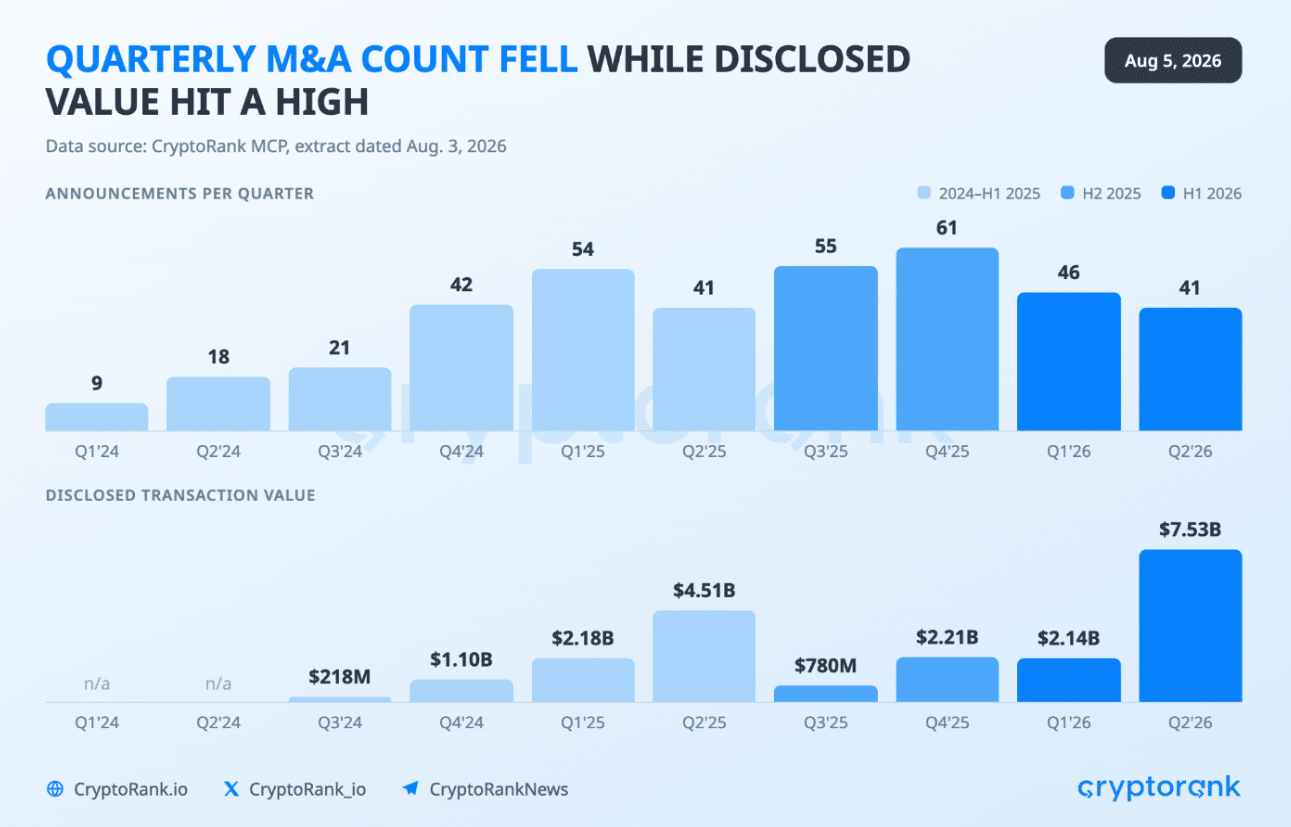
According to CryptoRank Research, digital asset dealmaking reached $9.7 billion in disclosed transaction value during the first six months of 2026, establishing a new first-half record. However, the increase was not accompanied by higher overall deal activity.
| Crypto M&A Metric | H1 2026 Result |
| Disclosed deal value | $9.7 billion |
| Year-over-year value growth | 44% |
| Announced acquisitions | 87 |
| Year-over-year acquisition count | Down 8% |
| Share held by four largest deals | 76% |
Table 1. Crypto M&A Activity in the First Half of 2026
The concentration suggests that buyers are increasingly willing to commit larger amounts to selected businesses rather than simply completing more transactions across the sector.
It also means the record should not be interpreted as evidence that every category of crypto company is attracting stronger acquisition demand. The disclosed value remains heavily influenced by a handful of large transactions.
CLARITY Act Failure Has Not Stopped Dealmakers
The US Senate failed to advance the CLARITY Act on September 15 after a 49–50 procedural vote fell short of the 60 votes required.
The legislation was intended to establish a more comprehensive federal crypto market structure framework, including clearer responsibilities for the Securities and Exchange Commission (SEC) and Commodity Futures Trading Commission (CFTC).
Its failure raised concerns that regulatory uncertainty could discourage acquisitions, particularly when a target company operates in an area where the legal treatment of digital assets remains unresolved.
However, Paul McCaffery, head of digital assets at investment bank KBW, argued that the setback does not change the broader trajectory of crypto dealmaking. He pointed to continued regulatory activity from the SEC and CFTC as an alternative source of progress while Congress remains divided.
Industry participants therefore expect more selective dealmaking rather than a complete slowdown.
SEC and CFTC Actions Keep Institutional Plans Moving
Two days after the Senate vote, the SEC introduced a temporary Innovation Exemption allowing certain eligible venues to facilitate limited trading of tokenized US stocks.
On October 1, the agency also proposed updated crypto custody requirements for investment firms.
Meanwhile, the CFTC has taken steps to address regulatory barriers for certain software providers, tokenized investments, and blockchain-based recordkeeping.
However, agencies’ actions are not equivalent to permanent legislation because their scope is limited, and future regulators could revise or replace them.
Dmitriy Berenzon, a partner at venture firm Archetype, said a clearer statutory framework would support more deals and partnerships across financial services. He pointed to the GENIUS Act and its impact on stablecoin adoption as an example of how legislation can support industry expansion.
Kraken Parent Payward Pursues More Than $1B in Acquisitions
Payward, the parent company of Kraken, provides a recent example of the industry’s appetite for strategic acquisitions. The company has agreed to acquire payments firm Reap for approximately $600 million and derivatives platform Bitnomial for up to $550 million.
Those two agreements represent up to $1.15 billion in combined transaction consideration.
Nasdaq has also agreed to invest $100 million in Payward alongside an expanded commercial partnership.
| Transaction | Reported Value |
| Payward acquisition of Reap | $600 million |
| Payward acquisition of Bitnomial | Up to $550 million |
| Nasdaq investment in Payward | $100 million |
Table 2. Recent Payward Transactions and Strategic Investment
Regulatory Uncertainty Could Change Which Crypto Firms Attract Buyers
The CLARITY Act setback has not removed the commercial reasons behind crypto acquisitions, but it could influence which businesses become attractive targets.
Companies with established licenses, existing compliance systems and infrastructure suited to institutional adoption may hold an advantage over businesses whose operations depend heavily on unresolved token classifications or future regulatory exemptions.
For TradFi institutions, acquisition decisions must also account for whether a target can operate under the buyer’s existing regulatory obligations.
That leaves the market with two competing forces: growing demand for digital asset infrastructure and uncertainty over how consistently US rules will apply over the longer term.
What Comes Next
With limited legislative time remaining before the November midterm elections, attention is shifting toward SEC and CFTC rulemaking and whether their initiatives can support continued institutional investment.
The next crypto merger and acquisition figures will also more clearly indicate how dealmakers responded after the September 15 vote, rather than relying on record first-half results that preceded it.
What this means for you: The CLARITY Act setback has not stopped major crypto companies from expanding through acquisitions. However, the record $9.7 billion figure was concentrated in a small number of large deals. Watch whether acquisition activity remains strong after September, particularly among companies focused on regulated payments, custody, tokenization and trading infrastructure.



Be the first to comment