


AI Summary
- The CFTC has started a public comment process for purpose-built regulation of crypto asset transactions and markets.
- The action begins a rulemaking process rather than granting immediate approval to crypto exchanges.
- Bitcoin’s reported technical setup, exchange outflows and possible US dollar weakness support a bullish thesis, but none confirms a breakout.
- Claims of an approaching altseason depend on Bitcoin dominance falling and capital rotating into other crypto assets.
- Regulatory progress and market momentum should be evaluated separately because each carries distinct uncertainties.
The loudest narrative around the latest CFTC action is that US regulators are preparing to give crypto an institutional green light. The concrete development is narrower but still consequential: wording reproduced from the Commodity Futures Trading Commission’s announcement says the agency has published an advance notice of proposed rulemaking covering crypto asset transactions and crypto asset markets.
This is the beginning of a regulatory process, not its conclusion. It arrives as Bitcoin is being assessed against a bullish technical setup, reported exchange outflows and a possible reversal in the US dollar. Our analysis separates that market thesis from the regulator’s actual action, much as our earlier examination of a Bitcoin monetary reset and speculative altseason case distinguished structural arguments from outcomes that still required confirmation.
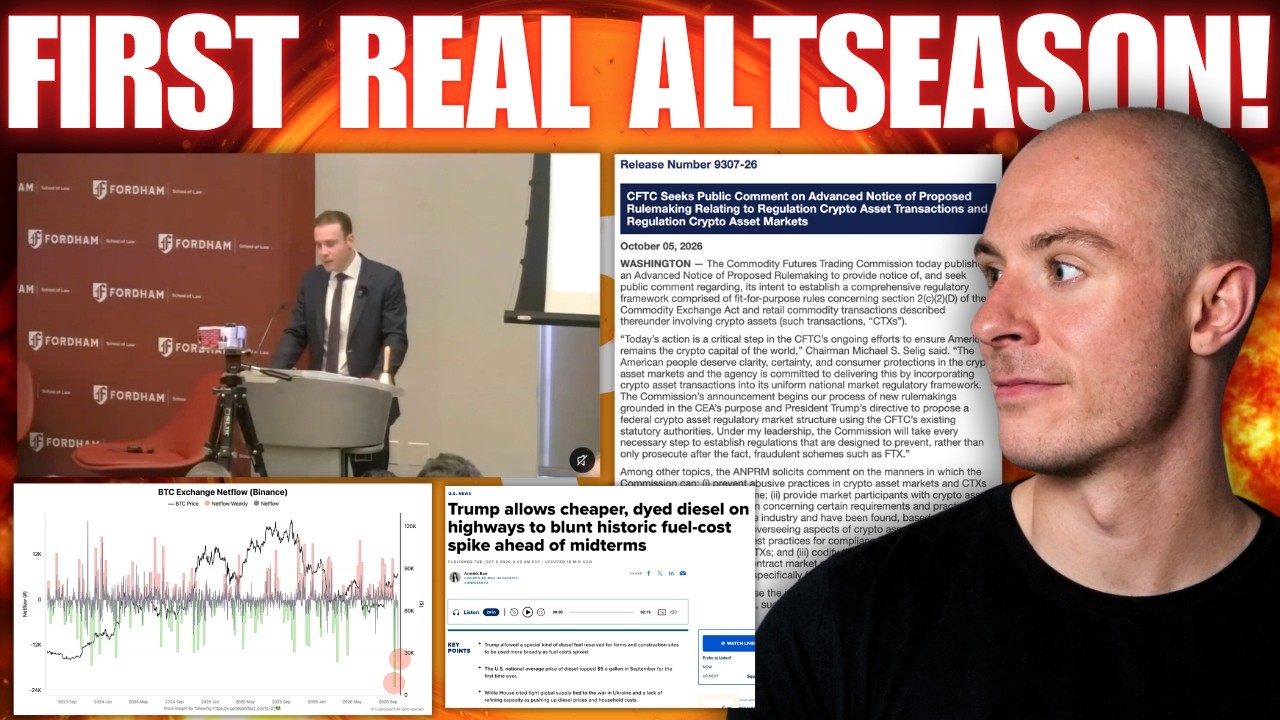
The *FIRST* Real Altseason Is Here! CFTC About To Green light Crypto! Bitcoin $90K? Major Outflows!!
What the CFTC notice actually changes
The notice described in the source seeks comment on a potential framework under Section 2(c)(2)(D) of the Commodity Exchange Act. That provision is presented as relevant to retail commodity transactions involving crypto assets. The stated objective is to place qualifying activity within a uniform national regulatory framework using the CFTC’s existing statutory authority.

“Today, the CFTC is doing its part to deliver clear rules of the road for crypto asset markets with its advanced notice of proposed rulemaking on regulation crypto asset transactions or REGGTX and regulation crypto asset markets or REGG CAM, which is now live on the CFTC’s website.”
The proposal outlined in the transcript has several connected aims:
- National oversight: Explore a common regulatory route for crypto exchanges rather than relying on fragmented treatment.
- Purpose-built registration: Consider a designated contract market subcategory tailored to crypto asset activity.
- Industry context: Determine how established crypto practices could satisfy applicable regulatory requirements.
- Abuse prevention: Gather views on preventing abusive practices before harm occurs.
The notice therefore matters because it moves the debate from broad political promises toward questions of registration, compliance and supervision. It does not, by itself, settle those questions.
A rulemaking process is not an immediate green light
An advance notice normally signals that an agency is collecting information before deciding what future action to take. The transcript describes a 60-day public comment period and says the responses may inform later rulemaking. That sequence is materially different from adopting a final rule or approving a particular exchange, product or token.
- What has happened: The CFTC has solicited written comments on a contemplated framework.
- What remains open: The scope, obligations and final form of any future regulations.
- What has not been established: Automatic authorization for existing platforms or blanket commodity status for every crypto asset.
This distinction is especially important because the source characterizes most crypto assets as commodities while acknowledging a role for the SEC where tokenized securities are concerned. That is an interpretation within the source, not a final classification covering every asset. Our view is that the most credible near-term implication is a clearer route for discussing market structure, rather than an instant resolution of jurisdictional boundaries.
Coinbase co-founder and CEO Brian Armstrong was reported as welcoming the move and the opening of the comment period. His reaction shows why market participants may regard the process as constructive, but support from an industry executive does not determine the eventual regulatory outcome.
Consumer protection sits at the center of the proposal
The announcement language places consumer protection, certainty and fraud prevention at the center of the proposed framework. It also refers to the CFTC’s experience overseeing aspects of crypto markets since 2014 and asks how commonly accepted industry practices could be reflected in regulatory requirements for crypto exchanges, described as CTXs.
“The American people deserve clarity, certainty and consumer protection in the crypto asset markets and the agency is committed to delivering this by incorporating crypto asset transactions into its uniform national market regulatory framework.”
The policy direction outlined in the source can be reduced to three practical tests:
- Registration: Can a crypto-specific category fit within the CFTC’s existing designated contract market authority?
- Disclosure: What contextual information should platforms give market participants?
- Prevention: Which controls could deter abusive or fraudulent conduct before enforcement becomes necessary?
Those questions are more significant than the “green light” shorthand. If the process ultimately produces workable rules, its value would lie in defining obligations and accountability. If the rules remain unclear or incomplete, the existence of a consultation alone will not remove operational or legal uncertainty.
Bitcoin’s technical case remains conditional
The market thesis accompanying the regulatory development is based on an inverse head and shoulders pattern and a possible symmetrical triangle. The source interprets these structures as evidence that Bitcoin may have formed a bottom and could continue higher. It identifies $90,000 as an initial destination and $116,000 as the inverse head and shoulders target.
“So we’ve got an inverse head and shoulders here which is a bottoming pattern and then we’ve got potentially a symmetrical triangle that is likely going to set up for continuation which means Bitcoin is heading to 90K and then the 116k target that the inverse head and shoulders has.”
These are forecasts derived from chart interpretation, not established facts. A pattern can fail, and a projected target does not establish the path, timing or probability of reaching it. In our view, the useful part of the thesis is the conditional framework:
- Bullish confirmation: Price would need to break and hold beyond the relevant consolidation structure.
- Market breadth: Other crypto assets would need to participate rather than leaving gains concentrated in Bitcoin.
- Invalidation risk: A failed breakout or renewed macro pressure would weaken the continuation case.
The related altseason forecast is more speculative. It depends on Bitcoin dominance falling, with the source offering an eventual 25% level as an opinion. A dominance decline could reflect capital rotation, but neither the direction nor the magnitude is assured.
Binance outflows suggest accumulation but do not prove it
The source reports that $3.3 billion left Binance over two weeks, describing the movement as a three-year high. It interprets coins leaving the exchange as more bullish than bearish because withdrawals may be consistent with accumulation.
“Interestingly $3.3 billion left Binance in two weeks as outflows hit a three-year high.”
That interpretation is plausible but incomplete. Exchange outflows show movement away from a trading venue; they do not disclose the holder’s intention. Assets can be transferred for custody, redistribution or other reasons. The figure therefore supports a possible supply-side accumulation narrative, but it cannot independently confirm one.
We would look for agreement among price structure, sustained exchange balances and broader participation before treating the reported outflow as confirmation of a durable trend. The CFTC process adds a potentially constructive institutional backdrop, but it does not transform ambiguous flow data into proof.
The dollar remains the key macro variable
The macro argument rests on the possibility that the US dollar is forming a bear flag comparable to the environment associated in the source with the 2017 crypto advance. A weaker dollar could support risk assets, while renewed dollar and bond-yield strength could challenge the bullish setup.
The source also cites energy-market strain and pressure in Britain’s bond market as unresolved concerns. These references do not establish a direct causal path to Bitcoin, but they illustrate why the technical thesis cannot be assessed in isolation. Monetary policy, yields, energy conditions and currency strength can change liquidity expectations even when crypto-specific regulation appears to be improving.
Our measured interpretation is that crypto’s resilience during dollar strength would be constructive, while an actual dollar reversal could reinforce momentum. Until either path is confirmed, the macro case remains a scenario rather than a signal.
What this means
- Regulatory movement is substantive but preliminary. The CFTC has opened a formal channel for input on crypto-specific rules. The consultation may shape future action, but it is not a final framework or universal exchange approval.
- The bullish Bitcoin case needs market confirmation. Technical patterns, reported Binance outflows and possible dollar weakness point in the same constructive direction, yet each indicator remains conditional and open to alternative interpretations.
- An altseason is the least certain part of the thesis. Regulatory clarity could improve the operating environment for crypto markets, but broad token performance would still require falling Bitcoin dominance, sustained liquidity and participation beyond a single asset.
Bigger picture
The CFTC initiative is one part of a wider institutional effort to define how digital assets fit within existing financial rules. Our recent coverage of an SEC custody proposal affecting Bitcoin and tokenized markets examined another regulatory boundary, while a separate analysis considered how SEC crypto guidance refines the policy test facing Bitcoin.
Market infrastructure is developing alongside that policy work. Recent verified developments include DTCC and regulators advancing tokenized securities infrastructure and a European consortium targeting euro stablecoins on three major chains. Together, these developments support a broader institutionalization thesis, but they concern different authorities, instruments and technical systems. They should not be treated as evidence that the CFTC’s contemplated rules are already settled.
Sources
This article is for informational purposes only and does not constitute financial advice.



Be the first to comment