



Key Takeaways
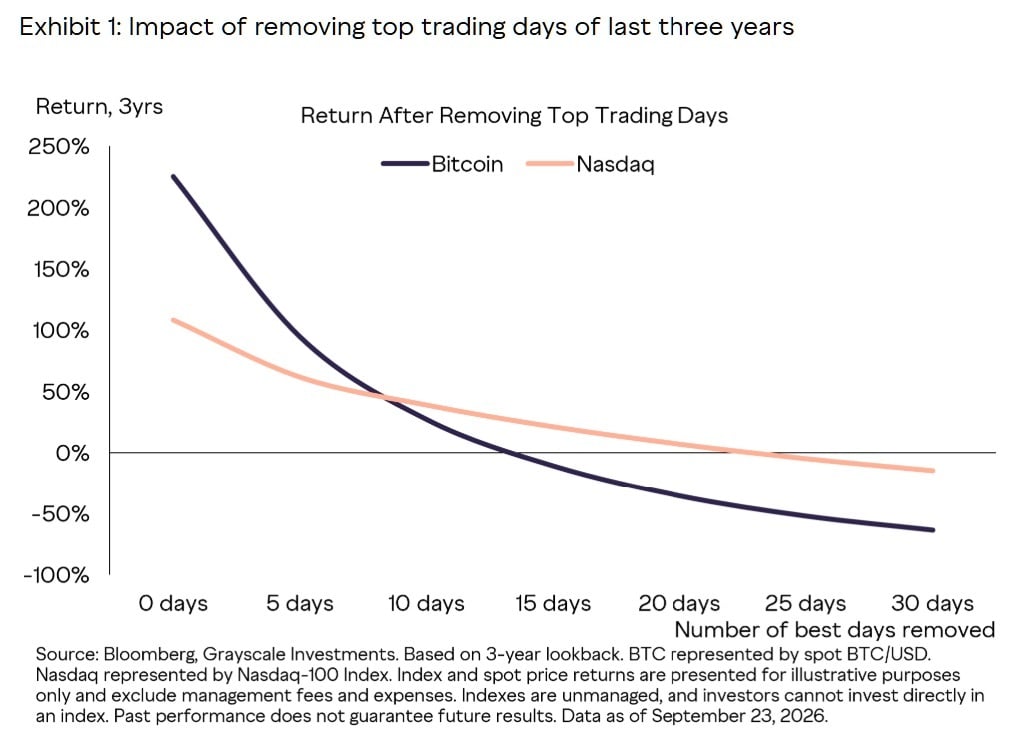
- Excluding the five top days reduces bitcoin’s three-year return to 95%.
- Removing the 10 strongest sessions leaves a cumulative gain of 27%.
- Grayscale favors consistent exposure over trying to time rallies.
Just 15 Days Separate Bitcoin’s Gain From a Loss
Missing bitcoin’s strongest rallies could substantially alter long-term investment results, an analysis published by Grayscale on Oct. 5 shows. Zach Pandl, head of research at the digital asset investment manager, examined the opportunity cost of remaining outside the bitcoin market in its research series The Stack. Opportunity cost here means potential gains missed while remaining uninvested.
Bitcoin (BTC) returned approximately 225% over the three-year period examined through Sept. 23. Excluding its five best trading days reduced the cumulative return to 95%. Without the top 10, the gain fell to 27%, while eliminating the strongest 15 days produced an 11% loss.
Pandl wrote:

“Investors waiting for volatility to subside or the outlook to become clearer may find that much of the repricing has already occurred.”
The calculation illustrates the impact of missing selected positive sessions while retaining the remaining daily price changes across the period. For a hypothetical $10,000 starting investment, a 225% return would produce $32,500 before costs, compared with $8,900 under the scenario excluding the top 15 days.
Waiting for Calm Can Mean Missing a Recovery
Attempts to avoid short-term losses can leave investors outside the market when prices rebound, a challenge extending beyond cryptocurrency. The Financial Industry Regulatory Authority (FINRA) explained that market timing involves shifting investments to anticipate short-term price movements. Strong sessions sometimes occur during turbulent periods, so an exit during a temporary sell-off risks missing the recovery.
That trade-off centers on volatility, which measures the extent of price fluctuations, rather than whether prices ultimately rise or fall. Grayscale’s sample illustrates the concentration: fewer than 0.5% of days provided enough upside that excluding them more than halved BTC’s cumulative gain.
Bitcoin’s measured volatility is also associated with ownership patterns, according to crypto analytics firm Glassnode’s Sept. 8 analysis. It identified long-term holder supply as the strongest explanatory variable for volatility among those examined. These are coins held for at least 155 days. The measure explained nearly 19% of variation after removing longer-term statistical trends, a relationship that does not establish causation.
Grayscale Favors Long-Term Exposure Over Market Timing
The concentration of past gains presents a separate question from how much the cryptocurrency might rise in future cycles. Cryptoquant founder and CEO Ki Young Ju on Sept. 22 projected threefold to fivefold cycle returns alongside a milder downturn. The crypto analytics firm executive’s forecast concerns potential performance, while Pandl’s calculation examines an observed period.
The investment vehicle can also change the price swings associated with exposure to a bitcoin-focused business. Michael Saylor’s comparison of bitcoin and Strategy securities showed different volatility profiles using a chart dated Oct. 2. Saylor is executive chairman of Strategy Inc. (Nasdaq: MSTR), the largest bitcoin treasury company with holdings valued in excess of $72 billon. Its shares introduce company-related risks distinct from owning the cryptocurrency directly.
Grayscale used BTC’s market price and the Nasdaq-100 Index, which tracks large nonfinancial companies listed on Nasdaq, excluding management fees and expenses. The equity benchmark’s gains were less concentrated: without its 15 best trading days, its three-year return declined from 109% to 21%.
Pandl argues that the strongest sessions cannot be reliably predicted, supporting the firm’s preference for consistent, long-term exposure among investors seeking capital appreciation. That approach captures rallies when they arrive while retaining exposure to declines.







Be the first to comment