



IMF Tokenization has been gaining momentum with the growth of financial markets on the blockchain. But legal issues, platform connectivity issues, and risks to financial stability might hamper the process of acceptance, claims the International Monetary Fund (IMF).
According to an analysis piece released by the IMF on Thursday, tokenization can increase the efficiency of financial markets with fast settlement times, fractional ownership possibilities, and trading outside regular market hours. Still, tokenized assets are significantly less regulated than those in conventional financial markets.
The IMF Tokenization report suggested the need for better regulation, improved interconnection of financial platforms, and enhanced protection to control risks, considering that blockchain-based assets would be increasingly used.
Also Read | Polkadot Launches dotUSD as DOT Price Outlook Gains Market Focus

IMF Tokenization Report Highlights RWA Market Growth
According to the IMF, tokenized RWA is now at $65 billion as of July. This is a very minor amount compared to the total capital market assets of $300 trillion in the world.
The tokenized credit products stood at $30.4 billion and the tokenized money market funds at $17.5 billion. The tokenized equities are estimated at $2.3 billion.
Tokenized repurchase agreements, or repos, also make up a large proportion of trading in tokenized markets. In such deals, securities are sold on the premise of buying them back in the future.
According to the IMF, tokenized repos transact in a daily amount of $300-$350 billion in volume. On the other hand, the total daily transactions done in the US repo market are roughly $13 trillion.
This indicates that there is room left for further growth of tokenization. As per the IMF Tokenization report, it would depend on the integration of blockchains into financial systems.
Tokenized Equities Attract Interest Through 24/7 Trading
Tokenized equities are drawing attention due to the possibilities of trading after the regular market closing time and the ability for investors to buy parts of a share.
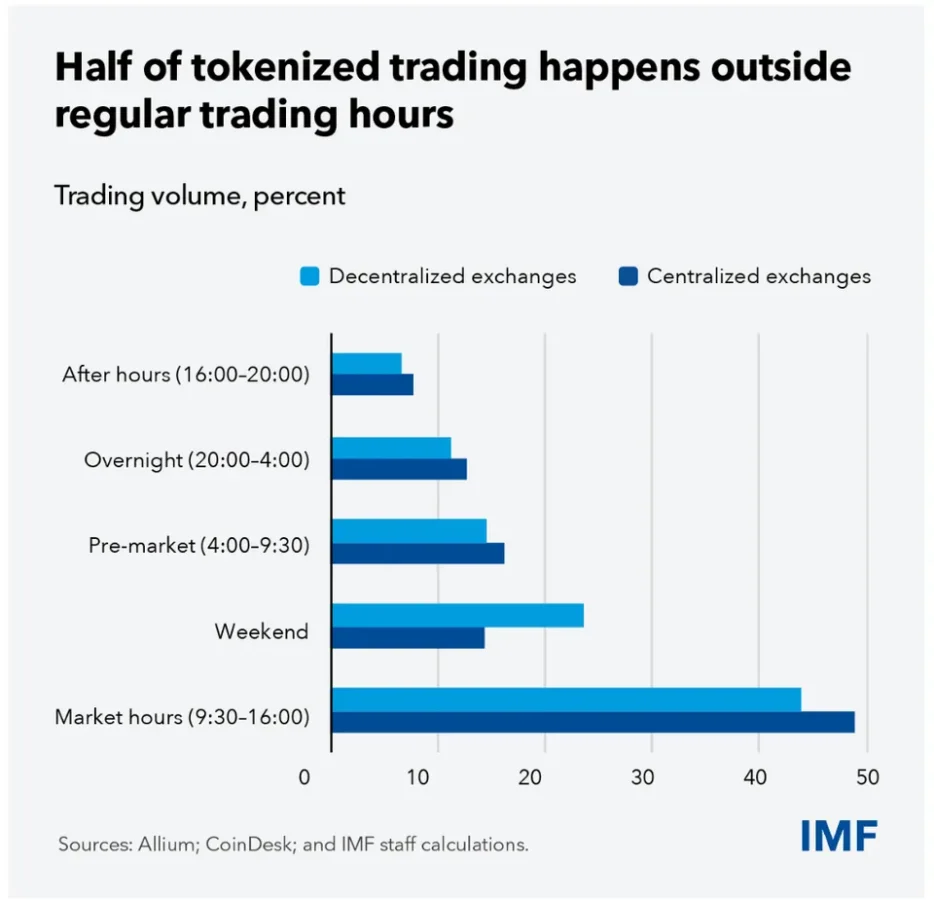
As noted by the IMF, more than half of all trading in tokenized equities took place outside normal US market hours. Approximately 80% of trades were for less than a whole share, indicating the desire to have the opportunity for fractional share purchasing.
Moreover, overnight price fluctuations of tokenized equities were reflected in the prices of the corresponding stocks right after the opening of the US market.
Tokenization also presented certain risks, as highlighted by IMF Tokenization results. Tokenized stocks were considerably less liquid than conventional stocks and experienced about 1.5 times higher realized volatility.
The fact is that illiquidity does not mean that it will be harder for an investor to buy or sell assets; however, it may imply higher risks in terms of price changes.
IMF Tokenization Warns of Financial Stability Risks
The IMF noted that increased integration of tokenized and conventional markets might lead to contagion of financial distress.
There are dangers of liquidation, withdrawal of liquidity, and financial contagion. There are fears that leverage might make such dangers even more significant because investors would have to liquidate their assets in case of price falls.
A quicker settlement will lower some risks in transactions, but it can also speed up financial instability as institutions will not have much time to react to disruptions in the market.
Currently, the IMF has noted that the systemic risks are still low, as the tokenized markets are small in size. But this could change as more people adopt tokenization.
Regulators Seek Clearer Rules for Tokenization
The IMF has made similar claims in earlier reports. For example, in November 2025, the IMF said that there is a risk of amplifying market volatility and causing sudden crashes due to automated trading and connected smart contracts. The report from April 2026 emphasized that the speed of settlements might make financial stress worse.
In September 2026, the European Securities and Markets Authority warned that enhanced integration between cryptocurrencies and traditional finance, including equity tokens, may result in more chances for financial shock spillovers.
However, on September 17, 2026, the US Securities and Exchange Commission launched a temporary Innovation Exemption in order to promote the trading of some tokenized stocks on selected on-chain platforms.
The IMF Tokenization report emphasized the need for legal clarity, interoperability, secure settlement assets, and coordination among regulators.
In other words, the IMF Tokenization forecast is not dependent only on technology. Legal certainty, sufficient liquidity, and protection will be crucial in the development of tokenized assets.
Also Read | Tokenized Assets: 1,473 Assets, $476M Value, $35B Market


Be the first to comment