


Zcash developers are targeting January 2027 for quantum-resistant payment support as the Zcash price trades near $1,240 following a steep weekly decline. The planned changes focus on transparent transactions, while shielded payments still need separate protection against future attacks.
Zakura engineer Roman Akhtariev outlined the schedule in an engineering update. Developers intend to add instructions that verify hash-based signatures for future payments. January remains a development target, not a confirmed mainnet activation date.
The Zcash price recovered from Thursday’s selloff on October 9. ZEC remained below its September peak near $1,700. Near $1,300, the Zcash price faced its next technical test.
How Will Zcash Protect Transparent Transactions?
For spending, transparent payment entails the use of cryptographic signatures. Current technology uses elliptic curve-based cryptography, which is secure against ordinary computing. Future quantum machines would constitute another threat by being able to decode private keys.
Also Read: Zcash ETF Crosses $1 Billion as Crypto Funds Enter Selective Phase
The Zakura proposal includes hash-based signature verification and one-time signatures like Winternitz One-Time Signatures. These use other assumptions in cryptography. This does not imply that Zcash has developed full resistance to quantum attacks.
Future quantum attacks may put at risk exposed public keys. The suggested instructions help deal with such future threats, not any real quantum attacks on Zcash wallets.
This proposal applies to most of the ZEC supply. ZecStats data from October 9 indicated 11.96 million ZEC in transparent wallets, or 70.4% of the total 16.98 million ZEC in circulation. Another 4.95 million were in shielded pools.
Ordinary transparent addresses hide public keys through the use of hashes. Spending from any transparent address exposes its public key and thus all coins controlled through this key. Creation of new addresses minimizes the threat since the keys are not yet known.
Akhtariev noted that extended public keys and viewing information should also be guarded against exposure since these might reveal even more wallet keys regardless of the address rotation. Rotation of addresses is not sufficient as a protective measure.
The Ironwood upgrade was introduced by Zcash on July 28. A new shielded pool and the supply verification features are included in this version. Other instructions for quantum recovery in the future are included in it as well.
Why Is Zakura Adding Private Wallet Queries?
The use of rotating addresses poses another challenge to wallets. Standard balance checking makes it possible for the server to find out the requested addresses. The private information retrieval system (PIR) by Zakura conceals the data that is requested from the server.
As mentioned by Akhtariev, wallets use this method in order to restore old transaction history. It might be necessary to restore transaction history even in the case of an empty address. PIR makes it possible to do it without disclosing any information about the addresses that are required.
The experimental version can be obtained using the Private Queries feature in the Vizor wallet. Transactions that are made using transparent payments are still visible on-chain.
Can the Zcash Price Recover Above $1,300?
The Zcash price is trading close to $1,240 on October 9 after falling close to $1,180. According to CoinGecko, there was a daily 2.5% gain on the recorded snapshot. At the same time, the token was trading more than 12% low on a weekly basis.
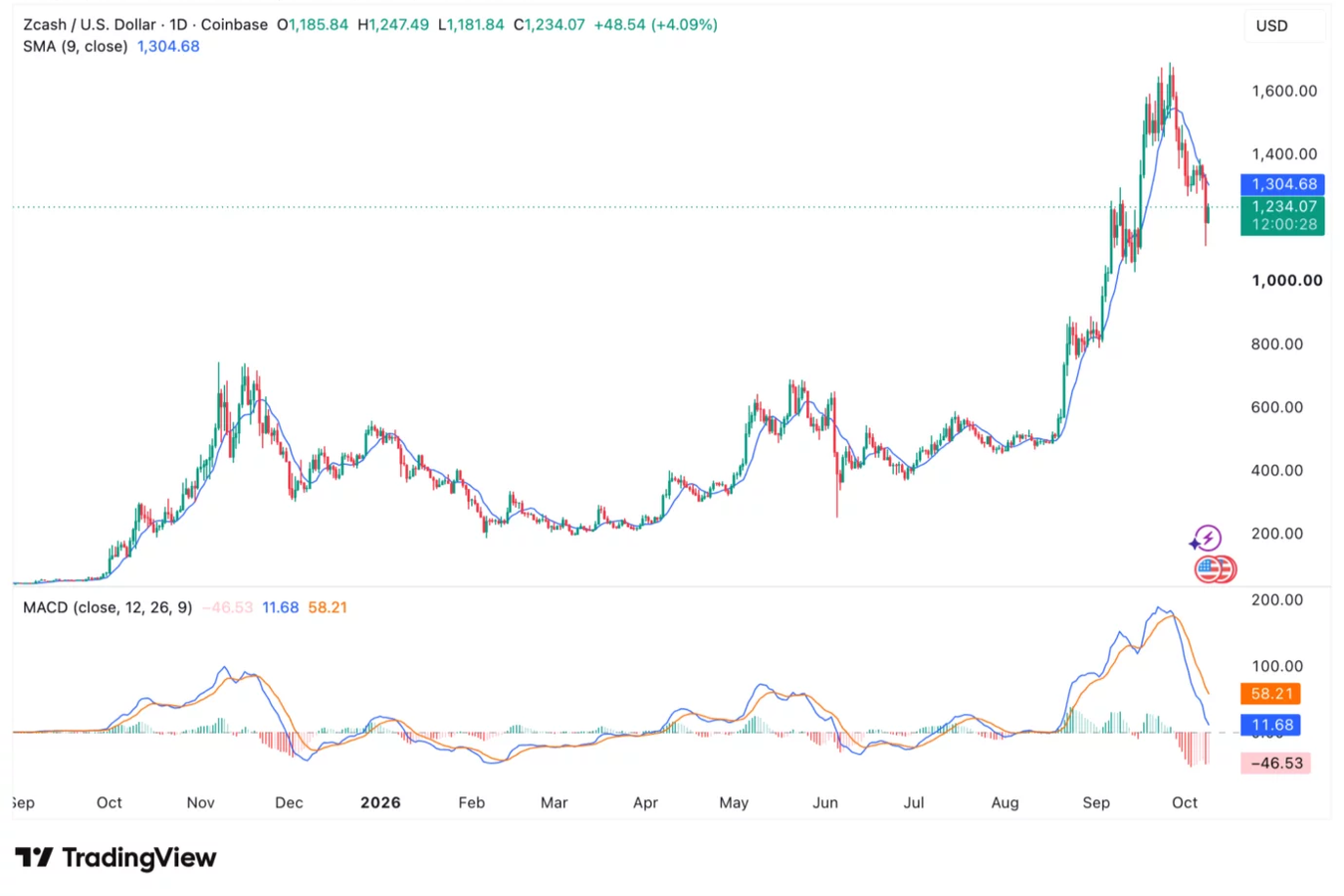
On a daily chart, ZEC was trading at $1,237.39, below the nine-day simple moving average of $1,305.05. The average served as a resistance level. The Zcash price remained below the series of lower highs.
Binance, on the other hand, reported that there was $1.5 billion in the daily trading volume and market cap of $20.8 billion on October 9. The figures represented the trading activity during the Zcash price recovery period.
According to crypto analyst Trader Symba, there were three areas of interest at 1,300–1,330, 1,350–1,370, and $1,430. The latter two were the higher targets. The areas were projections and not guarantees.
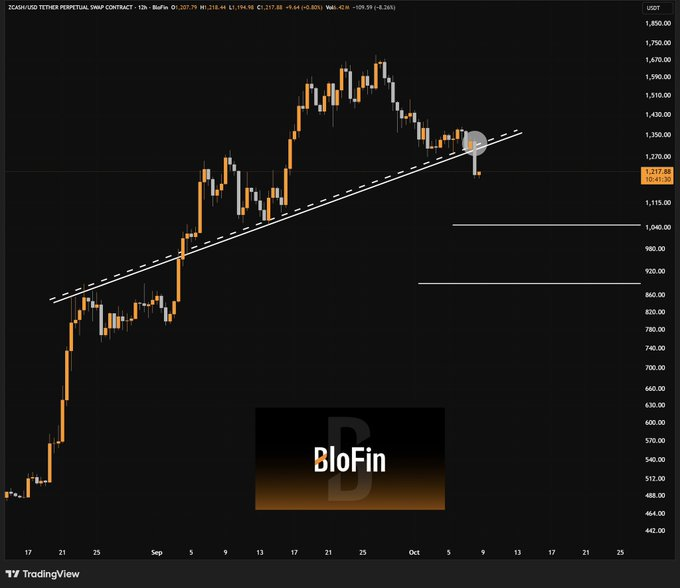
Symba further outlined 1,195–1,200, then $1,115, and 1,040–1,050 as the areas below the market. In addition, the moving average convergence divergence indicator on the chart gave a negative histogram of -46.32.
According to analyst More Crypto Online, the fall was a fourth-wave correction according to Elliott Wave analysis. The confirmation would be when there is a breakout above the preceding high, the analyst explained. At the moment, the Zcash price remains below the recovery areas.
At the moment, the quantum roadmap details the future work on the security of the network. There is no proof that links the plan to ZEC’s price recovery.
Also Read: Winklevoss Spot Zcash ETF Seeks SEC Approval for Nasdaq Debut
This article contains market analysis and price predictions. These are not guarantees. Crypto markets are volatile. Always DYOR. Not financial advice.



Be the first to comment