



Key Takeaways
- Papertrade has no traditional airdrop; PAPER tokens are minted when traders close losing positions or get liquidated.
- The initial emission rate is 100 PAPER per $1 lost while the liquidity pool remains below $2 million.
- PAPER holders can stake for USDC rewards, but tokens are initially non-transferable and trading losses are not reimbursed.
Disclaimer: Crypto airdrops are promotional events in which tokens are distributed to existing cryptocurrency holders or individuals who meet certain criteria. While airdrops can be a way to acquire tokens at no cost, they also involve risks. There’s no guarantee that the airdropped tokens will increase in value, and there may be associated fees or requirements. Airdrops can also be susceptible to scams and phishing attempts. Always exercise caution and verify the legitimacy of any airdrop opportunity before participating.
Papertrade has introduced one of the more unusual token distribution models in DeFi. Instead of rewarding users for trading volume, completing tasks or holding assets, the platform mints PAPER tokens when traders lose money.
The exchange launched on HyperEVM on October 10, 2026, offering Bitcoin and Ethereum perpetual futures with leverage of up to 1,000x. Traders who close eligible positions at a loss or get liquidated receive newly minted PAPER tokens based on their losses.
However, Papertrade’s documentation explicitly states that there is no airdrop. PAPER is distributed through trading losses, not through a free token campaign.
The tokens can be staked for a share of protocol revenue paid in USDC, but they cannot initially be freely transferred or sold on exchanges.
What Is Papertrade?
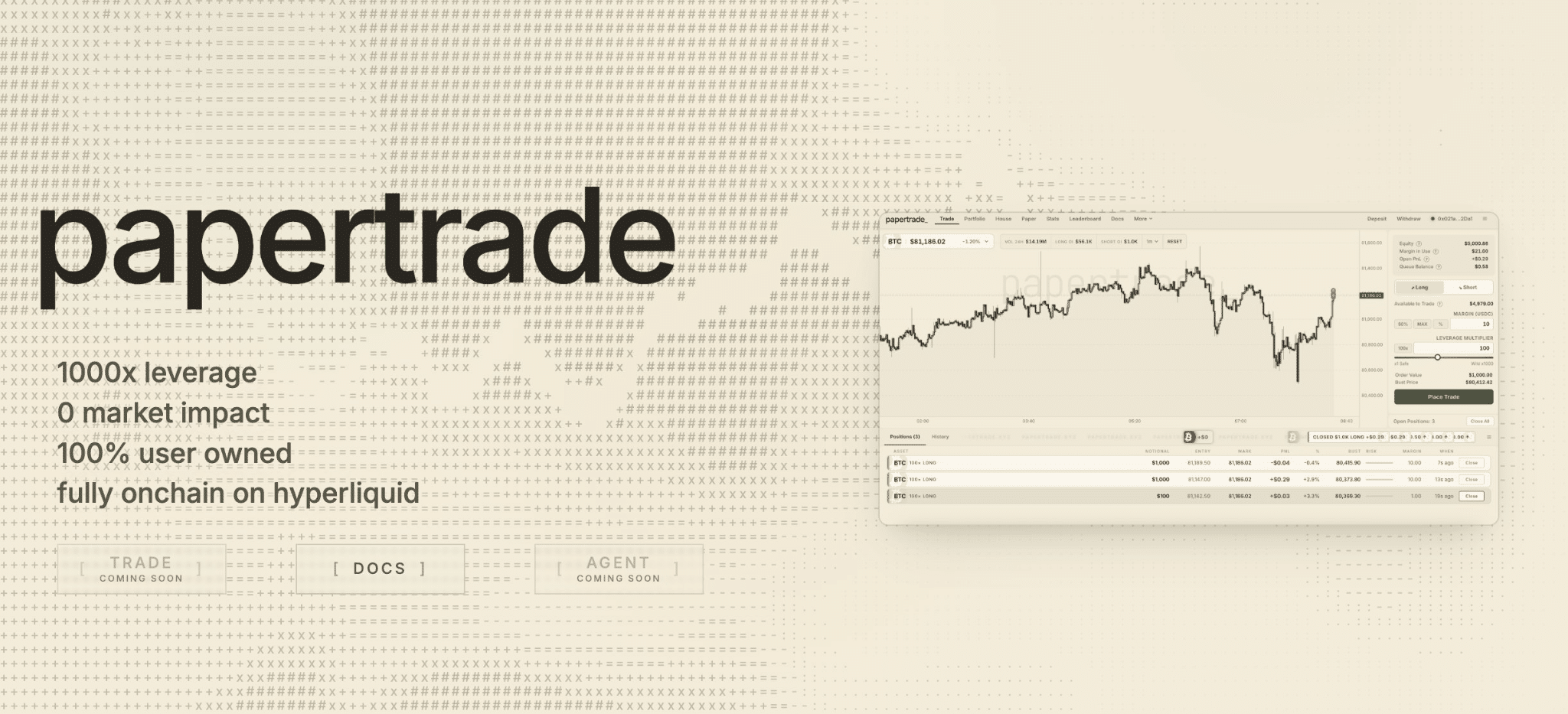
Papertrade is a fully onchain synthetic perps exchange built on HyperEVM, the smart contract environment associated with Hyperliquid.
The platform lets users trade Bitcoin and Ethereum perpetual contracts using USDC as collateral, with leverage up to 1,000x.
Unlike conventional perpetual exchanges that match buyers and sellers through an order book, Papertrade uses a shared liquidity pool as each trade’s counterparty.
When traders lose money, their losses increase the protocol’s liquidity pool. When traders profit, they are paid from that pool.
Papertrade uses Hyperliquid’s order book prices as a reference, but executes and settles trades through its own contracts rather than as positions on Hyperliquid. Its main features include the following:
- Up to 1,000x leverage on BTC and ETH perpetuals.
- No conventional order book slippage.
- No recurring funding fees.
- USDC collateral and settlement.
- PAPER tokens minted from realized trading losses.
- PAPER staking for USDC revenue distributions.
The platform does not charge a standard fee based on total trade size. Instead, profitable trades are subject to adjustments that reduce the trader’s final payout, followed by a 2% fee on the adjusted gain.
Papertrade Funding and Team
Papertrade was founded by two traders known as Jez and Blurr.
Jez has also been identified in project-related coverage as Colin Hong, who previously worked at Morgan Stanley and Standard Crypto.
The project has not announced a traditional venture capital funding round.
According to its documentation, PAPER launched without a pre-mine, team allocation or venture capital allocation.
The liquidity pool also began without an upfront funding contribution from the founders.
| Project Detail | Information |
| Project | Papertrade |
| Blockchain | HyperEVM |
| Product | Synthetic perpetual futures exchange |
| Initial markets | BTC and ETH |
| Maximum leverage | 1,000x |
| Native token | PAPER |
| Token distribution | Minted through realized trading losses |
| Team allocation | None |
| Venture capital allocation | None |
| Launch date | October 10, 2026 |
Table 1. Papertrade Project and Token Details
The available source material does not establish a published independent smart contract audit or a fully verified operating legal entity.
Is the Papertrade Airdrop Confirmed?
No. Papertrade does not have a conventional airdrop. Instead, PAPER is minted whenever a trader closes an eligible position at a loss or gets liquidated.
There is no separate points campaign, deposit reward or confirmed token distribution for users who simply connect their wallets.
| PAPER Distribution Detail | Status |
| PAPER token | Launched |
| Traditional airdrop | None |
| Points campaign | None |
| Premine | None |
| Team or VC allocation | None |
| Token minting | Realized losses and liquidations |
| Initial minting rate | 100 PAPER per $1 lost |
| Token transfers | Restricted at launch |
| Staking rewards | USDC |
| Exchange trading date | Not announced |
Table 2. Papertrade Token Distribution Status
How to Be Eligible for the Papertrade Airdrop?
There is no airdrop eligibility requirement because Papertrade has not announced an airdrop.
To receive PAPER through the existing mechanism, users must trade on Papertrade and close an eligible position at a realized loss or be liquidated.
The protocol then mints PAPER based on the eligible loss and the current emission rate.
Depositing USDC alone does not generate PAPER.
Profitable trades also do not mint PAPER, and the protocol has not announced a separate farming program for referrals or social tasks.
How to Participate in the Papertrade Token Distribution
Papertrade’s token distribution is built directly into its trading system. The following steps explain how the mechanism works, but we do not recommend deliberately losing money or using excessive leverage to acquire PAPER.
Visit the Official Papertrade Exchange
Open the official Papertrade exchange.
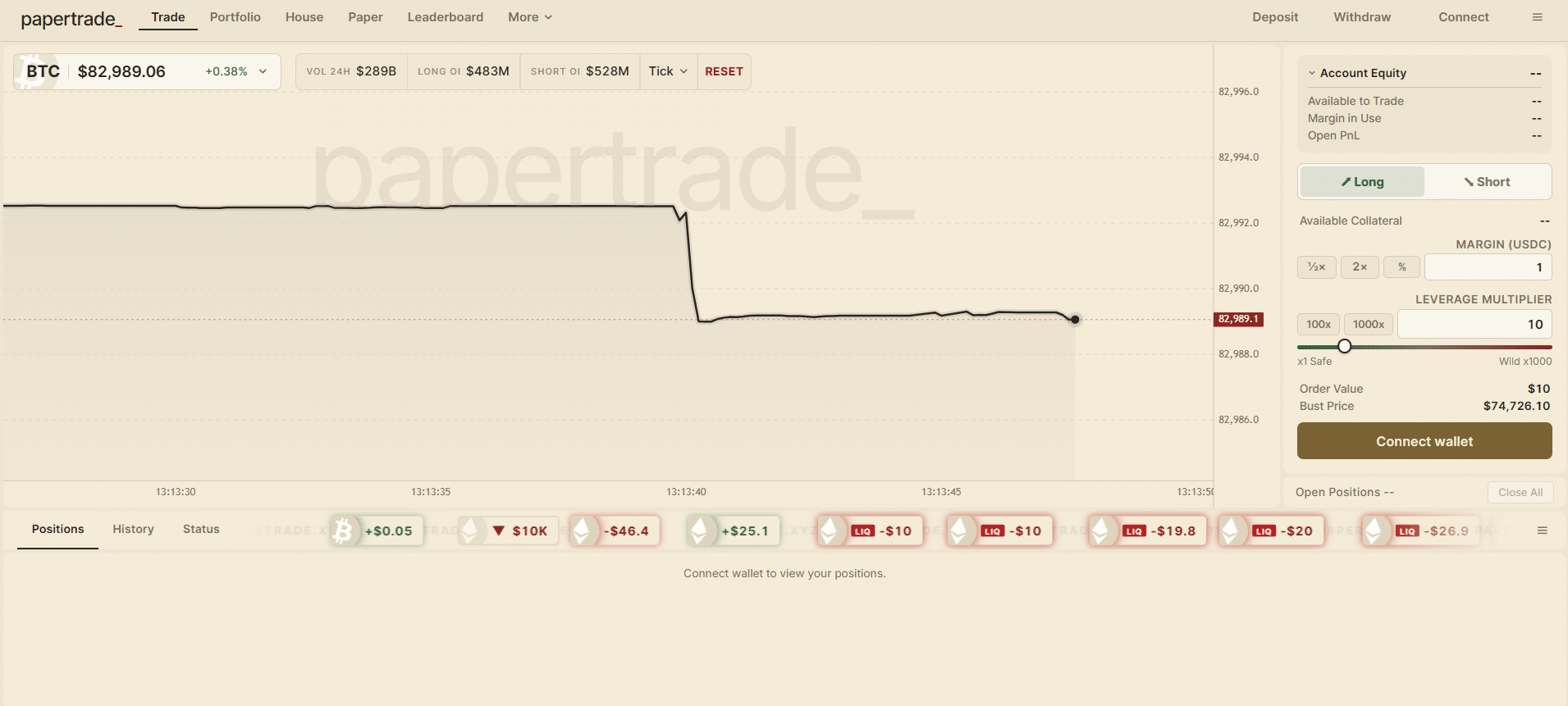
Connect a supported Ethereum Virtual Machine (EVM) wallet.
The platform uses a session-key system that allows subsequent trades to be placed without requiring a new wallet signature for every action.
Before connecting, verify you are on the correct website. The official project domain is papertrade.xyz, and its official X account is @papertrade_xyz.
Deposit USDC
Select Deposit from the trading interface and choose a supported deposit route.
Papertrade accepts deposits through supported networks including HyperEVM, Hyperliquid, Ethereum, Arbitrum and Solana, depending on the available application routes.
The minimum deposit is 10 USDC, with a one-time 1 USDC account activation fee.
Make sure the required minimum arrives after applicable fees.
Importantly, make deposits through the application’s supported flow rather than by directly transferring tokens to an unfamiliar contract address.
Open a BTC or ETH Perpetual Position
Once your account is funded, choose Bitcoin or Ethereum from the available markets.
Select Long or Short, enter the margin amount and choose the desired leverage.
The platform supports leverage up to 1,000x, but using the maximum leverage leaves very little margin for adverse price movement.
According to the platform’s documentation, a position using 1,000x leverage can be liquidated after a price movement of approximately 0.052% against it under the stated settings.
Each position uses isolated margin, meaning liquidation can result in the loss of the entire margin committed to that trade.
Understand How PAPER Tokens Are Minted
When an eligible position closes at a loss, Papertrade automatically mints PAPER tokens to the trader’s account. The initial emission schedule provides 100 PAPER for every $1 of eligible realized loss while the liquidity pool is below $2 million.
However, the emission rate decreases as the liquidity pool grows above that threshold. For example, under the initial 100 PAPER rate:
| Eligible Trading Loss | PAPER Minted |
| $1 | 100 PAPER |
| $5 | 500 PAPER |
| $10 | 1,000 PAPER |
| $50 | 5,000 PAPER |
| $100 | 10,000 PAPER |
Table 3. PAPER Token Minting Examples at the Initial Emission Rate
These are examples of the initial formula, not guaranteed current rewards.
Users should check the PAPER dashboard for the applicable emission rate before interpreting any trading activity.
Crucially, receiving PAPER does not recover the USDC lost in the trade. The token is initially non-transferable and has no established liquid market price.
Check Your PAPER Balance
Open the PAPER dashboard inside the exchange. Users can review their accumulated tokens, minting history and the current emission rate.
Since PAPER starts with zero supply and new tokens are created through trading losses, the total supply changes as users trade.
The number of PAPER tokens issued per dollar also depends on the size of the protocol’s liquidity pool.
Stake PAPER for USDC Rewards
Open the PAPER staking dashboard.
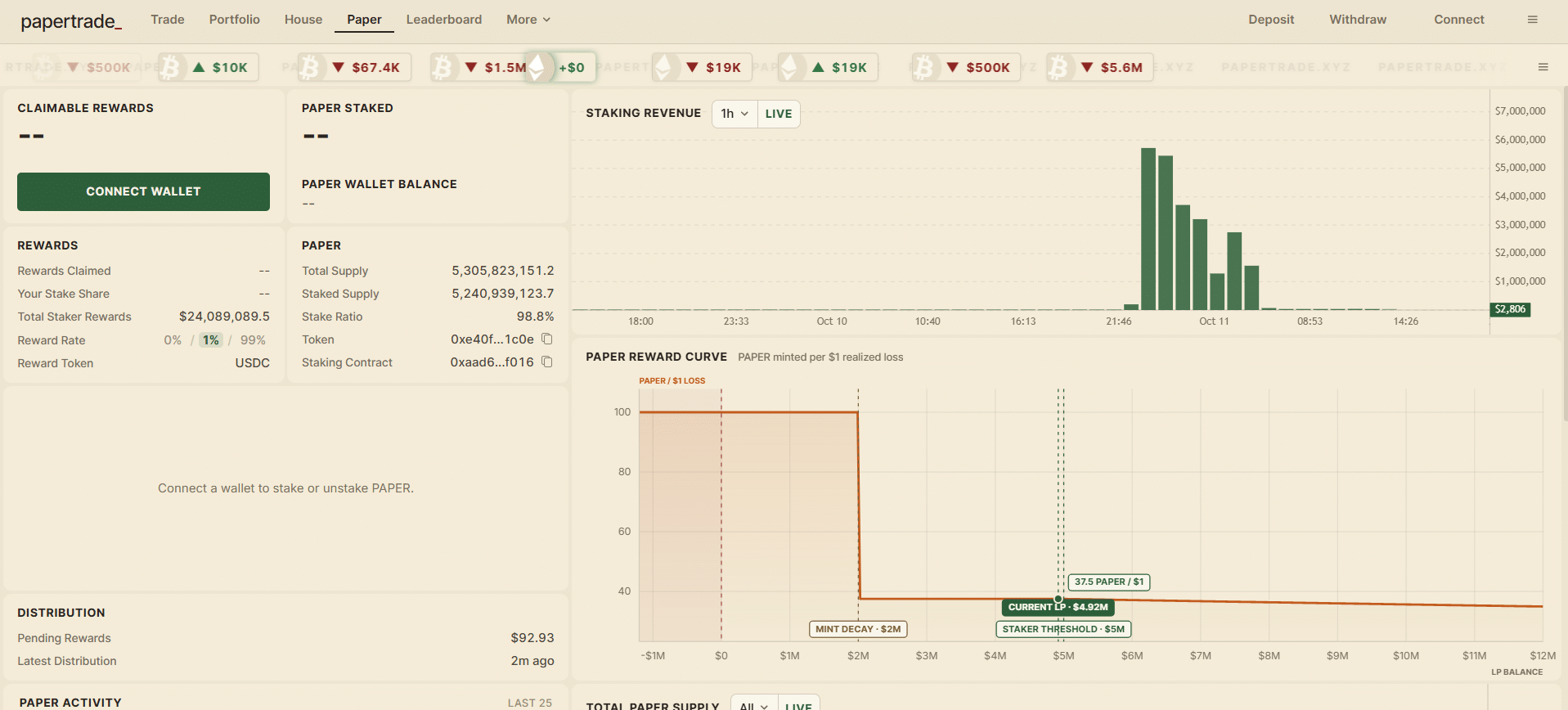
Select the amount of PAPER you want to stake and confirm the transaction.
PAPER stakers can receive USDC distributions funded by protocol revenue.
According to the project’s distribution model, staking rewards include 50% of protocol fees and qualifying excess liquidity above the pool’s $5 million cap.
The other half of the protocol’s applicable trading fees goes to the development fee recipient.
Rewards vary and depend on trading activity and the protocol’s financial performance, rather than a guaranteed annual percentage yield (APY).
Monitor Liquidity and Rewards
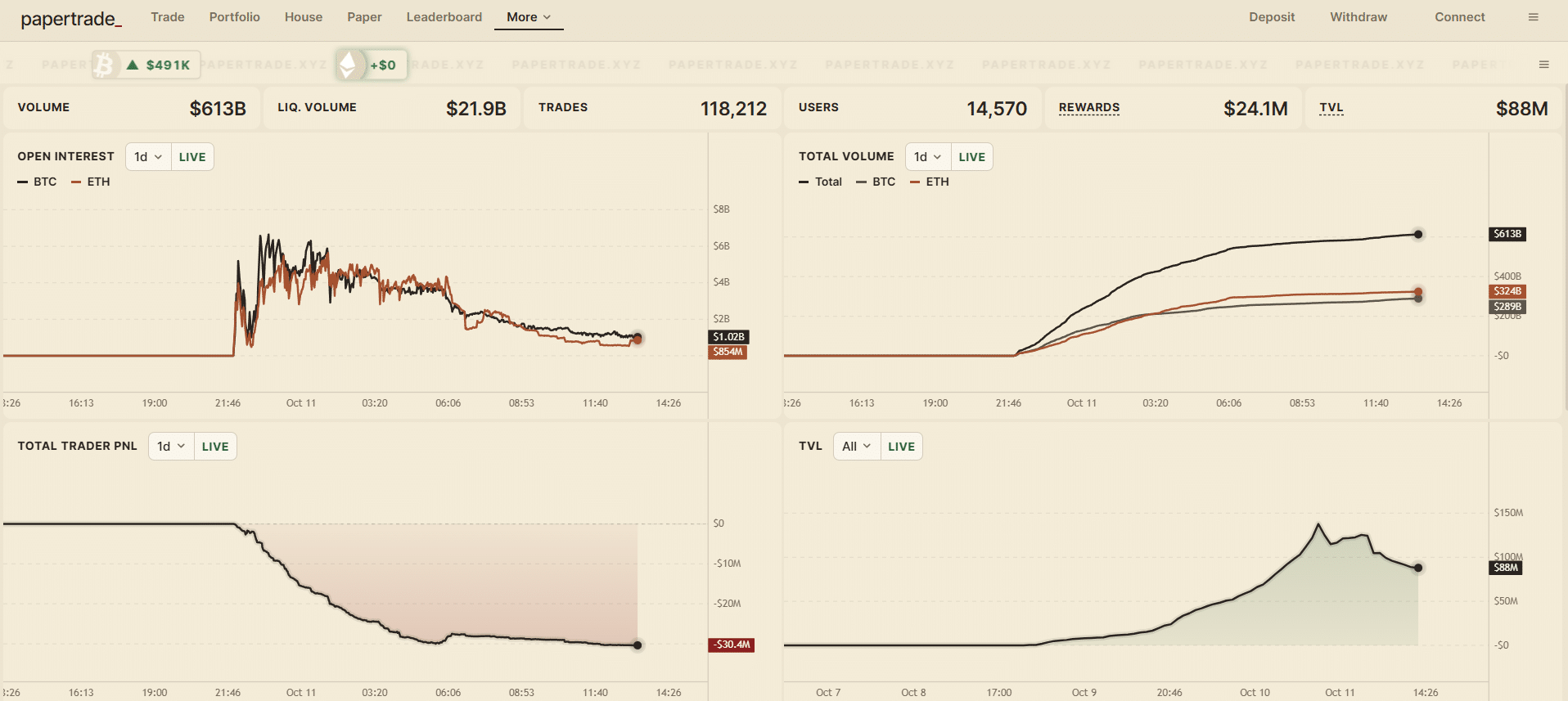
Papertrade provides a statistics dashboard for tracking trading volume, open interest and liquidations.
Users can also monitor the House dashboard to see available liquidity and outstanding settlement obligations.
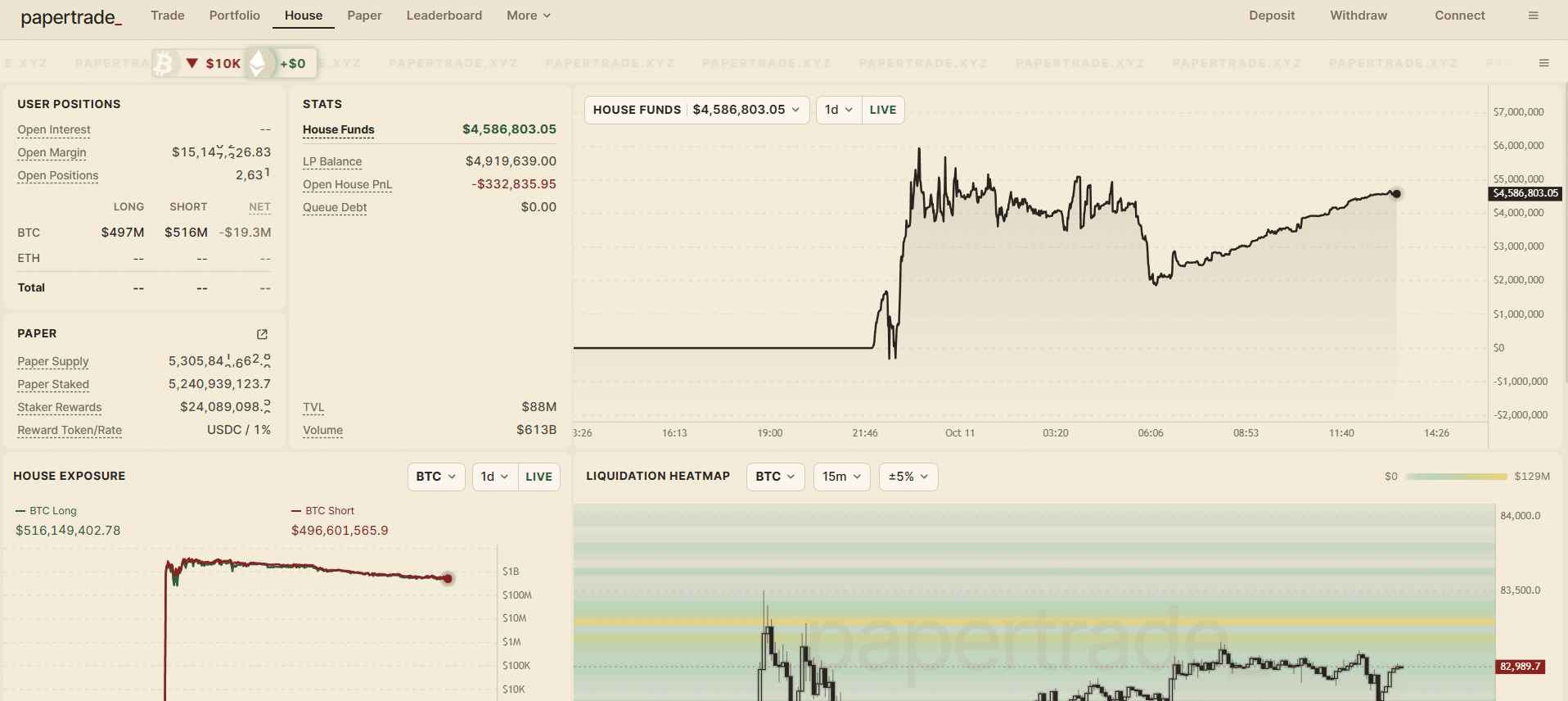
This information matters because Papertrade pays profitable positions from its shared liquidity pool.
If the pool cannot cover the full profit owed to a winning trader, the unpaid amount can enter a first-in, first-out settlement queue, meaning a profitable position does not necessarily grant immediate access to all gains.
How Does the PAPER Token Work?
PAPER is designed around an unusual idea: traders who lose money receive tokens that represent a claim on future protocol distributions through staking.
The protocol starts with no PAPER supply, and tokens only enter circulation when qualifying trading losses occur.
Unlike conventional token launches, there is no initial sale, pre-mine, or allocation reserved for the development team. However, PAPER is not currently freely tradable.
At launch, transfers between wallets are disabled. PAPER can be staked and unstaked, but the project has not announced when unrestricted transfers or exchange trading will begin, creating a major valuation problem for anyone attempting to farm PAPER by trading at a loss.
A trader can calculate exactly how much USDC was lost, but cannot reliably determine the dollar value of the PAPER received without a liquid market and predictable future distributions.
How Do PAPER Staking Rewards Work?
PAPER staking is the main stated utility of the token. Stakers can earn USDC from two sources:
- Half of the protocol’s applicable trading fees.
- Excess liquidity above the protocol’s $5 million pool threshold, subject to its distribution rules.
The model attempts to give PAPER holders exposure to the protocol’s trading activity. However, this is not the same as receiving a refund for losing trades.
A trader who loses USDC receives PAPER, but whether staking those tokens eventually generates enough USDC to offset the original loss depends on the amount staked, total staking participation and future revenue.
Why Does Papertrade Offer Up to 1,000x Leverage?
The platform allows highly leveraged synthetic positions because every trade settles against its own liquidity pool, not a traditional order book.
However, that structure does not eliminate trading losses. At 1,000x leverage, even a small adverse price move can trigger liquidation and wipe out the entire isolated margin.
The exchange also adjusts profitable trades. While it advertises zero conventional slippage and no funding fees, its payout mechanism reduces winning gains through price adjustments and a 2% fee.
For example, the documentation’s launch settings indicate that a winning trade may retain substantially less than its raw calculated gain after the adjustments. Consequently, don’t confuse zero slippage with cost-free trading.
What Are the Main Risks of Trading on Papertrade?
Papertrade introduces several risks beyond those found in a typical airdrop campaign.
Extreme Leverage and Liquidation
Leverage of up to 1,000x can liquidate positions after very small price movements. PAPER received from liquidation should not be treated as compensation for the entire margin lost.
Unknown PAPER Market Value
The token is initially non-transferable, and no unrestricted trading date has been announced. Users cannot assume newly minted PAPER can be sold at a profitable price.
Liquidity Pool Risk
The shared liquidity pool pays winning trades. If available liquidity is insufficient, profits may enter a settlement queue.
Smart Contract and Administrative Risk
Papertrade’s source material describes upgradeable contracts and administrator-controlled functions. No independently published audit was established in the supplied research.
Uncertain Revenue Distributions
Staking rewards depend on actual protocol activity and distribution conditions. High early rewards do not guarantee that similar payouts will continue.
Impersonation and Fake Tokens
Lookalike accounts and unofficial token promotions have circulated around Papertrade. Users should verify the official website and X account before connecting a wallet.
Final Thoughts: Is Papertrade Worth Farming?
Papertrade is not worth deliberately losing money on simply to accumulate PAPER.
Its loss-based distribution is unusual, and staking tokens for USDC gives PAPER defined utility. However, traders must risk real capital to receive the tokens, while their future market value remains unknown.
The platform may interest experienced derivatives traders who understand its settlement model, but beginners and users seeking free airdrops should approach it with particular caution. At 1,000x leverage, liquidation can happen after an extremely small price movement.
For campaigns that do not require intentionally losing money, explore our crypto airdrops page.
Frequently Asked Questions
Need a refresher? Here are the questions most readers ask about Papertrade, PAPER tokens and the protocol’s unusual distribution model.
Is the Papertrade Airdrop Confirmed?
No. Papertrade’s official documentation explicitly states that there is no airdrop. Instead, PAPER is minted through realized trading losses and liquidations.
How Do You Earn PAPER Tokens?
Users receive PAPER when eligible BTC or ETH perpetual positions close at a loss or are liquidated. The initial emission rate was 100 PAPER per $1 lost while the liquidity pool was below $2 million, with declining emissions as the pool grows.
Can You Earn PAPER Without Losing Money?
Under the initial distribution rules, there is no separate way to earn for free. Deposits, referrals, social tasks and profitable trades do not independently mint PAPER.
Can You Sell PAPER Tokens?
Not under the initial launch restrictions. PAPER transfers are disabled except for staking-related functions, and the project has not announced when unrestricted transfers or exchange trading will begin.
Are PAPER Staking Rewards Guaranteed?
No. PAPER stakers can earn USDC from applicable protocol fees and excess liquidity distributions, but rewards depend on trading activity, available liquidity and the amount of PAPER staked. There is no guaranteed APY.



Be the first to comment