



The Ethereum price stood at $2,504 on Sunday afternoon, or 2,237 euros. Over 24 hours that is a move of three dollars, 0.15 percent. The real movement this time sits in the block data rather than the chart: the base fee per unit of gas, the minimum price every Ethereum transaction has to pay, averaged 0.0673 gwei over the past 24 hours. Across the past seven days the average was 0.4210 gwei. The network is running at a sixth of last week’s price.
There are two sides to that if you hold ether. Sending ether costs a fraction of a cent today, so whoever already planned to move holdings off an exchange and into their own wallet is paying about as little as they ever will. At the same time the network’s ether consumption, which normally offsets part of the new issuance, has all but disappeared. Both effects belong together, and both are set out below with figures.
Ethereum price $2,504: the daily range narrows to 0.63 percent
Today’s low of $2,495.23 and high of $2,510.93 are $15.70 apart, which is 0.63 percent. Compare that with the four trading days before, measured on the daily candles of the Coinbase exchange: October 8 spanned 7.53 percent, October 7 spanned 6.48 percent, October 9 still spanned 1.99 percent and October 10 spanned 1.34 percent. The range has contracted on four consecutive days, and today is the tightest session since October 6.
Across the full rolling 24-hour window, which takes in yesterday evening as well, the range runs from $2,495.23 to $2,517, or 0.87 percent. A market moving that little either has no trigger or is waiting for one. This week brings the US consumer price release on Wednesday.


The base fee per gas stands at 0.0673 gwei
Gas is the unit in which Ethereum measures the work a transaction requires. A simple ether transfer consumes 21,000 gas, whatever the amount sent. The base fee is the price per unit of gas that the protocol sets itself, measured in gwei, or billionths of an ether. That price moves from block to block with network load.
The figures for the past 24 hours, taken from the block data at ultrasound.money on October 11: an average of 0.0673 gwei, a lowest block of 0.0510 gwei and a highest block of 0.1551 gwei. The weekly average is 0.4210 gwei and the monthly average 0.3812 gwei. Since the base fee was introduced in August 2021, the average has been 18.827 gwei.
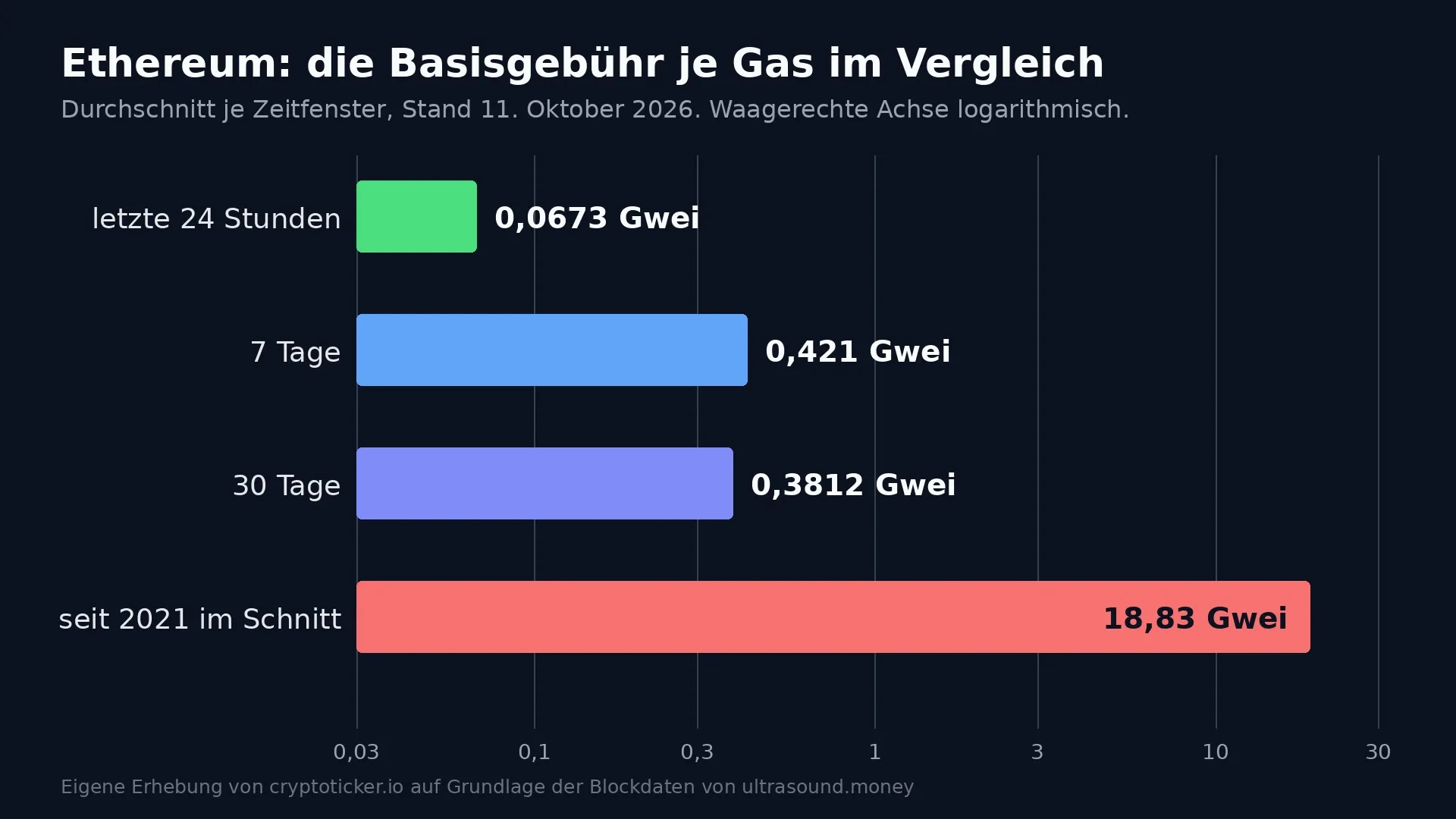
The live reading sits a little above the daily average: an Ethereum node queried directly reported a gas price of 0.077 gwei on Sunday afternoon, which is the base fee plus the customary tip to the validator. The all-time low for the base fee is 0.0087 gwei, set in block 23,937,362. The network is some way off that, but the gap to its own monthly average is considerable.
Half-empty blocks push the base fee down automatically
The base fee follows a fixed rule from the protocol change EIP-1559, in force since August 2021. If a block is more than half full, the base fee for the next block rises by up to 12.5 percent. If it is less than half full, it falls by up to 12.5 percent. The rule can be read in the text of the change itself at eips.ethereum.org. A fee of 0.0673 gwei therefore means one thing only: blocks have been running half empty on average for days.
That is demand at work rather than a defect. Little trading on decentralised exchanges, little movement in stablecoins, little minting and selling of NFTs: each of those activities fills blocks. Take them away and gas costs next to nothing. The narrow price action above and the cheap fee here are two readings of the same thing.
The burn now offsets just 0.49 percent of new issuance
The base fee never reaches the validator. It is destroyed instead, and that burn is the reason the ether supply can shrink when the network is busy. At 0.0673 gwei, very little of it accumulates.
Measured on October 11: 0.0102 ether per minute was burned over the past 24 hours. The seven-day average is 0.0636 ether per minute and the monthly average 0.0569. Annualised, today’s figure gives 5,365 ether burned against 1,087,004 ether issued to validators. The burn offsets 0.49 percent of that. On the weekly average it was 3.07 percent, on the monthly average 2.77 percent.
Supply is growing at 0.886 percent a year as a result. In absolute terms, read from the same source: the ether supply stood at 122,116,611 ether at 14:43 on October 10 and at 122,119,572 at the same time on October 11. That is a net addition of 2,960.61 ether in 24 hours. At a price of $2,504 that amounts to roughly $7.4 million of new supply in a single day.

Some context, so the number does not look bigger than it is: 0.886 percent annual growth is low by historical standards. Under the old mining regime, issuance would run at 4,930,875 ether a year and growth at 4.03 percent. The switch to proof of stake in September 2022 removed most of the dilution, and the burn was always the fine adjustment on top. Judging the situation by slogans such as ultra sound money measures the wrong quantity.
The staking queue since October 10
Our report yesterday recorded that the buffer in the staking entry queue had shrunk by 252,402 ether, at a price of $2,507. The price has moved three dollars lower since then, and today’s narrow range shows that no direction has come of it. The $2,500 mark, which fuelled the debate as recently as October 9, has held in both directions for three days.
What is new in the 24 hours in between is set out above: the base fee has fallen to a sixth of the weekly average, and the burn with it. Whoever tracks the ether supply has one more figure on the list, and it points the opposite way to the staking queue. The queue locks ether up, while the low fee leaves more of it in circulation.
0.077 gwei in euros: what a transfer costs today
Converting the daily average of 0.0673 gwei into money, at $2,504 and 2,237 euros per ether:
- A simple ether transfer at 21,000 gas: 0.00000141 ether, around 0.35 US cents or 0.32 euro cents.
- A transfer of an ERC-20 token such as a stablecoin, roughly 65,000 gas: around 1.1 US cents.
- A swap on a decentralised exchange, roughly 150,000 gas: around 2.5 US cents.
The gas figures for the token transfer and the swap are guide values; actual consumption depends on the contract. The price per gas, by contrast, is measured. For comparison: at the all-time average of 18.827 gwei the same simple transfer would have cost around 99 US cents, and at the weekly average around 2.2 cents.
Network fees before you send: what you can do now
A low network fee changes nothing about whether ether is a good buy. Cheap gas only changes the cost of a transaction you intended to make anyway. Three cases where it counts in practice today:
Moving to self-custody. Pulling holdings off an exchange to hold them yourself costs fractions of a cent on the chain right now. The catch lies elsewhere: exchanges often charge a flat withdrawal fee of their own, independent of the network and untouched by the cheap gas. Check your exchange’s withdrawal fee before you rely on the gas price. Which venues charge what is set out in our crypto exchange comparison, and which device makes sense for custody is compared in our hardware wallet comparison.
Tidying up your holdings. If small amounts have accumulated on several addresses over the years, consolidating them normally costs more than the remainders are worth. At 0.077 gwei that calculation shifts. Work out before each transaction whether the sum carries the effort.
Pending contract business. Revoking a contract approval or unwinding a staking arrangement is cheaper today than on the weekly average. That is no reason to rush it, and a good reason to stop putting it off.
Holding period and proof when moving to your own wallet
For investors in Germany, the one-year rule under section 23 of the Income Tax Act still applies to private disposals: hold crypto assets for more than a year before selling and the gain carries no income tax. The Bundestag rejected scrapping that period on October 9, 2026 by 445 votes to 132, as we reported the same day.
What counts in practice when moving between your own addresses is the paper trail. The tax authorities expect transfers between an investor’s own addresses to be documented, so that the acquisition date and the acquisition cost can be assigned later. If you use today’s cheap gas to move holdings, the safest course is to save the transaction hash, the date and time and both the source and the destination address straight away. Which tools record that automatically is set out in our overview of crypto tax software and portfolio trackers. The individual case remains a matter for a tax adviser.
Three levels decide the range: $2,495, $2,517 and $2,555
The nearest level below is $2,495.23, today’s low, which also sits just under the round $2,500 threshold. If it gives way, the weekly low of $2,404.60 from October 8 is the next stop, more than four percent lower.
Above, the 24-hour high of $2,517 caps the narrow band the price has held since Friday. Beyond it, at some distance, lies the 50-day line, which runs at $2,555.47 on the daily closes of the past 50 trading days, around two percent above the current level. The weekly high of $2,737.55 from October 4 is 9.3 percent away.
Far below runs the 200-day line at $2,133.72. The gap of 17.4 percent to the upside shows that the longer-term trend is intact despite a weak week. All four values are calculated from the daily candles of the same exchange, as of October 11.
Our view: cheap gas is no buy signal
In the editorial team’s view, the low network fee will turn up in some coverage over the coming days as a good sign for ether. The figures above argue against it. A base fee of 0.0673 gwei arises because blocks are half empty, which is to say because little is happening on the chain. It is evidence of weak demand, not strong. The burn falls in the same move to 0.49 percent of new issuance, which leaves the supply side growing less restrained than it was the week before.
On the other side of the ledger, a cheap chain makes the network easier to use, and 0.886 percent annual growth is still modest next to the 4.03 percent of the old mining regime. Direction will be settled elsewhere in any case: in fund inflows, in Wednesday’s US consumer prices, and in whether the $2,495 mark holds. The fee is a thermometer rather than an engine. The reading tells you how warm it is, and nothing about where the price is going.
Network fee at 0.077 gwei: cheap only if you had a reason to send
Three steps to make use of today’s situation without taking a directional bet:
- Check the withdrawal fee, not just the gas price. The chain costs less than a cent, the exchange often a multiple of it. Which venues levy which flat fee is set out in the crypto exchange comparison.
- Settle custody before you send. A transfer to an address whose keys you do not securely hold is no progress at all. The devices in the hardware wallet comparison differ above all in recovery.
- Keep the records as you go. The transaction hash, the timestamp and both addresses belong in your archive while they are still to hand. Tools that record this themselves are listed in the overview of tax software and portfolio trackers.
(As of October 11, 2026. This article is not investment advice. Prices and fee structures change; check the terms with the provider before you buy.)



Be the first to comment