



3. Polygon Bridge
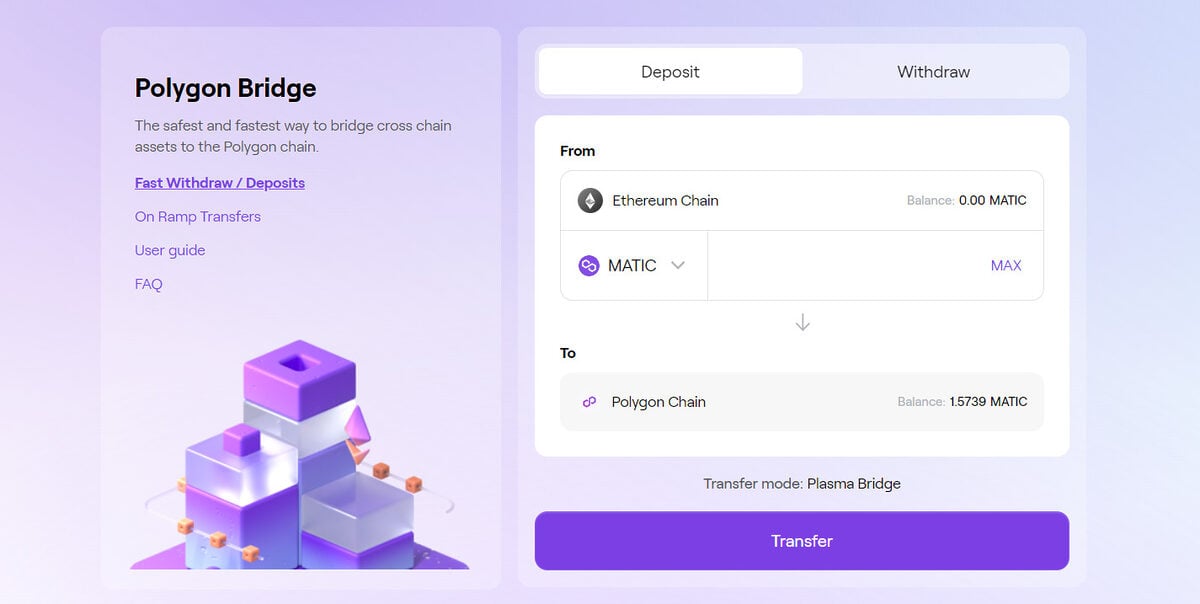
The Polygon bridge provides access to the native Polygon PoS bridge, which enables users to transfer supported assets between Ethereum and the Polygon PoS network. The native bridge locks assets on the source network and releases corresponding pegged assets on the destination network; transfers in the opposite direction burn the pegged assets and release the original assets.
Sponsored
Crypto Prediction Markets

18+ · Gambling involves risk. Play responsibly.
An important change concerns Polygon zkEVM. Its Mainnet Beta sequencer was shut down on July 3, 2026, and the network no longer produces blocks. Withdrawals through the Agglayer Bridge are no longer available. Users with eligible assets held in self-custodied wallets can use Polygon’s dedicated claims interface to recover them on Ethereum, subject to the applicable restrictions.
Key Takeaways
-
-
Provides the native bridge between Ethereum and Polygon PoS.
-
Supports transfers of eligible assets between the two networks.
-
Polygon zkEVM Mainnet Beta is no longer active and must not be presented as a supported bridge destination.
-
Supported networks for the native bridge: Ethereum and Polygon PoS.
-
4. Avalanche Bridge
Designed by AvaLabs and Core, the Avalanche Bridge serves various functions. Not only does it facilitate the transfer of assets between the Avalanche C-Chain and other networks like Bitcoin and Ethereum, but it’s also used internally within the Avalanche ecosystem.
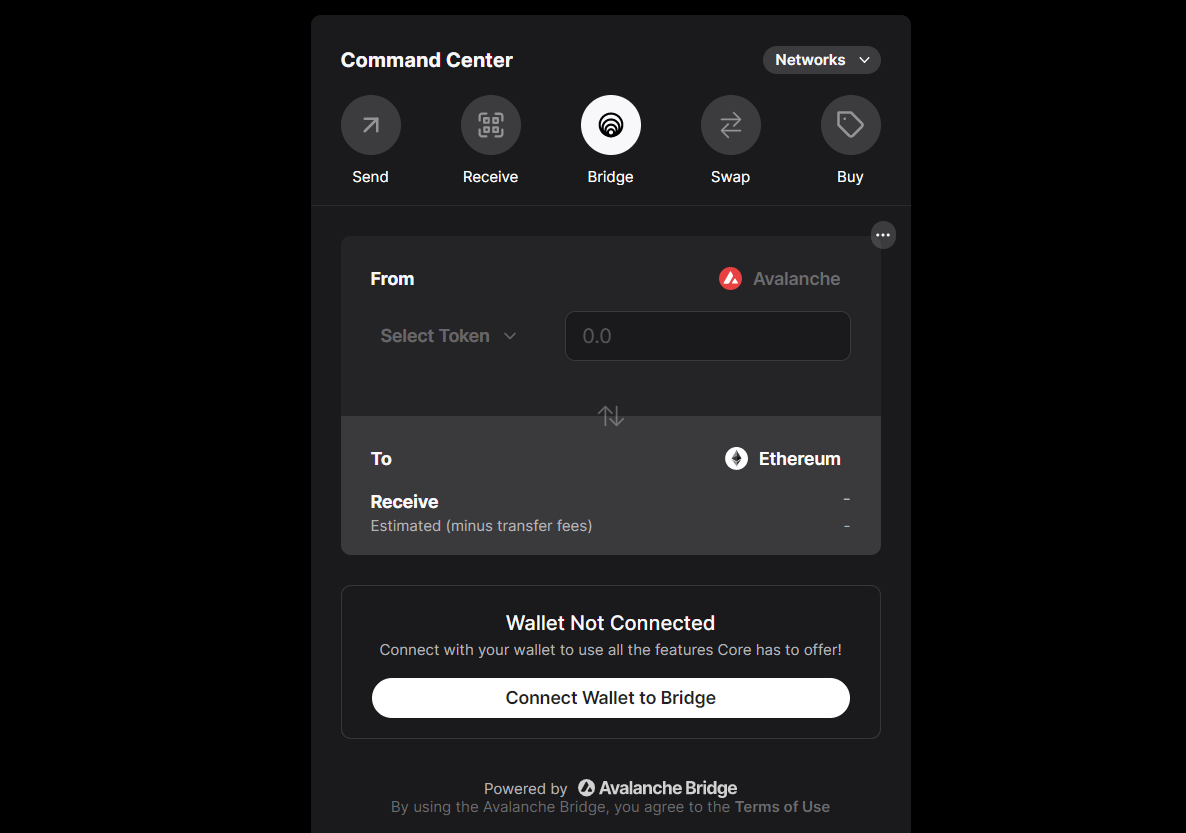
The bridge enables users to transfer supported assets between Ethereum and the Avalanche C-Chain. The bridge is accessible through the Core ecosystem, and users should initiate transfers through the official interface rather than sending funds directly to bridge contract or wallet addresses. Incorrect use can result in permanent loss of funds.
What many users don’t understand about Avalanche is that the network is comprised of three separate blockchains, X-Chain, P-Chain, and C-Chain. While most DeFi and NFT enthusiasts are only interested in the C-Chain, blockchain engineers often use the other two chains for development.
The Bitcoin bridging process has changed. As of January 28, 2026, Lombard handles Avalanche Bitcoin bridging, and the original Avalanche Bitcoin Bridge infrastructure has been wound down. The Avalanche EVM Bridge between Ethereum and Avalanche continues to operate.
Key Takeaways
-
-
Provides cross-chain asset transfers between Ethereum and Avalanche C-Chain.
-
Accessible through the official Core interface.
-
Bitcoin bridging is now handled by Lombard rather than the original Avalanche Bitcoin Bridge infrastructure.
-
Supported networks: Ethereum and Avalanche C-Chain for the Avalanche EVM Bridge.
-
What Happened to Binance Bridge?
Binance Bridge was once a highly popular cross-chain service facilitating asset transfers between blockchain networks and the Binance ecosystem. However, the original Binance Bridge was decommissioned, and Binance Bridge 2.0 was introduced in March 2022 to provide a new way to transfer supported assets between Ethereum and BNB Smart Chain.
Today, users looking to bridge assets to BNB Chain can access the official BNB Chain Cross-Chain Bridge, which integrates third-party bridging providers, including Celer, deBridge, Meson, and Stargate. Available routes and supported assets depend on the selected networks and provider.
Are Crypto Bridges Safe?
For all the wonder and excitement that cross-chain bridges bring, there are some risks. Blockchain bridges are notoriously complicated at an architectural level, making them a common target for hacks and exploits. In fact, over $1.4 billion was stolen through crypto bridge hacks in 2022.
Bridge hacks are devastating, with some networks never truly recovering from a catastrophic attack. Since hackers drained the Harmony Horizon bridge and disappeared with over $100 million in crypto, the Harmony network has struggled to recapture its former glory.
Even the most popular and reputable bridges are liable to make mistakes, and blockchain security audits always look good until a malicious hacker finds a chink in the code.
To keep yourself safe in the crypto space and protect your funds, you should always revoke any approvals confirmed in your wallet after using a bridge. This only takes a couple of seconds with sites like Revoke.cash, and might protect you from getting your entire crypto portfolio stolen in a bridge hack.
On the Flipside
-
- Bridging tokens is a great way to explore dApps and NFT collections on different blockchain networks. However, the Web 3 world is plagued with user experience issues, making this a daunting and intimidating task for first-timers.
- Beyond that, bridge hacks are the most common exploit in the crypto space, so please revoke token approvals after bridging to protect your wallet’s integrity.
Why This Matters
The cryptocurrency industry is growing at a startling pace. The variety of innovative dApps, products, and services in a cross-chain world is staggering and opens a world of opportunity to those willing to explore emerging ecosystems. Many Ethereum NFT maximalists refused to buy DeGods because they couldn’t be bothered bridging to Solana. Today, they’re some of the most valuable NFTs in the market.
FAQs
Why are cross-chain bridges vulnerable?
As a rule of thumb in blockchain security, the simpler a smart contract is, the safer it is because less can go wrong. Cross-chain bridges rely on complicated codebases with a lot of moving parts, and typically hold high rates of TVL (total value locked). This makes them a popular target for hackers.
What is the most used cross-chain bridge?
Among the cross-chain bridges in this list, the Polygon Bridge and Mulitchain are used the most based on monthly volume.
What are the benefits of cross-chain bridges?
Cross-chain bridges allow users to transfer digital assets like cryptocurrencies and NFT across different blockchain networks and explore new ecosystems.
[/vc_column_text][/vc_column][/vc_row]
Key Takeaways
-
-
Enables cross-chain transfers between supported blockchain networks.
-
Supports EVM and non-EVM ecosystems.
-
Supports NFT transfers on eligible routes.
-
Supported networks include Ethereum, Solana, Aptos, Arbitrum, Avalanche, BNB Chain, Optimism, Polygon, Sui, and other currently supported networks.
-
3. Polygon Bridge
The Polygon bridge provides access to the native Polygon PoS bridge, which enables users to transfer supported assets between Ethereum and the Polygon PoS network. The native bridge locks assets on the source network and releases corresponding pegged assets on the destination network; transfers in the opposite direction burn the pegged assets and release the original assets.
An important change concerns Polygon zkEVM. Its Mainnet Beta sequencer was shut down on July 3, 2026, and the network no longer produces blocks. Withdrawals through the Agglayer Bridge are no longer available. Users with eligible assets held in self-custodied wallets can use Polygon’s dedicated claims interface to recover them on Ethereum, subject to the applicable restrictions.
Key Takeaways
-
-
Provides the native bridge between Ethereum and Polygon PoS.
-
Supports transfers of eligible assets between the two networks.
-
Polygon zkEVM Mainnet Beta is no longer active and must not be presented as a supported bridge destination.
-
Supported networks for the native bridge: Ethereum and Polygon PoS.
-
4. Avalanche Bridge
Designed by AvaLabs and Core, the Avalanche Bridge serves various functions. Not only does it facilitate the transfer of assets between the Avalanche C-Chain and other networks like Bitcoin and Ethereum, but it’s also used internally within the Avalanche ecosystem.
The bridge enables users to transfer supported assets between Ethereum and the Avalanche C-Chain. The bridge is accessible through the Core ecosystem, and users should initiate transfers through the official interface rather than sending funds directly to bridge contract or wallet addresses. Incorrect use can result in permanent loss of funds.
What many users don’t understand about Avalanche is that the network is comprised of three separate blockchains, X-Chain, P-Chain, and C-Chain. While most DeFi and NFT enthusiasts are only interested in the C-Chain, blockchain engineers often use the other two chains for development.
The Bitcoin bridging process has changed. As of January 28, 2026, Lombard handles Avalanche Bitcoin bridging, and the original Avalanche Bitcoin Bridge infrastructure has been wound down. The Avalanche EVM Bridge between Ethereum and Avalanche continues to operate.
Key Takeaways
-
-
Provides cross-chain asset transfers between Ethereum and Avalanche C-Chain.
-
Accessible through the official Core interface.
-
Bitcoin bridging is now handled by Lombard rather than the original Avalanche Bitcoin Bridge infrastructure.
-
Supported networks: Ethereum and Avalanche C-Chain for the Avalanche EVM Bridge.
-
What Happened to Binance Bridge?
Binance Bridge was once a highly popular cross-chain service facilitating asset transfers between blockchain networks and the Binance ecosystem. However, the original Binance Bridge was decommissioned, and Binance Bridge 2.0 was introduced in March 2022 to provide a new way to transfer supported assets between Ethereum and BNB Smart Chain.
Today, users looking to bridge assets to BNB Chain can access the official BNB Chain Cross-Chain Bridge, which integrates third-party bridging providers, including Celer, deBridge, Meson, and Stargate. Available routes and supported assets depend on the selected networks and provider.
Are Crypto Bridges Safe?
For all the wonder and excitement that cross-chain bridges bring, there are some risks. Blockchain bridges are notoriously complicated at an architectural level, making them a common target for hacks and exploits. In fact, over $1.4 billion was stolen through crypto bridge hacks in 2022.
Bridge hacks are devastating, with some networks never truly recovering from a catastrophic attack. Since hackers drained the Harmony Horizon bridge and disappeared with over $100 million in crypto, the Harmony network has struggled to recapture its former glory.
Even the most popular and reputable bridges are liable to make mistakes, and blockchain security audits always look good until a malicious hacker finds a chink in the code.
To keep yourself safe in the crypto space and protect your funds, you should always revoke any approvals confirmed in your wallet after using a bridge. This only takes a couple of seconds with sites like Revoke.cash, and might protect you from getting your entire crypto portfolio stolen in a bridge hack.
On the Flipside
-
- Bridging tokens is a great way to explore dApps and NFT collections on different blockchain networks. However, the Web 3 world is plagued with user experience issues, making this a daunting and intimidating task for first-timers.
- Beyond that, bridge hacks are the most common exploit in the crypto space, so please revoke token approvals after bridging to protect your wallet’s integrity.
Why This Matters
The cryptocurrency industry is growing at a startling pace. The variety of innovative dApps, products, and services in a cross-chain world is staggering and opens a world of opportunity to those willing to explore emerging ecosystems. Many Ethereum NFT maximalists refused to buy DeGods because they couldn’t be bothered bridging to Solana. Today, they’re some of the most valuable NFTs in the market.
FAQs
Why are cross-chain bridges vulnerable?
As a rule of thumb in blockchain security, the simpler a smart contract is, the safer it is because less can go wrong. Cross-chain bridges rely on complicated codebases with a lot of moving parts, and typically hold high rates of TVL (total value locked). This makes them a popular target for hackers.
What is the most used cross-chain bridge?
Among the cross-chain bridges in this list, the Polygon Bridge and Mulitchain are used the most based on monthly volume.
What are the benefits of cross-chain bridges?
Cross-chain bridges allow users to transfer digital assets like cryptocurrencies and NFT across different blockchain networks and explore new ecosystems.
[/vc_column_text][/vc_column][/vc_row]
Key Takeaways
-
-
Enables cross-chain transfers between supported blockchain networks.
-
Supports EVM and non-EVM ecosystems.
-
Supports NFT transfers on eligible routes.
-
Supported networks include Ethereum, Solana, Aptos, Arbitrum, Avalanche, BNB Chain, Optimism, Polygon, Sui, and other currently supported networks.
-
3. Polygon Bridge
The Polygon bridge provides access to the native Polygon PoS bridge, which enables users to transfer supported assets between Ethereum and the Polygon PoS network. The native bridge locks assets on the source network and releases corresponding pegged assets on the destination network; transfers in the opposite direction burn the pegged assets and release the original assets.
An important change concerns Polygon zkEVM. Its Mainnet Beta sequencer was shut down on July 3, 2026, and the network no longer produces blocks. Withdrawals through the Agglayer Bridge are no longer available. Users with eligible assets held in self-custodied wallets can use Polygon’s dedicated claims interface to recover them on Ethereum, subject to the applicable restrictions.
Key Takeaways
-
-
Provides the native bridge between Ethereum and Polygon PoS.
-
Supports transfers of eligible assets between the two networks.
-
Polygon zkEVM Mainnet Beta is no longer active and must not be presented as a supported bridge destination.
-
Supported networks for the native bridge: Ethereum and Polygon PoS.
-
4. Avalanche Bridge
Designed by AvaLabs and Core, the Avalanche Bridge serves various functions. Not only does it facilitate the transfer of assets between the Avalanche C-Chain and other networks like Bitcoin and Ethereum, but it’s also used internally within the Avalanche ecosystem.
The bridge enables users to transfer supported assets between Ethereum and the Avalanche C-Chain. The bridge is accessible through the Core ecosystem, and users should initiate transfers through the official interface rather than sending funds directly to bridge contract or wallet addresses. Incorrect use can result in permanent loss of funds.
What many users don’t understand about Avalanche is that the network is comprised of three separate blockchains, X-Chain, P-Chain, and C-Chain. While most DeFi and NFT enthusiasts are only interested in the C-Chain, blockchain engineers often use the other two chains for development.
The Bitcoin bridging process has changed. As of January 28, 2026, Lombard handles Avalanche Bitcoin bridging, and the original Avalanche Bitcoin Bridge infrastructure has been wound down. The Avalanche EVM Bridge between Ethereum and Avalanche continues to operate.
Key Takeaways
-
-
Provides cross-chain asset transfers between Ethereum and Avalanche C-Chain.
-
Accessible through the official Core interface.
-
Bitcoin bridging is now handled by Lombard rather than the original Avalanche Bitcoin Bridge infrastructure.
-
Supported networks: Ethereum and Avalanche C-Chain for the Avalanche EVM Bridge.
-
What Happened to Binance Bridge?
Binance Bridge was once a highly popular cross-chain service facilitating asset transfers between blockchain networks and the Binance ecosystem. However, the original Binance Bridge was decommissioned, and Binance Bridge 2.0 was introduced in March 2022 to provide a new way to transfer supported assets between Ethereum and BNB Smart Chain.
Today, users looking to bridge assets to BNB Chain can access the official BNB Chain Cross-Chain Bridge, which integrates third-party bridging providers, including Celer, deBridge, Meson, and Stargate. Available routes and supported assets depend on the selected networks and provider.
Are Crypto Bridges Safe?
For all the wonder and excitement that cross-chain bridges bring, there are some risks. Blockchain bridges are notoriously complicated at an architectural level, making them a common target for hacks and exploits. In fact, over $1.4 billion was stolen through crypto bridge hacks in 2022.
Bridge hacks are devastating, with some networks never truly recovering from a catastrophic attack. Since hackers drained the Harmony Horizon bridge and disappeared with over $100 million in crypto, the Harmony network has struggled to recapture its former glory.
Even the most popular and reputable bridges are liable to make mistakes, and blockchain security audits always look good until a malicious hacker finds a chink in the code.
To keep yourself safe in the crypto space and protect your funds, you should always revoke any approvals confirmed in your wallet after using a bridge. This only takes a couple of seconds with sites like Revoke.cash, and might protect you from getting your entire crypto portfolio stolen in a bridge hack.
On the Flipside
-
- Bridging tokens is a great way to explore dApps and NFT collections on different blockchain networks. However, the Web 3 world is plagued with user experience issues, making this a daunting and intimidating task for first-timers.
- Beyond that, bridge hacks are the most common exploit in the crypto space, so please revoke token approvals after bridging to protect your wallet’s integrity.
Why This Matters
The cryptocurrency industry is growing at a startling pace. The variety of innovative dApps, products, and services in a cross-chain world is staggering and opens a world of opportunity to those willing to explore emerging ecosystems. Many Ethereum NFT maximalists refused to buy DeGods because they couldn’t be bothered bridging to Solana. Today, they’re some of the most valuable NFTs in the market.
FAQs
Why are cross-chain bridges vulnerable?
As a rule of thumb in blockchain security, the simpler a smart contract is, the safer it is because less can go wrong. Cross-chain bridges rely on complicated codebases with a lot of moving parts, and typically hold high rates of TVL (total value locked). This makes them a popular target for hackers.
What is the most used cross-chain bridge?
Among the cross-chain bridges in this list, the Polygon Bridge and Mulitchain are used the most based on monthly volume.
What are the benefits of cross-chain bridges?
Cross-chain bridges allow users to transfer digital assets like cryptocurrencies and NFT across different blockchain networks and explore new ecosystems.
[/vc_column_text][/vc_column][/vc_row]
-
-
Supports cross-chain asset transfers between compatible networks.
-
Offers multiple bridging methods, depending on the selected route.
-
Supports stablecoin transfers, including USDC on eligible CCTP routes.
-
Supported networks and tokens: Ethereum, Arbitrum, Optimism, Base, Polygon, Avalanche, BNB Chain, Linea, and other networks
-
2. Portal (Wormhole)
The Portal bridge is a cross-chain application powered by Wormhole that enables users to transfer supported digital assets between different blockchain networks, including EVM and non-EVM ecosystems. Its supported routes depend on the participating networks and assets available through the interface.
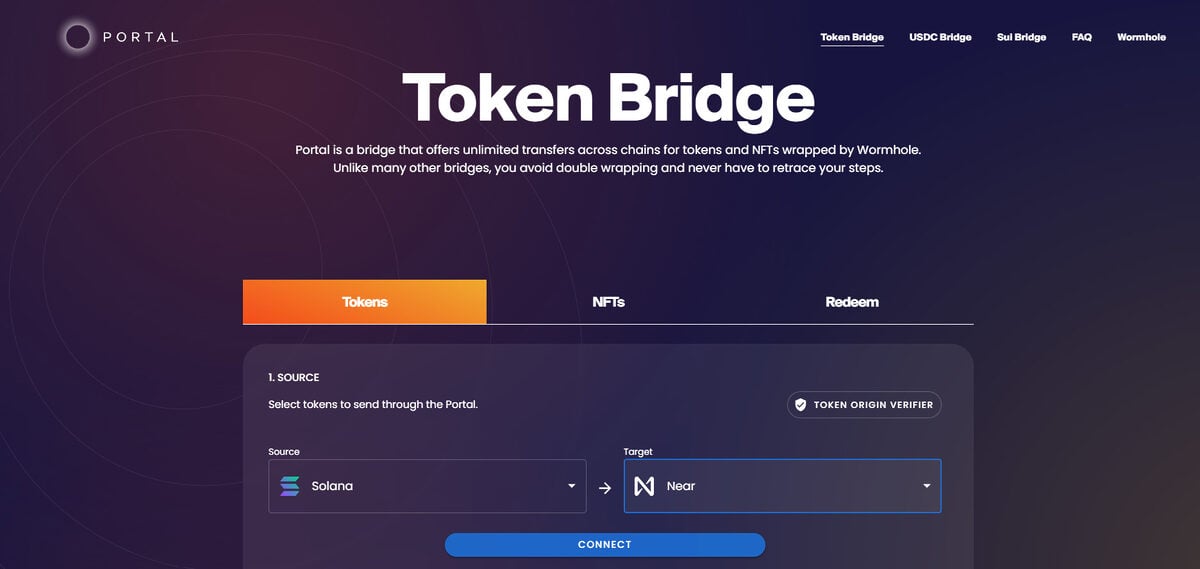
Wormhole has changed its network support over time. With Portal, crypto enthusiasts can bridge digital assets between alternative Layer-1 blockchains that don’t use an EVM. These include popular PoS (Proof-of-Stake) chains like Aptos and NEAR. This gives experienced chain-hoppers greater flexibility than other cross-chain bridges and opens immense opportunities.
If that wasn’t enough, Portal also supports NFT bridging. Like wrapped tokens, tokens can be locked and minted on other chains. A famous example of this was when HGE.SOL, a Solana NFT whale, fractionalized and bridged 50 cryptopunks to the Solana blockchain.
Key Takeaways
-
-
Enables cross-chain transfers between supported blockchain networks.
-
Supports EVM and non-EVM ecosystems.
-
Supports NFT transfers on eligible routes.
-
Supported networks include Ethereum, Solana, Aptos, Arbitrum, Avalanche, BNB Chain, Optimism, Polygon, Sui, and other currently supported networks.
-
3. Polygon Bridge
The Polygon bridge provides access to the native Polygon PoS bridge, which enables users to transfer supported assets between Ethereum and the Polygon PoS network. The native bridge locks assets on the source network and releases corresponding pegged assets on the destination network; transfers in the opposite direction burn the pegged assets and release the original assets.
An important change concerns Polygon zkEVM. Its Mainnet Beta sequencer was shut down on July 3, 2026, and the network no longer produces blocks. Withdrawals through the Agglayer Bridge are no longer available. Users with eligible assets held in self-custodied wallets can use Polygon’s dedicated claims interface to recover them on Ethereum, subject to the applicable restrictions.
Key Takeaways
-
-
Provides the native bridge between Ethereum and Polygon PoS.
-
Supports transfers of eligible assets between the two networks.
-
Polygon zkEVM Mainnet Beta is no longer active and must not be presented as a supported bridge destination.
-
Supported networks for the native bridge: Ethereum and Polygon PoS.
-
4. Avalanche Bridge
Designed by AvaLabs and Core, the Avalanche Bridge serves various functions. Not only does it facilitate the transfer of assets between the Avalanche C-Chain and other networks like Bitcoin and Ethereum, but it’s also used internally within the Avalanche ecosystem.
The bridge enables users to transfer supported assets between Ethereum and the Avalanche C-Chain. The bridge is accessible through the Core ecosystem, and users should initiate transfers through the official interface rather than sending funds directly to bridge contract or wallet addresses. Incorrect use can result in permanent loss of funds.
What many users don’t understand about Avalanche is that the network is comprised of three separate blockchains, X-Chain, P-Chain, and C-Chain. While most DeFi and NFT enthusiasts are only interested in the C-Chain, blockchain engineers often use the other two chains for development.
The Bitcoin bridging process has changed. As of January 28, 2026, Lombard handles Avalanche Bitcoin bridging, and the original Avalanche Bitcoin Bridge infrastructure has been wound down. The Avalanche EVM Bridge between Ethereum and Avalanche continues to operate.
Key Takeaways
-
-
Provides cross-chain asset transfers between Ethereum and Avalanche C-Chain.
-
Accessible through the official Core interface.
-
Bitcoin bridging is now handled by Lombard rather than the original Avalanche Bitcoin Bridge infrastructure.
-
Supported networks: Ethereum and Avalanche C-Chain for the Avalanche EVM Bridge.
-
What Happened to Binance Bridge?
Binance Bridge was once a highly popular cross-chain service facilitating asset transfers between blockchain networks and the Binance ecosystem. However, the original Binance Bridge was decommissioned, and Binance Bridge 2.0 was introduced in March 2022 to provide a new way to transfer supported assets between Ethereum and BNB Smart Chain.
Today, users looking to bridge assets to BNB Chain can access the official BNB Chain Cross-Chain Bridge, which integrates third-party bridging providers, including Celer, deBridge, Meson, and Stargate. Available routes and supported assets depend on the selected networks and provider.
Are Crypto Bridges Safe?
For all the wonder and excitement that cross-chain bridges bring, there are some risks. Blockchain bridges are notoriously complicated at an architectural level, making them a common target for hacks and exploits. In fact, over $1.4 billion was stolen through crypto bridge hacks in 2022.
Bridge hacks are devastating, with some networks never truly recovering from a catastrophic attack. Since hackers drained the Harmony Horizon bridge and disappeared with over $100 million in crypto, the Harmony network has struggled to recapture its former glory.
Even the most popular and reputable bridges are liable to make mistakes, and blockchain security audits always look good until a malicious hacker finds a chink in the code.
To keep yourself safe in the crypto space and protect your funds, you should always revoke any approvals confirmed in your wallet after using a bridge. This only takes a couple of seconds with sites like Revoke.cash, and might protect you from getting your entire crypto portfolio stolen in a bridge hack.
On the Flipside
-
- Bridging tokens is a great way to explore dApps and NFT collections on different blockchain networks. However, the Web 3 world is plagued with user experience issues, making this a daunting and intimidating task for first-timers.
- Beyond that, bridge hacks are the most common exploit in the crypto space, so please revoke token approvals after bridging to protect your wallet’s integrity.
Why This Matters
The cryptocurrency industry is growing at a startling pace. The variety of innovative dApps, products, and services in a cross-chain world is staggering and opens a world of opportunity to those willing to explore emerging ecosystems. Many Ethereum NFT maximalists refused to buy DeGods because they couldn’t be bothered bridging to Solana. Today, they’re some of the most valuable NFTs in the market.
FAQs
Why are cross-chain bridges vulnerable?
As a rule of thumb in blockchain security, the simpler a smart contract is, the safer it is because less can go wrong. Cross-chain bridges rely on complicated codebases with a lot of moving parts, and typically hold high rates of TVL (total value locked). This makes them a popular target for hackers.
What is the most used cross-chain bridge?
Among the cross-chain bridges in this list, the Polygon Bridge and Mulitchain are used the most based on monthly volume.
What are the benefits of cross-chain bridges?
Cross-chain bridges allow users to transfer digital assets like cryptocurrencies and NFT across different blockchain networks and explore new ecosystems.
[/vc_column_text][/vc_column][/vc_row]
-
-
Supports cross-chain asset transfers between compatible networks.
-
Offers multiple bridging methods, depending on the selected route.
-
Supports stablecoin transfers, including USDC on eligible CCTP routes.
-
Supported networks and tokens: Ethereum, Arbitrum, Optimism, Base, Polygon, Avalanche, BNB Chain, Linea, and other networks
-
2. Portal (Wormhole)
The Portal bridge is a cross-chain application powered by Wormhole that enables users to transfer supported digital assets between different blockchain networks, including EVM and non-EVM ecosystems. Its supported routes depend on the participating networks and assets available through the interface.
Wormhole has changed its network support over time. With Portal, crypto enthusiasts can bridge digital assets between alternative Layer-1 blockchains that don’t use an EVM. These include popular PoS (Proof-of-Stake) chains like Aptos and NEAR. This gives experienced chain-hoppers greater flexibility than other cross-chain bridges and opens immense opportunities.
If that wasn’t enough, Portal also supports NFT bridging. Like wrapped tokens, tokens can be locked and minted on other chains. A famous example of this was when HGE.SOL, a Solana NFT whale, fractionalized and bridged 50 cryptopunks to the Solana blockchain.
Key Takeaways
-
-
Enables cross-chain transfers between supported blockchain networks.
-
Supports EVM and non-EVM ecosystems.
-
Supports NFT transfers on eligible routes.
-
Supported networks include Ethereum, Solana, Aptos, Arbitrum, Avalanche, BNB Chain, Optimism, Polygon, Sui, and other currently supported networks.
-
3. Polygon Bridge
The Polygon bridge provides access to the native Polygon PoS bridge, which enables users to transfer supported assets between Ethereum and the Polygon PoS network. The native bridge locks assets on the source network and releases corresponding pegged assets on the destination network; transfers in the opposite direction burn the pegged assets and release the original assets.
An important change concerns Polygon zkEVM. Its Mainnet Beta sequencer was shut down on July 3, 2026, and the network no longer produces blocks. Withdrawals through the Agglayer Bridge are no longer available. Users with eligible assets held in self-custodied wallets can use Polygon’s dedicated claims interface to recover them on Ethereum, subject to the applicable restrictions.
Key Takeaways
-
-
Provides the native bridge between Ethereum and Polygon PoS.
-
Supports transfers of eligible assets between the two networks.
-
Polygon zkEVM Mainnet Beta is no longer active and must not be presented as a supported bridge destination.
-
Supported networks for the native bridge: Ethereum and Polygon PoS.
-
4. Avalanche Bridge
Designed by AvaLabs and Core, the Avalanche Bridge serves various functions. Not only does it facilitate the transfer of assets between the Avalanche C-Chain and other networks like Bitcoin and Ethereum, but it’s also used internally within the Avalanche ecosystem.
The bridge enables users to transfer supported assets between Ethereum and the Avalanche C-Chain. The bridge is accessible through the Core ecosystem, and users should initiate transfers through the official interface rather than sending funds directly to bridge contract or wallet addresses. Incorrect use can result in permanent loss of funds.
What many users don’t understand about Avalanche is that the network is comprised of three separate blockchains, X-Chain, P-Chain, and C-Chain. While most DeFi and NFT enthusiasts are only interested in the C-Chain, blockchain engineers often use the other two chains for development.
The Bitcoin bridging process has changed. As of January 28, 2026, Lombard handles Avalanche Bitcoin bridging, and the original Avalanche Bitcoin Bridge infrastructure has been wound down. The Avalanche EVM Bridge between Ethereum and Avalanche continues to operate.
Key Takeaways
-
-
Provides cross-chain asset transfers between Ethereum and Avalanche C-Chain.
-
Accessible through the official Core interface.
-
Bitcoin bridging is now handled by Lombard rather than the original Avalanche Bitcoin Bridge infrastructure.
-
Supported networks: Ethereum and Avalanche C-Chain for the Avalanche EVM Bridge.
-
What Happened to Binance Bridge?
Binance Bridge was once a highly popular cross-chain service facilitating asset transfers between blockchain networks and the Binance ecosystem. However, the original Binance Bridge was decommissioned, and Binance Bridge 2.0 was introduced in March 2022 to provide a new way to transfer supported assets between Ethereum and BNB Smart Chain.
Today, users looking to bridge assets to BNB Chain can access the official BNB Chain Cross-Chain Bridge, which integrates third-party bridging providers, including Celer, deBridge, Meson, and Stargate. Available routes and supported assets depend on the selected networks and provider.
Are Crypto Bridges Safe?
For all the wonder and excitement that cross-chain bridges bring, there are some risks. Blockchain bridges are notoriously complicated at an architectural level, making them a common target for hacks and exploits. In fact, over $1.4 billion was stolen through crypto bridge hacks in 2022.
Bridge hacks are devastating, with some networks never truly recovering from a catastrophic attack. Since hackers drained the Harmony Horizon bridge and disappeared with over $100 million in crypto, the Harmony network has struggled to recapture its former glory.
Even the most popular and reputable bridges are liable to make mistakes, and blockchain security audits always look good until a malicious hacker finds a chink in the code.
To keep yourself safe in the crypto space and protect your funds, you should always revoke any approvals confirmed in your wallet after using a bridge. This only takes a couple of seconds with sites like Revoke.cash, and might protect you from getting your entire crypto portfolio stolen in a bridge hack.
On the Flipside
-
- Bridging tokens is a great way to explore dApps and NFT collections on different blockchain networks. However, the Web 3 world is plagued with user experience issues, making this a daunting and intimidating task for first-timers.
- Beyond that, bridge hacks are the most common exploit in the crypto space, so please revoke token approvals after bridging to protect your wallet’s integrity.
Why This Matters
The cryptocurrency industry is growing at a startling pace. The variety of innovative dApps, products, and services in a cross-chain world is staggering and opens a world of opportunity to those willing to explore emerging ecosystems. Many Ethereum NFT maximalists refused to buy DeGods because they couldn’t be bothered bridging to Solana. Today, they’re some of the most valuable NFTs in the market.
FAQs
Why are cross-chain bridges vulnerable?
As a rule of thumb in blockchain security, the simpler a smart contract is, the safer it is because less can go wrong. Cross-chain bridges rely on complicated codebases with a lot of moving parts, and typically hold high rates of TVL (total value locked). This makes them a popular target for hackers.
What is the most used cross-chain bridge?
Among the cross-chain bridges in this list, the Polygon Bridge and Mulitchain are used the most based on monthly volume.
What are the benefits of cross-chain bridges?
Cross-chain bridges allow users to transfer digital assets like cryptocurrencies and NFT across different blockchain networks and explore new ecosystems.
[/vc_column_text][/vc_column][/vc_row]
Cross-chain bridges are an essential instrument in your DeFi toolbox. As the cryptocurrency industry expands at a dizzying rate, being able to shift your funds across different blockchain networks securely helps you explore new ecosystems easily.
Despite what the maxis tell you, no one chain will rule them all. There are hundreds of different networks in the Web3 world, each with its unique identity and decentralized applications.
Staying fixated on just one chain, like Bitcoin (BTC) or Ethereum (ETH), will significantly limit your opportunities within the crypto market. The need for interoperability between networks has never been higher.
What exactly are cross-chain bridges, and why should I use them? Are blockchain bridges safe?
In this article, we’ll explain why bridging between blockchain ecosystems is such a valuable skill and why cross-chain interoperability is so important for the growth of the cryptocurrency industry.
What Is a Cross-Chain Bridge?
A cross-chain bridge is a blockchain-based application that allows users to transfer digital assets and data from one network to another. For example, you can bridge ETH tokens from the Ethereum mainnet to the Binance Smart Chain (BSC), which has lower gas fees.
In the true spirit of DeFi (decentralized finance), crypto bridges are permissionless, meaning anyone with a crypto wallet can access them and transfer tokens without being intercepted by centralized authorities.
Most bridges use a ‘Lock and Release’ function, similar to how wrapped crypto assets like wBTC work.
Imagine each blockchain is an island. When you initiate a token transfer, you deposit cryptocurrency onto the bridge from one side. The bridge application locks your deposit into its wide liquidity pool and releases an equal number of the same tokens to your wallet on the destination chain, or new island.
While it may sound surprising, the same token can exist simultaneously on multiple networks. An easier way to think of it is to imagine apps in a mobile phone. Underneath the hood are slight differences between the Twitter app on Android and the Twitter app on iOS. However, the average end user isn’t bothered by the technicalities.
Why Would I Want to Use a Cross-Chain Bridge?
Using various networks is a great way to learn about blockchain technology and its use cases. While the Ethereum network has far more dApps than other chains, every blockchain has its own thriving ecosystem, with exclusive applications, tokens, and NFTs.
User experience varies from chain to chain, with some networks being much more affordable than others. For example, the Ethereum blockchain is plagued with scalability issues. A token swap might cost upwards of $50 in transaction fees, while the same swap on Polygon would only cost you a few cents.
Bridging tokens to emerging chains is another excellent way to qualify for crypto airdrops. Sending a handful of ETH tokens and interacting with a handful of smart contracts on Arbitrum netted some users thousands of dollars worth of ARBI.
Best Cross-Chain Bridges
Now that you’re clued up on why bridging over to exciting new blockchains is worthwhile pursuit, let’s take a look at some of the best cross-chain bridges in crypto. While there are hundreds of directional bridges and cross-chain swaps, it’s essential to know what to look for.
The top cross-chain crypto bridges should provide the following:
-
- A good variety of networks and tokens.
- Secure transfer of assets.
- An easy-to-use interface.
- Let’s see who made the list!
1. Synapse
The Synapse Bridge enables users to transfer supported digital assets between compatible blockchain networks. Its routing system selects an appropriate bridging method based on the source chain, destination chain, and tokens involved. Supported methods include canonical bridging, liquidity-pool swaps, and native USDC transfers through Circle’s Cross-Chain Transfer Protocol (CCTP).
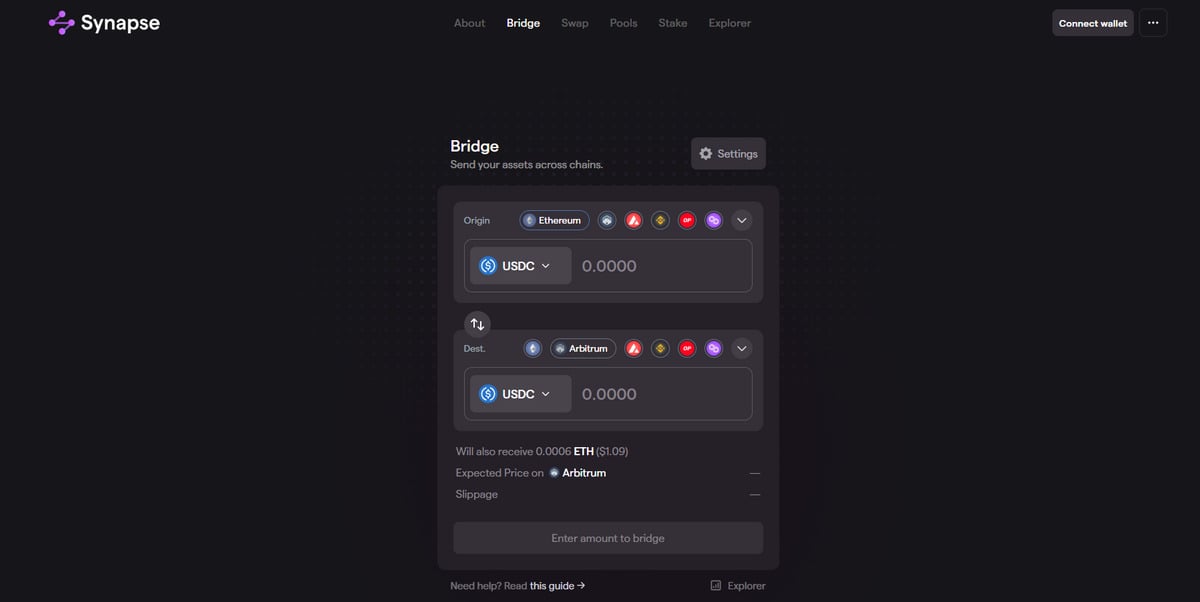
The platform offers a wide variety of ERC-20 token standards and EVM-compatible blockchain networks. What’s great about Synapse is that it also supports several popular stablecoins, like USDT and USDC.
Synapse also converts a small percentage of your transfer to the destination chain’s native cryptocurrency. For example, when you bridge to the BSC, a smart contract in the dApp automatically provides you with a small amount of BNB to pay the first few gas fees as you explore the chain.
Key Takeaways
-
-
Supports cross-chain asset transfers between compatible networks.
-
Offers multiple bridging methods, depending on the selected route.
-
Supports stablecoin transfers, including USDC on eligible CCTP routes.
-
Supported networks and tokens: Ethereum, Arbitrum, Optimism, Base, Polygon, Avalanche, BNB Chain, Linea, and other networks
-
2. Portal (Wormhole)
The Portal bridge is a cross-chain application powered by Wormhole that enables users to transfer supported digital assets between different blockchain networks, including EVM and non-EVM ecosystems. Its supported routes depend on the participating networks and assets available through the interface.
Wormhole has changed its network support over time. With Portal, crypto enthusiasts can bridge digital assets between alternative Layer-1 blockchains that don’t use an EVM. These include popular PoS (Proof-of-Stake) chains like Aptos and NEAR. This gives experienced chain-hoppers greater flexibility than other cross-chain bridges and opens immense opportunities.
If that wasn’t enough, Portal also supports NFT bridging. Like wrapped tokens, tokens can be locked and minted on other chains. A famous example of this was when HGE.SOL, a Solana NFT whale, fractionalized and bridged 50 cryptopunks to the Solana blockchain.
Key Takeaways
-
-
Enables cross-chain transfers between supported blockchain networks.
-
Supports EVM and non-EVM ecosystems.
-
Supports NFT transfers on eligible routes.
-
Supported networks include Ethereum, Solana, Aptos, Arbitrum, Avalanche, BNB Chain, Optimism, Polygon, Sui, and other currently supported networks.
-
3. Polygon Bridge
The Polygon bridge provides access to the native Polygon PoS bridge, which enables users to transfer supported assets between Ethereum and the Polygon PoS network. The native bridge locks assets on the source network and releases corresponding pegged assets on the destination network; transfers in the opposite direction burn the pegged assets and release the original assets.
An important change concerns Polygon zkEVM. Its Mainnet Beta sequencer was shut down on July 3, 2026, and the network no longer produces blocks. Withdrawals through the Agglayer Bridge are no longer available. Users with eligible assets held in self-custodied wallets can use Polygon’s dedicated claims interface to recover them on Ethereum, subject to the applicable restrictions.
Key Takeaways
-
-
Provides the native bridge between Ethereum and Polygon PoS.
-
Supports transfers of eligible assets between the two networks.
-
Polygon zkEVM Mainnet Beta is no longer active and must not be presented as a supported bridge destination.
-
Supported networks for the native bridge: Ethereum and Polygon PoS.
-
4. Avalanche Bridge
Designed by AvaLabs and Core, the Avalanche Bridge serves various functions. Not only does it facilitate the transfer of assets between the Avalanche C-Chain and other networks like Bitcoin and Ethereum, but it’s also used internally within the Avalanche ecosystem.
The bridge enables users to transfer supported assets between Ethereum and the Avalanche C-Chain. The bridge is accessible through the Core ecosystem, and users should initiate transfers through the official interface rather than sending funds directly to bridge contract or wallet addresses. Incorrect use can result in permanent loss of funds.
What many users don’t understand about Avalanche is that the network is comprised of three separate blockchains, X-Chain, P-Chain, and C-Chain. While most DeFi and NFT enthusiasts are only interested in the C-Chain, blockchain engineers often use the other two chains for development.
The Bitcoin bridging process has changed. As of January 28, 2026, Lombard handles Avalanche Bitcoin bridging, and the original Avalanche Bitcoin Bridge infrastructure has been wound down. The Avalanche EVM Bridge between Ethereum and Avalanche continues to operate.
Key Takeaways
-
-
Provides cross-chain asset transfers between Ethereum and Avalanche C-Chain.
-
Accessible through the official Core interface.
-
Bitcoin bridging is now handled by Lombard rather than the original Avalanche Bitcoin Bridge infrastructure.
-
Supported networks: Ethereum and Avalanche C-Chain for the Avalanche EVM Bridge.
-
What Happened to Binance Bridge?
Binance Bridge was once a highly popular cross-chain service facilitating asset transfers between blockchain networks and the Binance ecosystem. However, the original Binance Bridge was decommissioned, and Binance Bridge 2.0 was introduced in March 2022 to provide a new way to transfer supported assets between Ethereum and BNB Smart Chain.
Today, users looking to bridge assets to BNB Chain can access the official BNB Chain Cross-Chain Bridge, which integrates third-party bridging providers, including Celer, deBridge, Meson, and Stargate. Available routes and supported assets depend on the selected networks and provider.
Are Crypto Bridges Safe?
For all the wonder and excitement that cross-chain bridges bring, there are some risks. Blockchain bridges are notoriously complicated at an architectural level, making them a common target for hacks and exploits. In fact, over $1.4 billion was stolen through crypto bridge hacks in 2022.
Bridge hacks are devastating, with some networks never truly recovering from a catastrophic attack. Since hackers drained the Harmony Horizon bridge and disappeared with over $100 million in crypto, the Harmony network has struggled to recapture its former glory.
Even the most popular and reputable bridges are liable to make mistakes, and blockchain security audits always look good until a malicious hacker finds a chink in the code.
To keep yourself safe in the crypto space and protect your funds, you should always revoke any approvals confirmed in your wallet after using a bridge. This only takes a couple of seconds with sites like Revoke.cash, and might protect you from getting your entire crypto portfolio stolen in a bridge hack.
On the Flipside
-
- Bridging tokens is a great way to explore dApps and NFT collections on different blockchain networks. However, the Web 3 world is plagued with user experience issues, making this a daunting and intimidating task for first-timers.
- Beyond that, bridge hacks are the most common exploit in the crypto space, so please revoke token approvals after bridging to protect your wallet’s integrity.
Why This Matters
The cryptocurrency industry is growing at a startling pace. The variety of innovative dApps, products, and services in a cross-chain world is staggering and opens a world of opportunity to those willing to explore emerging ecosystems. Many Ethereum NFT maximalists refused to buy DeGods because they couldn’t be bothered bridging to Solana. Today, they’re some of the most valuable NFTs in the market.
FAQs
Why are cross-chain bridges vulnerable?
As a rule of thumb in blockchain security, the simpler a smart contract is, the safer it is because less can go wrong. Cross-chain bridges rely on complicated codebases with a lot of moving parts, and typically hold high rates of TVL (total value locked). This makes them a popular target for hackers.
What is the most used cross-chain bridge?
Among the cross-chain bridges in this list, the Polygon Bridge and Mulitchain are used the most based on monthly volume.
What are the benefits of cross-chain bridges?
Cross-chain bridges allow users to transfer digital assets like cryptocurrencies and NFT across different blockchain networks and explore new ecosystems.



Be the first to comment