



AI Summary
- XRP Ledger has technical characteristics suited to fast payment and tokenization workflows, according to former Ripple CBDC adviser Anthony Welfare.
- Technical capability does not guarantee adoption because liquidity, custody, compliance and interoperability remain necessary.
- Stablecoins could reduce payment friction while creating a new orchestration role between otherwise incompatible networks.
- Welfare expects private blockchain deployments to grow before some activity moves toward public infrastructure for scale and security.
- Trust CBRC illustrates a proposed use of AI and XRP Ledger certification to evaluate real world blockchain projects.
The loudest narrative around XRP often assumes that technical capability will translate directly into a new financial system. The more defensible case is narrower: the XRP Ledger already offers infrastructure that can be applied to payments and tokenized assets, but institutions still need liquidity, custody, compliance and integration before those capabilities become usable at scale.
Anthony Welfare, identified in the source as a former Ripple CBDC adviser, argues that the ledger is fast, inexpensive and technically capable of supporting cross border transactions. His central distinction matters: blockchain infrastructure may be ready before the commercial and regulatory systems surrounding it are.
Our analysis is that this gap between capability and adoption is the real XRP Ledger thesis. It replaces the idea of inevitable disruption with a harder question: can institutions connect blockchain payment rails to the fragmented networks, currencies and controls they already use?
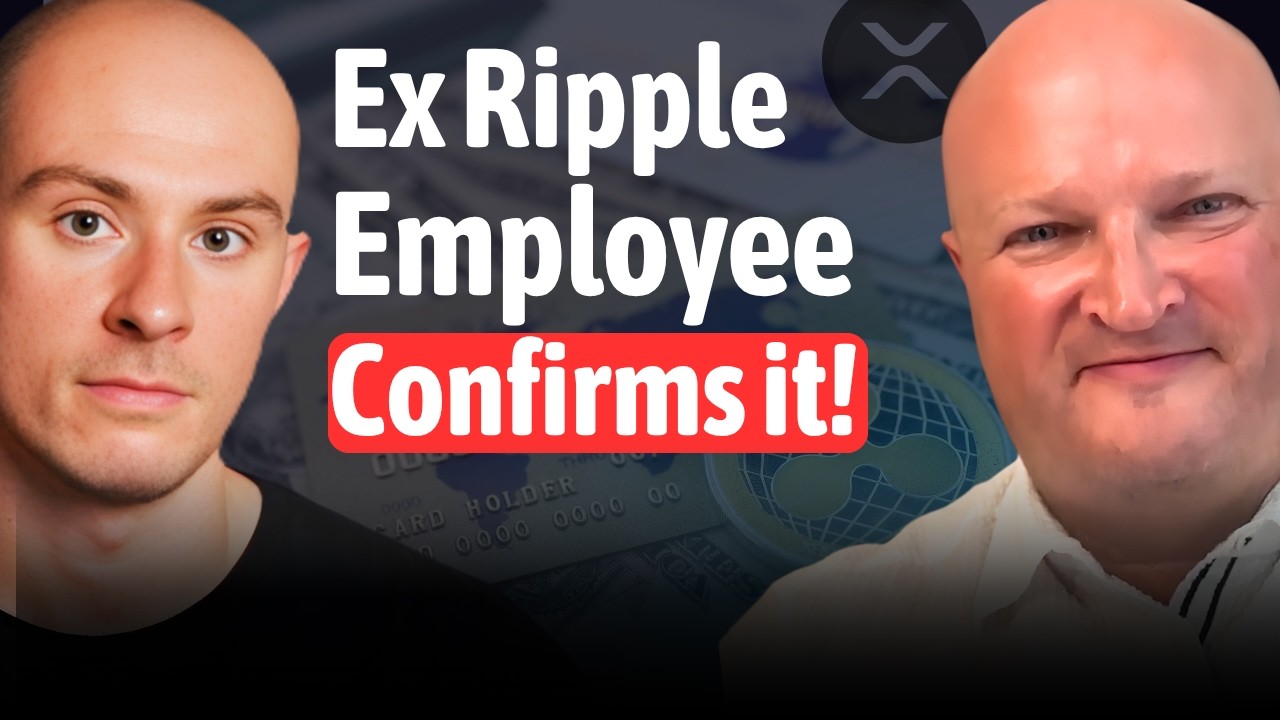
Ex Ripple XRP Employee Confirms It……!!!
Trust starts with usable transactions
Welfare reduces blockchain’s commercial proposition to “trusted transactions.” That formulation covers both money and data: a ledger can provide a shared record showing that a transaction occurred, while separate privacy controls determine which information should be visible.
The tech is there.
His experience at Oracle and DXC Technology, as described in the source, included work involving payments, supply chains and insurance. One example involved tracking premium olive oil with sensor and location data so that unexpected changes during transport could trigger scrutiny. Another explored whether shipping insurance data could be recorded and processed more efficiently.
- Payments: A shared ledger can provide a verifiable transfer record across participants.
- Supply chains: Sensor and location data can help identify where goods may have been altered.
- Insurance: Programmable records could reduce reconciliation across complex chains of intermediaries.
- Public spending: Welfare presented transparent government and charity expenditure as a potential use case, not an implemented system.
The limitation is commercial rather than purely technical. An efficiency that removes fees or intermediaries also removes someone’s revenue. That explains why adoption can remain slow even when a prototype demonstrates lower costs.
Stablecoins expose payment stack incentives
Stablecoins make this incentive problem visible. Wallet to wallet payments could reduce the number of entities involved in a transfer, but they do not eliminate every service surrounding it. Know your customer checks, sanctions screening, custody and liquidity can still impose costs.
we’re never going to get to zero.
That is an important corrective to claims that blockchain makes financial infrastructure effectively free. Welfare expects costs to decline, but his reasoning leaves a continuing role for regulated operators. Card networks could therefore shift from processing every conventional card payment toward orchestrating movement among multiple digital currencies and ledgers.
- Lower friction: Direct digital transfers could compress time and processing costs.
- Persistent controls: Compliance, custody and liquidity remain part of a regulated payment.
- New orchestration: Existing payment businesses may connect networks instead of disappearing entirely.
This interpretation aligns with our broader analysis that financial institutions face a choice over evolving blockchain rails. Adoption is unlikely to be a clean replacement event. It is more likely to redistribute where fees are earned and which operators control the connection points.
Interoperability is the missing commercial layer
A stablecoin on Ethereum cannot automatically settle with another asset on Arbitrum, Cardano, Solana or XRP Ledger. Welfare sees interoperability as a commercial opportunity because issuers and users will not voluntarily converge on one network.
Bridges are one available mechanism, but Welfare pointed to their history of problems and suggested that interledger technology could become more important. The desired user experience is simple: a sender pays with one supported asset, a recipient receives another, and the infrastructure handles routing, conversion and verification.
- Routing: The system must identify a workable path between different ledgers.
- Liquidity: Assets still require sufficient markets for conversion.
- Verification: Participants need confidence that each leg of the transfer completed correctly.
- Compliance: Regulated entities must preserve required checks across the full transaction path.
This is where blockchain payment rails become a systems problem rather than a contest over one chain’s transaction speed. Our view is that the most valuable infrastructure may be the layer that makes differences between networks less visible to users. The commercial questions surrounding Arbitrum and Robinhood’s revenue model provide one example of how applications and underlying networks can divide value.
Public and private chains may converge
Institutional adoption is frequently presented as a choice between public and private infrastructure. Welfare expects both. In his scenario, private blockchains expand first because businesses require controlled access and privacy. Some activity can later anchor to public networks when scale, security or shared settlement becomes more valuable.
the way that this will work is you’ll have a lot more private blockchains growing and then eventually they’ll go this needs to be public just for scale, security, all the rest of it.
Privacy remains the central technical constraint in this transition. Welfare identified zero knowledge technology as one potential way to separate verification from disclosure. He did not claim that the institutional privacy problem has been fully solved.
The practical approach is incremental. A company does not need to place every internal event on one ledger immediately. It can move a bounded workflow, test it and expand only when the system produces a measurable benefit. This also helps explain why institutional blockchain adoption can be substantial without producing a single dramatic migration announcement.
AI agents strengthen the verification case
AI agents introduce another reason to demand auditable transaction records. As software becomes more autonomous, financial and operational actions need a way to be checked after execution. Welfare’s thesis is that blockchain can provide that anchor for both payments and data.
we have to have blockchain underpinning the AI agents otherwise I have no idea what things look like.
This is a forward looking opinion, not proof that all autonomous systems require a public blockchain. Databases, permissions and conventional audit logs will continue to exist. The stronger case arises when multiple parties need to verify an agent’s actions without relying entirely on one party’s private record.
Security also becomes more important as automation expands. Our reporting on an Ethereum researcher’s warning about AI signature risk highlights the other side of this relationship: blockchain can help record automated actions, but AI can also place new pressure on authorization and key security.
XRP Ledger capability is not adoption
Welfare’s XRP Ledger assessment is positive but conditional. He identifies speed, low transaction costs, a built in DEX and support for tokenization as relevant capabilities. He also separates XRP the asset from XRP Ledger infrastructure and from the broader payment services built around those rails.
there’s a big misunderstanding as well with people between the asset and the ledger the rails sort of thing
That distinction prevents a common analytical error. An institution can test or use ledger functionality without the activity automatically creating the same role for every asset associated with that network. Welfare’s example uses RLUSD and hypothetical currency denominated tokens to illustrate how transfers might occur on one ledger, but conversion still depends on available liquidity and backing.
- Ledger capability: The network can record and settle supported transactions.
- Asset utility: The role of XRP depends on the design and routing of a specific transaction.
- Institutional services: Custody, treasury operations and compliance sit around the ledger itself.
- Adoption evidence: Tests and pilots matter, but production use is the stronger standard.
Welfare said his work at Ripple involved conversations with numerous central banks and trials relating to CBDCs. He did not identify those institutions or establish that every trial became a production deployment. His broader observation was that corporate projects tend to move from tests to pilots and then into smaller operational components.
there’s a lot more happening with corporates than people ever imagine
The same measured standard should apply to Trust CBRC, Welfare’s project for evaluating real world blockchain initiatives. He described an AI assisted assessment process, reviewed by humans, with scores and certificates intended to be verified on XRP Ledger. The project was presented as being in a launch phase, so its proposed methodology should not be confused with established market adoption.
What this means
- Technical readiness is only the first threshold. XRP Ledger may satisfy important speed and cost requirements, but real payment systems also need liquidity, custody, compliance and reliable integration.
- Interoperability could capture more value than isolated throughput. Institutions are likely to use multiple networks, making routing and verification across them a central commercial problem.
- XRP conclusions must follow actual transaction design. Ledger use does not by itself prove demand for XRP. Analysts need to determine which asset provides settlement, liquidity or collateral in each deployment.
In our view, the credible thesis is not that one network replaces the global financial system. It is that mature ledgers can become components within a more programmable stack, with adoption determined workflow by workflow.
Bigger picture
Recent AllinCrypto reporting shows why that narrower framework matters. The euro stablecoin initiative involving XRP Ledger places one specific network inside a multichain payments strategy. Separately, an IMF mapping of XRP Ledger and Stellar provides context for how established organizations are examining tokenized finance.
Infrastructure roles are also becoming more specialized. Our analysis of the XRP Ledger collateral thesis and the ISDA tokenization agenda focused on whether the ledger can fit institutional collateral workflows, while reporting on Ripple’s payments and treasury expansion examined the surrounding business stack.
Together, these developments support a cautious conclusion. Blockchain payment rails are moving closer to conventional finance, but network selection, asset utility and commercial success remain separate questions. XRP Ledger has a plausible role; evidence from implemented workflows will determine how large that role becomes.
Sources
This article is for informational purposes only and does not constitute financial advice.



Be the first to comment