


Existing depositors in Firelight, a DeFi cover protocol on Flare, now supply capital that can be used to pay losses at covered vaults. Its Oct. 6 activation automatically moved their staked Flare’s XRP (FXRP) into the coverage phase, bringing pooled slashing exposure and a longer wait to withdraw.
The change gives XRP-linked collateral a fee-funded role, but separates the end of income from the end of risk. Firelight’s current rules describe 30-60-day exits and stop new vault reward accrual when unstaking begins, while claims tied to the earlier backing period can still reduce the assets returned.
Firelight’s launch announcement names Sentora’s USD Protected Vault and Protected RWA Vaults as its first live cover integrations, and Flare says existing Phase 1 positions convert automatically. Holders already in the vault did not need a separate migration transaction to take on the new obligations.
FXRP is the XRP-backed asset used on Flare, while stXRP represents a holder’s position in Firelight’s vault. Firelight stakers supply the FXRP capital that earns fee-funded vault accrual, and bears claim risk.

This advances the status described in CryptoSlate’s Sept. 14 analysis, which outlined Firelight’s planned coverage-backed yield model for XRP-linked collateral. The first payment records now give that model an observable starting point.
Existing stakes carry pooled claims and longer exits
Under Firelight’s loss waterfall, a validated claim first draws on the protocol-owned stablecoin First-Loss Buffer, and any remaining loss reaches vault positions pro rata. Compounded rewards carry that exposure along with the original contribution.
A staker backs the portfolio’s aggregate claims experience, and Flare’s launch account also makes clear that capital supplied to Firelight has no cover of its own. Slashing is now part of the documented staker exposure.
The wallet Firelight identifies as its buffer held approximately 1,000,002.59 USDT0 on Oct. 14. The reserve’s adequacy depends on current liabilities, pending claims, and the funds available to pay them. Those figures remain unreconciled, so the wallet balance alone cannot establish the cushion available to stakers.
Firelight’s current withdrawal documentation dates 30-day periods to Oct. 6. When a holder requests an unstake, new vault reward accrual ends and the corresponding stXRP is redeemed, but the underlying FXRP stays in the withdrawal queue.
Capital continues backing cover for the remainder of the initiation period. During the following reconciliation period, it stops backing new cover, while an incident attributed to its earlier backing period can still reduce the pending withdrawal.
The FXRP becomes withdrawable at the end of the following full period, producing the documented 30-60-day wait. Returning the assets then requires a withdrawal transaction. The holder gives up new vault accrual throughout the wait, even though earlier-period claim exposure can remain.
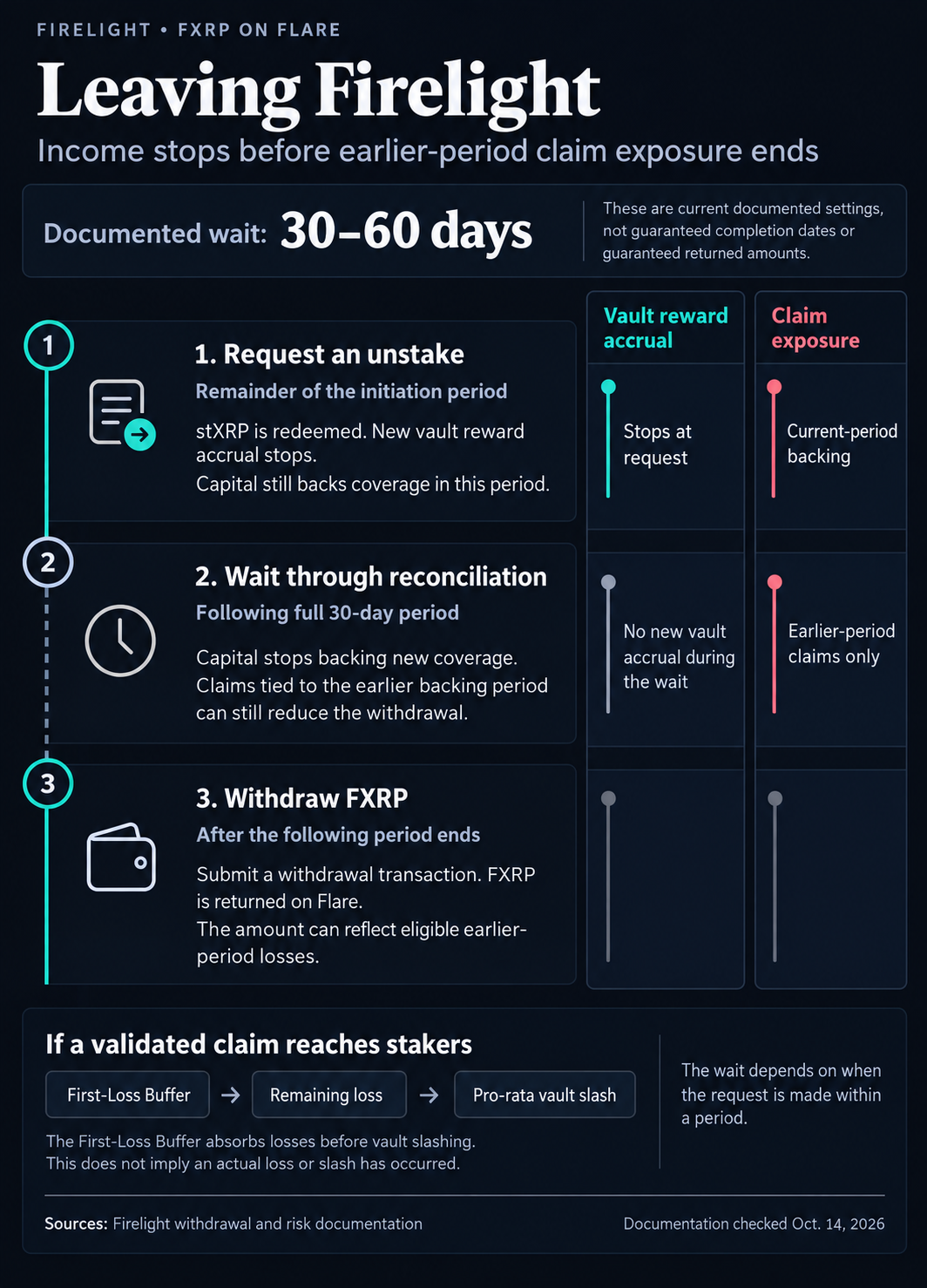
Firelight’s Oct. 6 announcement says emissions continue until full exit. Its more specific withdrawal and emissions rules end accrual at initiation, a treatment supported by the current vault implementation: redeemed shares burn, and the assets move out of active vault accounting into pending withdrawals.
Initial cover payments show what holders receive in exchange for those obligations.
Three observed orders settled on Oct. 6 allocated a combined $38 million of cover for period 308 and charged approximately $56,913.70 in premiums. Two carry the labels Sentora USD Protected and Sentora RWA, with allocations of $2.5 million and $5 million, respectively.
These initial settlements show orders matched and premiums charged, advancing the earlier bootstrapping phase.
Premium charges, vault transfers and contributor claims
Premiums charged at settlement go to a collector. The allocator implementation transfers the premium from the buyer to a collector before recording settlement.
| Observed record | Amount | What it measures |
|---|---|---|
| Three cover orders settled Oct. 6 | $38 million | Cover allocated in those orders |
| Premiums charged on those orders | About $56,913.70 | Charges at settlement |
| Premium-sale distribution events, Oct. 6, 8 and 12 | 9,245.46 FXRP | FXRP sent into the vault |
| Separate incentive-distribution events on those dates | 14,045.40 FXRP | Transfers recorded as incentives |
The reward distributor’s records separate premium-sale proceeds from incentives. Its three premium-sale events report 12,900.44 USDT0 swapped alongside the FXRP sent to the vault.
However, the distributor contract forwards FXRP, while an authorized caller supplies the stablecoin amounts and swap times, so the recorded transfers do not independently verify those trades.
The events’ incentive references identify no link to the contributor campaign or proof of an independent funding source, so the categories should be compared.
Firelight’s separate early-contributor campaign allocates 230,000 FXRP pro rata according to eligible Firelight Points, and the Merkl campaign record confirms that budget.
The 230,000-FXRP figure is a fixed budget for contributor claims, with the amount actually claimed still separate. Recurring vault income has another mechanism: Firelight’s emissions documentation says settled premiums compound into the vault’s redemption value, while other rewards can be claimed separately.
A fixed contributor claim rewards earlier participation, while an active staker’s continuing return depends on customer fees relative to the capital exposed to losses.
Collateral prices shape the XRP-linked risk
DefiLlama showed about $69.7 million in Firelight total value locked as of Oct. 14, using a methodology that counts FXRP held in the vault. An explorer snapshot recorded about 51.13 million FXRP there, including any assets awaiting withdrawal.
XRP backing, FXRP collateral and stXRP vault shares represent layers of the same capital, so counting all three as separate additions would count those assets again.
XRP hit an intraday low of $1.32 on Oct. 14 after inflation numbers came in above expectations.
Firelight’s capital framework includes the market value of staked assets in the resources supporting cover. A price decline can reduce those dollar resources without a claim, while an exiting holder is still waiting for access to the FXRP.
Premium conversion can support FXRP demand, but the acquisition route matters. FXRP can change hands in a secondary market, and minting it can use XRP a holder already owns. Neither pathway alone demonstrates fresh buying of native XRP.
Renewal records, continuing premium-sale distributions, claims, and completed exits would show whether fee income retains capital after incentives and obligations are settled. The first cycle’s lasting value to existing FXRP holders depends on the income earned for accepting that loss exposure and slower access to their assets.





Be the first to comment