



Robinhood Chain applications need reliable access to balances, contract state, transaction receipts, and live events. A slow or unavailable remote procedure call (RPC) endpoint can delay a wallet update, interrupt an indexer, or leave a trading interface waiting for fresh data.
Robinhood Chain is an Ethereum-compatible layer 2 built on Arbitrum technology. It uses ETH for gas and supports familiar Ethereum development tools, making managed RPC endpoints a practical starting point for developers building financial applications and services.
This list compares five Robinhood Chain RPC providers, starting with Chainstack for its measured RPC performance and coverage across managed, dedicated, and self-hosted deployments.
Robinhood Chain RPC providers at a glance
| Rank | Provider | Best for | Key consideration |
| 1 | Chainstack | Fast RPC access across deployment environments | Benchmark results apply to the tested endpoints and workload |
| 2 | NOWNodes | Adding Robinhood Chain to a multi-chain integration | Confirm required methods and interfaces |
| 3 | Dwellir | Historical queries and transaction analysis | Log-query access and ranges depend on the plan |
| 4 | RouteMesh | Provider routing and testnet development | The verified Robinhood listing covers testnet |
| 5 | Alchemy | Teams using Alchemy’s developer platform | Check network-specific product availability |
The order is an editorial recommendation based on performance evidence, deployment options, and application fit. It is not a benchmark ranking of all five providers.

1. Chainstack
Best for: teams and solo developers that want fast Robinhood Chain RPC with deployment flexibility.
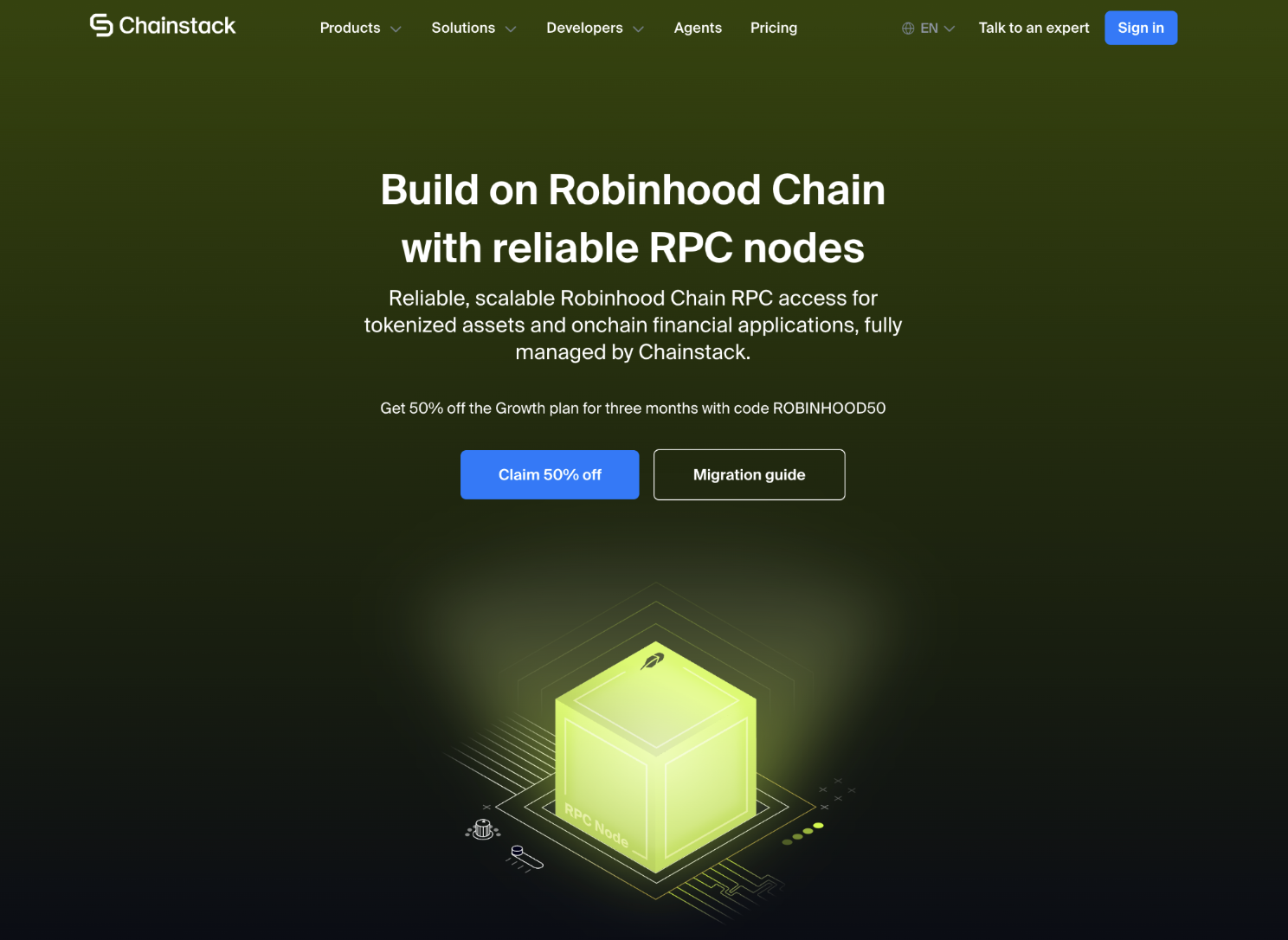
Chainstack is our leading overall choice for Robinhood Chain. It combines strong measured read performance with options for teams using shared infrastructure, isolated resources, or infrastructure they control.
Leading measured RPC performance
The OpenChainBench report dated October 12, 2026, lists Chainstack as the private-endpoint median latency leader at approximately 6 ms.
The benchmark measures eth_getBlockByNumber over a rolling 24-hour window from US East and EU West. This provides a concrete comparison of routine block reads, with public and private endpoints evaluated separately.
For applications that frequently read the latest block, this result makes Chainstack a strong starting point for performance testing.
Coverage across deployment environments
Chainstack supports Robinhood Chain mainnet and testnet through three operating models:
- Global Nodes: geo-balanced RPC access.
- Dedicated Nodes: isolated compute resources and greater configuration control.
- Chainstack Self-Hosted: nodes deployed on the team’s own cloud, on-premises, or hybrid infrastructure.
Teams can choose the operating model that matches their workload and infrastructure requirements. The managed endpoints support HTTPS and WebSocket access.
What to check: Benchmark your critical methods from your application’s regions. The published latency result concerns measured private endpoints, rather than every dedicated or self-hosted configuration.
2. NOWNodes
Best for: teams adding Robinhood Chain to an existing multi-chain stack.
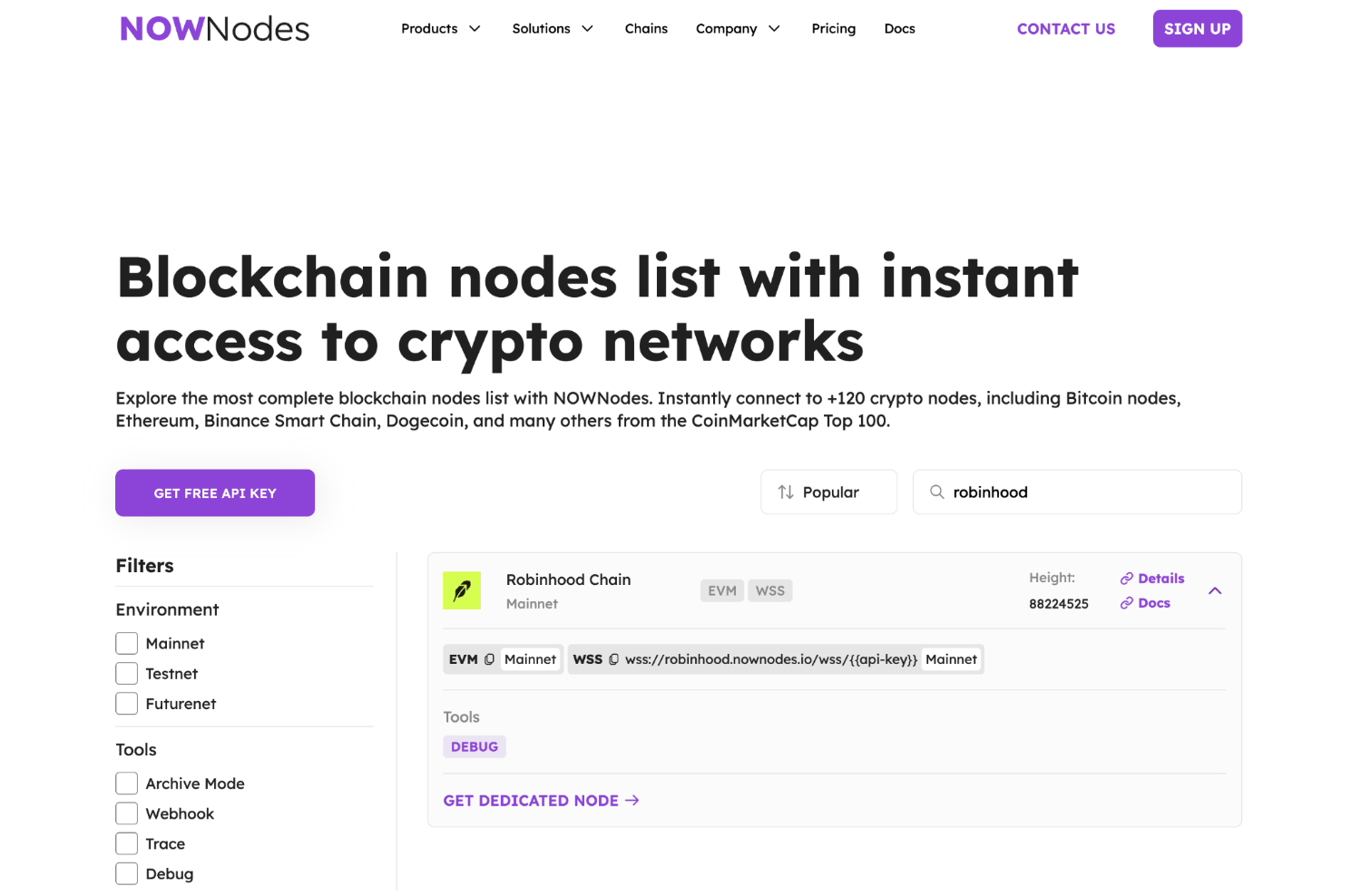
NOWNodes provides managed Robinhood Chain RPC access for reading blockchain data, submitting transactions, and interacting with smart contracts.
Its Robinhood Chain documentation describes an API-key setup process and lists mainnet and Sepolia testnet environments. For teams already using NOWNodes, adding Robinhood Chain can keep the integration within a familiar account and operational workflow.
The main appeal is straightforward managed access. Wallets and other multi-chain services can evaluate Robinhood Chain alongside their existing network integrations.
What to check: Confirm the exact interface, historical-data coverage, and method limits required by your application. General platform features should be verified for Robinhood Chain before deployment.
3. Dwellir
Best for: indexers, historical-data applications, and transaction debugging.
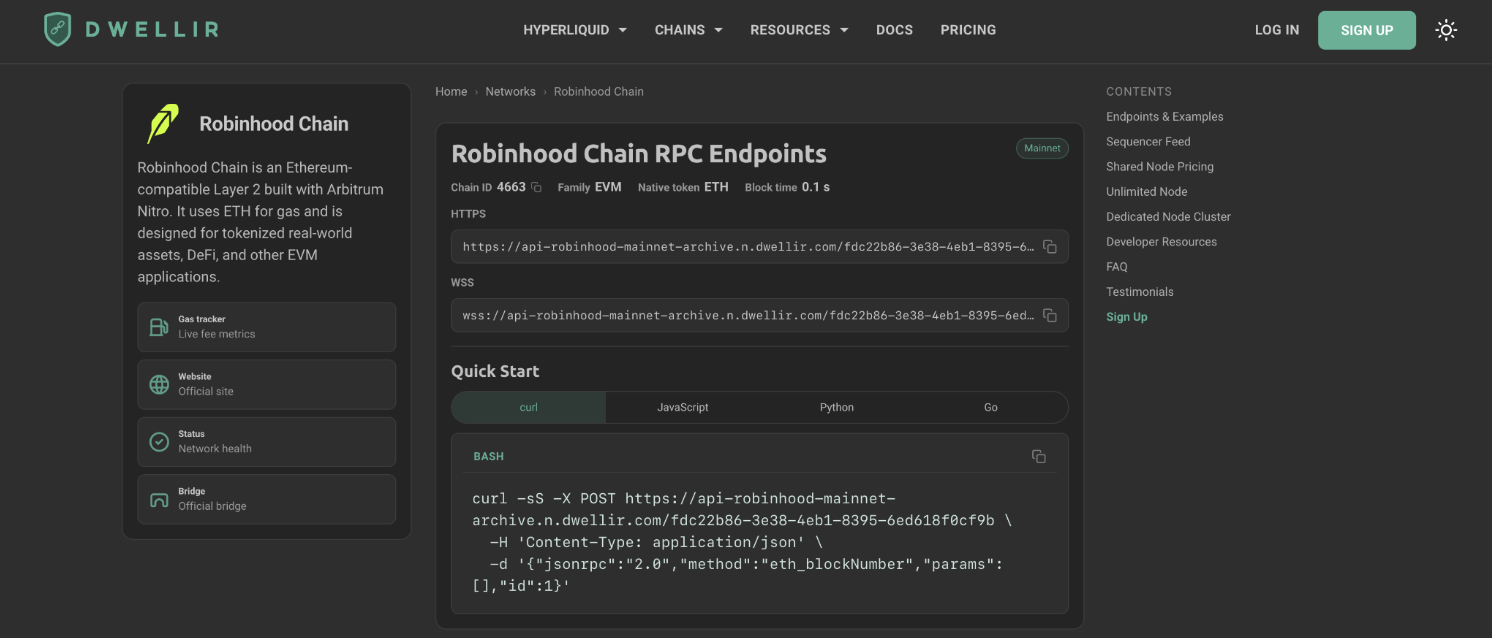
Dwellir provides Robinhood Chain mainnet access through HTTPS and WebSocket endpoints backed by archive nodes. This makes it a relevant option for applications that need historical state alongside current blockchain data.
Its documentation also identifies support for Nitro’s debug_* methods. Developers investigating transaction execution should use the supported debug methods rather than assume that Parity-style trace_* methods are available.
Log-query limits deserve attention. Dwellir’s free plan excludes eth_getLogs; its Developer plan enables the method with a 500-block range, while higher plans increase that range to 10,000 blocks. These limits affect the time and cost of historical indexing.
What to check: Estimate backfill requirements, test log queries, and review the plan’s block-range limits before choosing a subscription.
4. RouteMesh
Best for: developers exploring routed RPC access on Robinhood Chain testnet.
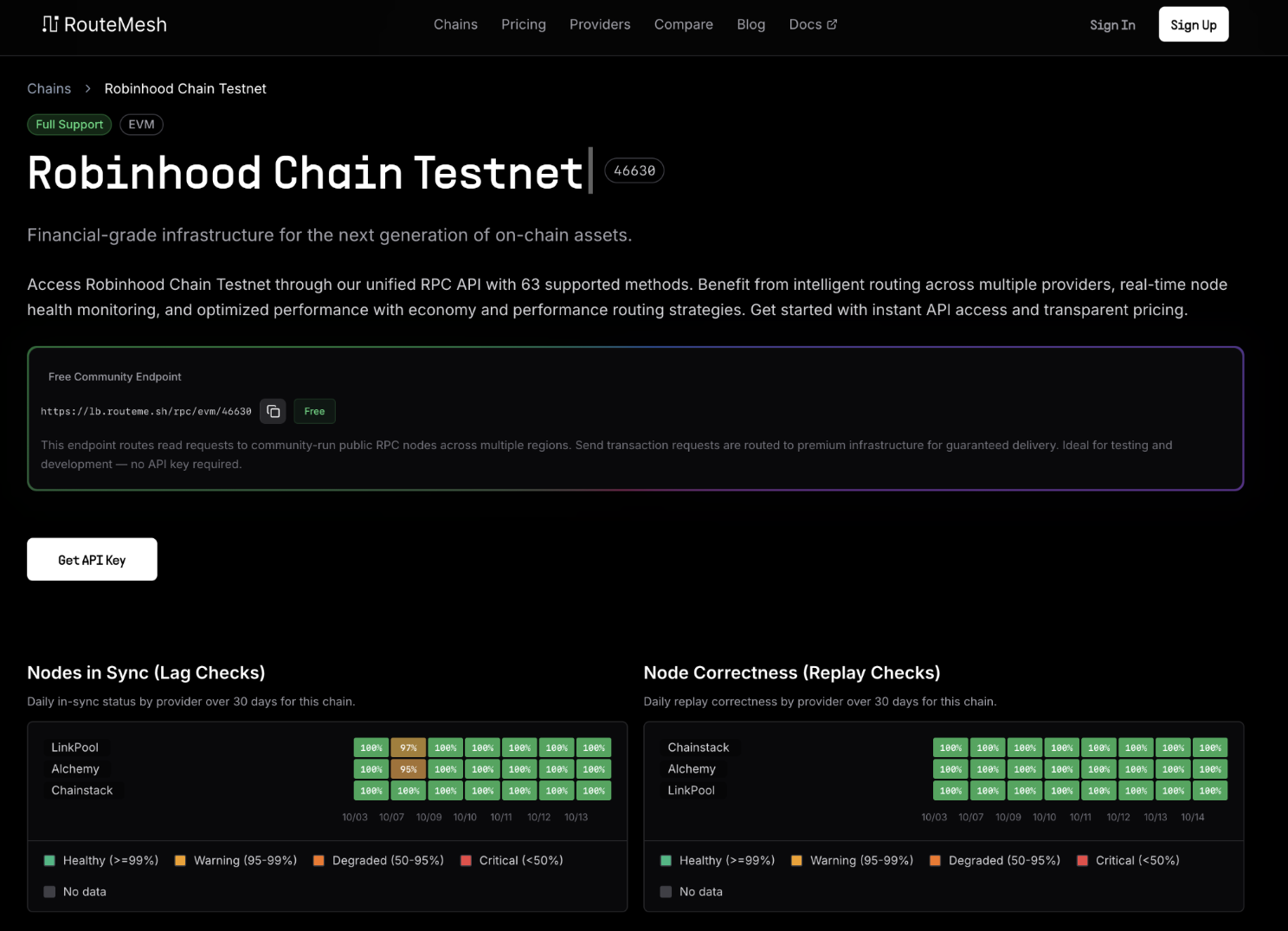
RouteMesh provides a unified RPC interface that routes requests across multiple infrastructure providers. Its Robinhood Chain testnet listing describes node-health monitoring and economy and performance routing strategies.
The listing includes a free community endpoint without an API key. Read requests use community infrastructure, while transaction submissions route to premium infrastructure. RouteMesh also lists WebSocket subscriptions with notification-based pricing.
This model suits teams that want to evaluate provider routing without building that layer themselves.
What to check: The verified listing covers Robinhood Chain testnet. Confirm mainnet availability, provider coverage, and production terms before choosing RouteMesh for a live application.
5. Alchemy
Best for: teams already building with Alchemy’s APIs and developer tools.
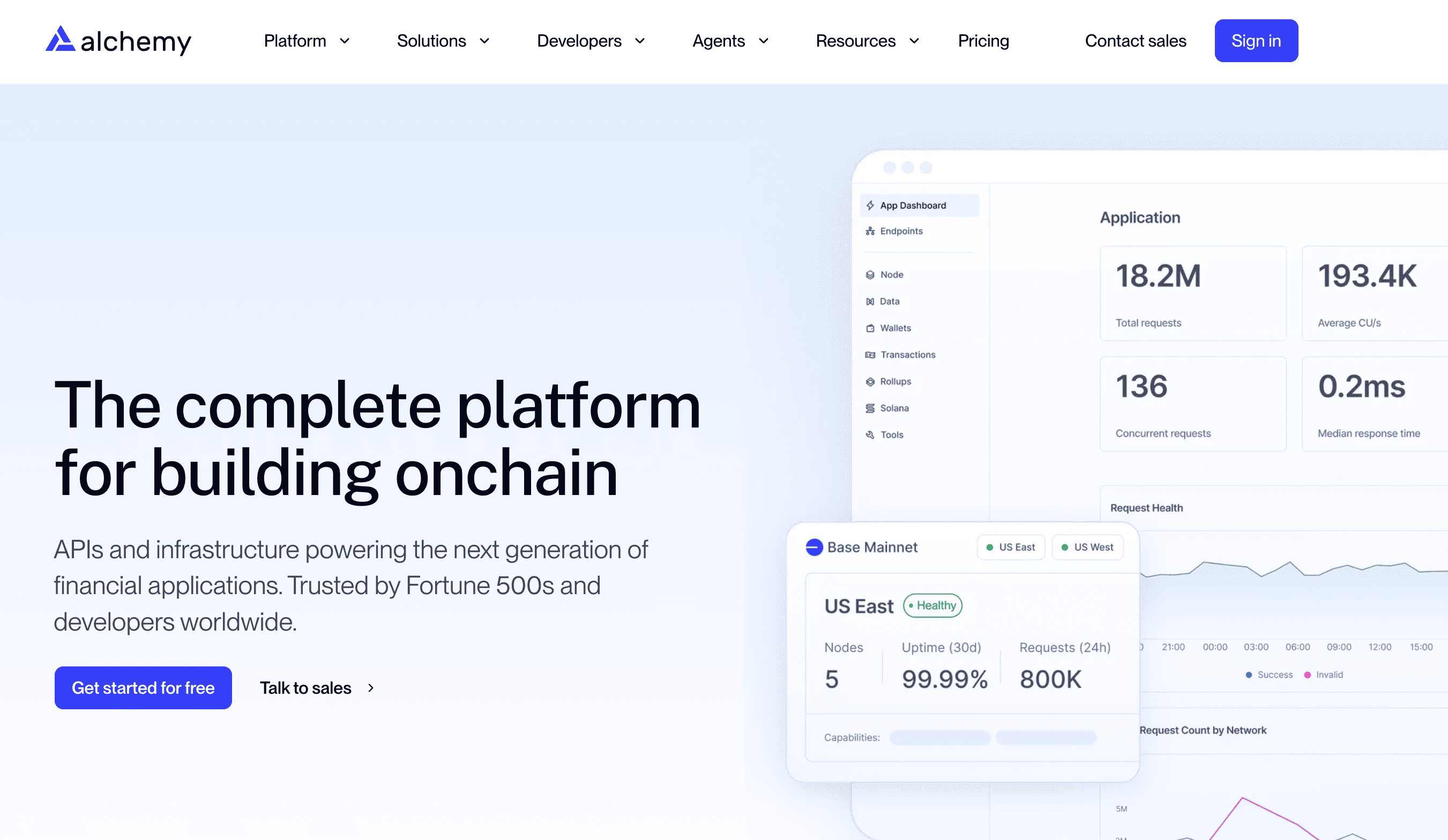
Alchemy supports Robinhood Chain through HTTP RPC and WebSocket connections. Its documentation provides a familiar workflow: create an application, obtain an API key, and connect using the endpoint for the target network.
Alchemy’s mainnet announcement also lists webhooks, gas sponsorship, and data APIs. These can help teams combine node access with application services, subject to the product coverage and plan available for their requirements.
For existing Alchemy users, Robinhood Chain support can reduce the work of introducing another infrastructure platform.
What to check: Verify each required API on Robinhood Chain and test its billing impact. RPC support alone does not establish identical availability across every developer product.
How to choose a Robinhood Chain RPC provider
Start with the calls your application makes most often.
For wallets and payment-related services, test balance reads, transaction submission, and receipt retrieval. For indexers, focus on historical coverage, eth_getLogs ranges, and backfill throughput. For trading interfaces, measure response latency, data freshness, and WebSocket delivery.
Compare these requirements across providers:
- Latency and reliability: measure typical and slow responses, errors, and timeouts.
- Method coverage: verify historical queries, logs, and debug methods.
- Deployment requirements: choose shared, dedicated, or self-hosted infrastructure.
- Total cost: include method weights, overages, subscriptions, and add-ons.
- Recovery behavior: test retries, WebSocket reconnection, and a fallback endpoint.
Which provider should you choose?
Chainstack leads this shortlist for its combination of benchmarked read performance and deployment flexibility. It is the strongest starting point for teams that want one provider across development, managed production, dedicated infrastructure, and self-hosted environments.
NOWNodes suits existing multi-chain integrations. Dwellir deserves consideration for historical queries and debugging. RouteMesh offers a routing-based option for testnet development, while Alchemy fits teams using its wider developer platform.
Before committing, run representative traffic through your primary and fallback endpoints.
Frequently Asked Questions
What is a Robinhood Chain RPC endpoint?
It is an interface that lets an application read blockchain data, call smart contracts, submit signed transactions, and retrieve transaction results.
Which Robinhood Chain RPC provider is fastest?
The OpenChainBench snapshot cited above lists Chainstack as the private-endpoint median latency leader for the tested block-read method. Results depend on region, endpoint, method, and measurement window.
Can I use Ethereum development tools on Robinhood Chain?
Yes. Robinhood Chain is Ethereum-compatible, so familiar tools such as ethers.js and viem can connect through a compatible RPC endpoint. Network documentation
Can I run Robinhood Chain nodes on my own infrastructure?
Yes. Chainstack Self-Hosted supports Robinhood Chain mainnet and testnet, with deployment and lifecycle management on infrastructure you control.
Do I need an archive endpoint?
You need historical-state access when your application queries older contract state. Confirm retention and method coverage separately for transaction history and log backfills.


Be the first to comment