



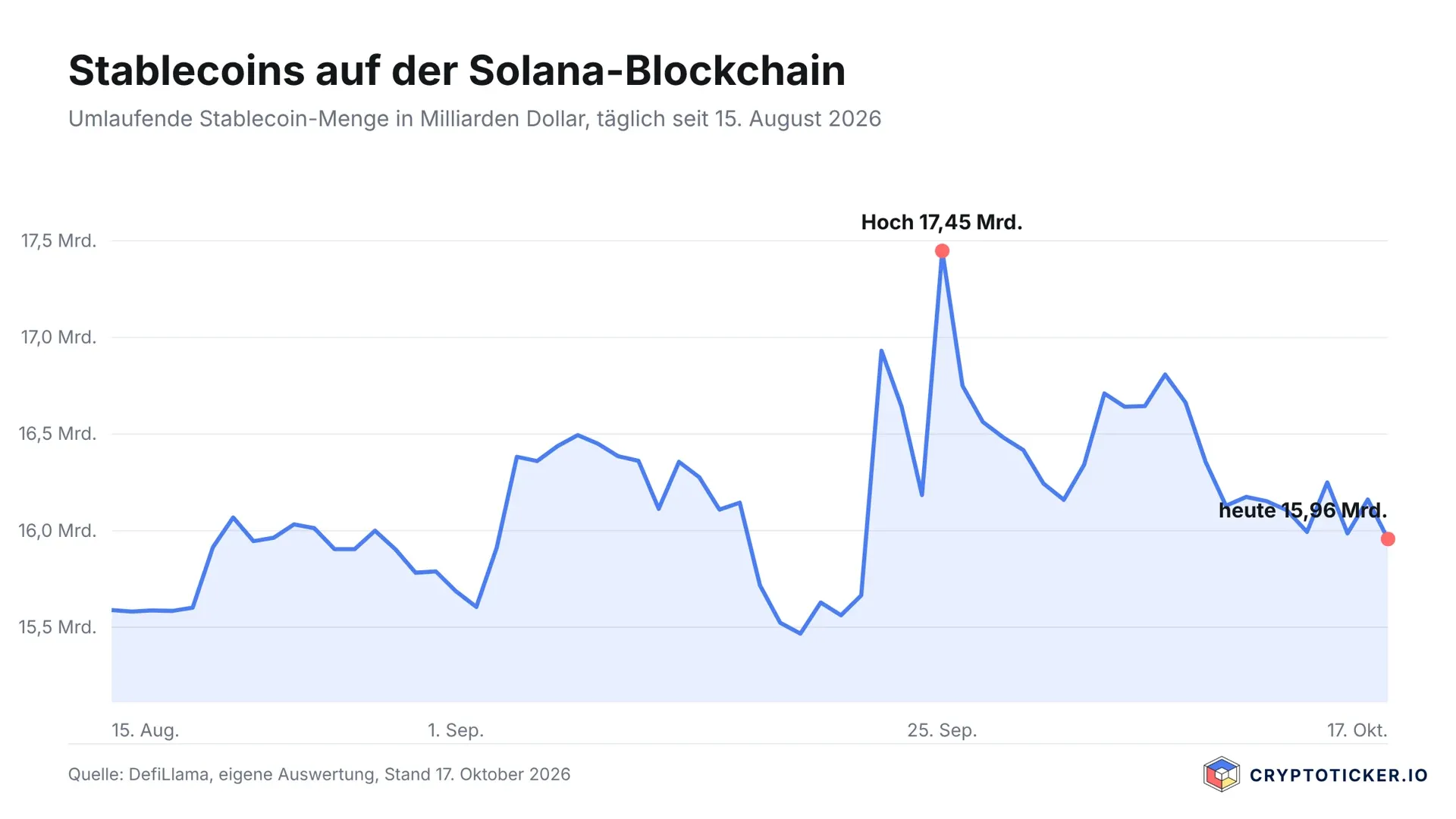
Solana traded at $103.34 on Saturday evening, around 1 percent below its Friday midday level and 6.2 percent below where it stood a week ago. The number that says more about the coming weeks than the daily price does not appear on the chart at all: the Solana blockchain now holds $15.96 billion in stablecoins, against $17.45 billion on September 25. That is $1.49 billion less purchasing power within three weeks, a drop of 8.6 percent. The figures come from DefiLlama’s daily series, which we analysed ourselves for this article.
Why it counts: stablecoins are the money already sitting on a blockchain. Anyone trading on Solana normally swaps USDC or USDT for SOL rather than wiring euros from a bank. When that balance shrinks, so does the amount that can flow into the market without a fresh transfer. Where the price can point over a horizon of months is covered in our Solana price prediction; this article looks at what will carry or break the next few days.
Start with the arithmetic. With 589.38 million SOL in circulation and a market value of $60.9 billion, the blockchain’s entire stablecoin base now equals barely more than a quarter of SOL’s market capitalisation. Three weeks ago it was almost a third. If you hold Solana, the question is therefore not only the $100 level, but whether fresh money arrives behind it.
Solana’s stablecoin base falls below its early September level
The path matters more than any single daily bar. On September 1 the blockchain held $15.69 billion in stablecoins. By September 25 the figure had risen to $17.45 billion, the high of the past two months. It has fallen since: $16.25 billion on October 14, $15.99 billion on October 15, $16.16 billion on October 16 and $15.96 billion today, October 17. The balance is back below its early September level for the first time since late summer.

One caveat belongs with that, otherwise a measurement turns into a claim. The series counts the circulating supply of every stablecoin issued on Solana, not the amount actively traded. Part of the decline may come from capital moving to other blockchains, part from redemptions at the issuer. Which of the two dominates cannot be read from the aggregate series alone. What can be said is this: the money is no longer standing ready on Solana.
How a shrinking stablecoin supply feeds through to the Solana price
The mechanism is unspectacular, and reliable for exactly that reason. Every purchase of SOL on a decentralised exchange on Solana needs a counterparty in a stablecoin. The trading pairs in the liquidity pools consist of SOL and USDC or USDT. The deeper that pot, the larger the order that can pass through without moving the price. Cut the pot by 8.6 percent and the same sell order moves the price further than it did three weeks earlier.
That explains a pattern many investors read as mere moodiness: in phases with a shrinking stablecoin base, daily swings get larger in both directions. Trading volume across all exchanges came to $1.89 billion over the past 24 hours. Measured against a stablecoin base of just under $16 billion, that is a lot of movement on a thin footing.
The second effect is slower. Stablecoins on a blockchain also serve as collateral for loans and deposits in applications. As the money withdraws, deposit rates there fall and loans in SOL become more expensive to collateralise. Both brake the build-up of leverage. For the price that is negative in the short term and healthy over the medium term, because a recovery is then less likely to be choked off by liquidations.
What has changed since our Solana outlook of October 16
Yesterday this slot dealt with locked capital and falling fees. The price has since dropped from a daily average of $105.34 to $103.34, a fall of 1.9 percent. Over the same period the stablecoin base slipped from $16.16 billion to $15.96 billion, which is $205 million in a single day.
Two levels from yesterday’s article have held: the 24-hour low sits at $102.51, and the round $100 was never tested. What is new is the number that gives this article its hook. Yesterday it was an open question where the next wave of buying pressure would come from. Today it is possible to put a figure on how much purchasing power has flowed out instead.
Ten consecutive trading days of outflows from the US spot ETFs
The second source of money is weakening too. According to data from the research firm SoSoValue, reported by the industry service TokenPost on October 17, a net $12.7 million left the American spot ETFs on Solana on October 16. That was the tenth consecutive trading session with outflows, a run that has been going since October 5. On October 15 the figure was $9.8 million.
The distribution is the remarkable part. A single fund accounted for the entire October 16 outflow: the Bitwise Solana Staking ETF, ticker BSOL. The remaining products, trading as VSOL, FSOL, TSOL, SOEZ, MSOL and GSOL, recorded exactly zero movement. Not one of the funds reported an inflow. Since launch, the group’s net inflows still add up to $1.549 billion, so the balance remains clearly positive.
Two things can be read from that. First, the outflows are small so far against the stock that has been built: $12.7 million is less than 1 percent of the cumulative inflow. Second, zero movement at six of seven products means institutional buyers are currently neither stepping in nor selling. Both sides are waiting. That wait is precisely why the stablecoin figure carries more information at the moment than the ETF figure.
The levels for the coming days: $102.51 below, $107.71 above
On the downside, the daily low of $102.51 counts first. Below it lies the round $100, which has served since October 13 as a condition in a concrete transaction: one provider tied a share buyback to Solana staying above that threshold. Conditions of that kind create buying interest just above the level, which in practice makes it sturdier than a round number deserves to be.
On the upside the first serious hurdle is $105.11, the day’s high, and above that $107.71. From the current level, the distance to the second hurdle is 4.2 percent. Further up, October 8 stands in the way at $116.23, the level that preceded the latest setback. Reaching it would take another 12.5 percent.
The case for these levels rests on liquidity, not on a chart pattern. With a thin stablecoin blanket, round numbers and fresh daily highs become the places where orders pile up. To use one of these levels as a signal, put the traded turnover alongside it: a break on $1.9 billion of daily turnover weighs differently from one on twice that.

Alpenglow on October 21: 150 milliseconds instead of 12.8 seconds
At around 14:50 UTC on October 21, the Alpenglow consensus mechanism replaces the existing TowerBFT on the main network. Anza, the developer house that prepared the switch, gives a target finality of roughly 150 milliseconds. Finality is the time after which an entry counts as definitive and can no longer be reversed. The figure today is about 12.8 seconds.
The date matters to investors for two reasons, and neither of them is the price. First, network changes of this size rarely run entirely smoothly: if you plan to move SOL on Monday, build in a buffer. Second, the outcome decides the argument Solana takes into competition with faster settlement systems. Finality below one second is the precondition for payments and tokenised securities to settle on the blockchain without anyone waiting for confirmation.
What the date is not: a price driver with a timetable. Announced upgrades are as a rule priced in before they happen. The price has fallen a good 11 percent since the announcement.
SIMD-550 pushes the nominal Solana staking yield down over three years
In the background runs a decision that asks more of SOL holders than any daily swing. The infrastructure provider Helius has proposed, under SIMD-550, doubling the annual reduction in the issuance rate from 15 to 30 percent. Terminal inflation of 1.5 percent would be reached in 2029 instead of 2032 as previously planned.
The asset manager 21Shares worked through what that does to the yield in an analysis dated August 26. The nominal staking yield stood at around 5.25 percent on August 24. After the change it would be about 4.34 percent in the first year, around 3 percent in the second and about 2.25 percent in the third. Together with the related proposal SIMD-553, roughly $1.4 billion to $1.5 billion less in newly issued SOL would enter circulation over six years. On the same calculation, 2 of 738 validators would become unprofitable in the first year, and about 30 by the third.
The state of play is not clear-cut, and that belongs in the picture. The vote opened on August 23 under the identifier SGP-0002 and requires a two-thirds majority by weighted stake. The industry service The Defiant reported that validators had approved it in this first governance vote; 21Shares still described the process as ongoing in the analysis cited above. No date has been set for technical activation. Calculating a staking yield of 5 percent today therefore means working with a number that may be a different one in twelve months. How providers differ in fees and payout is set out in our overview of staking providers and yields.
Holding period, tax allowance and staking: the German calculation
In Germany, more hangs on the date of sale than on the price difference. A sale of SOL from private assets is tax-free under Section 23 of the Income Tax Act if more than one year lies between purchase and sale. Sell within the year and the gain is taxed at your personal rate, with an exemption threshold of 1,000 euros applying since the 2024 assessment year to all private disposals in a year. An exemption threshold is not an allowance: exceed it by one euro and the entire gain becomes taxable.
Staking adds a second layer. Rewards allocated count as other income at the time they are received under Section 22 No. 3 of the Income Tax Act, with a separate threshold of 256 euros a year. The Federal Ministry of Finance clarified in its letter of May 10, 2022 that the one-year period applies even when the coins are staked; the extension to ten years once under discussion is off the table. We track what is still moving politically in the status of the holding period reform.
From that comes a concrete task for this weekend. If you bought SOL more than a year ago, you hold a tax-free position and need not sit out a setback. If you added over the summer, a sale falls inside the period and is taxable, so keep the 1,000-euro threshold in view. The evidence comes from a clean record of every purchase, sale and staking receipt; which programmes map that reliably in Germany is set out in our comparison of crypto tax tools.
Buying route and custody under the MiCA rules
Since the EU’s MiCA regulation became fully applicable, only licensed providers may trade or hold crypto assets for retail clients in Germany. In practice that means checking, before a purchase, whether the provider holds a licence in an EU member state and whether your SOL is held separately from the company’s own assets. Both points sit in the terms and conditions, not in the advertising.
Custody follows the same logic as the stablecoin blanket, only in reverse. Leaving coins on an exchange increases the amount that can be sold there at short notice. Moving them to your own wallet takes them out of the short-term supply and calls for a backup of the recovery phrase that survives a house fire. For amounts beyond a few hundred euros, that is not a matter of taste.
Our assessment: without fresh stablecoin capital the fuel is missing
In the view of our editorial team, the stablecoin figure currently weighs more heavily than the chart levels. The evidence: $1.49 billion less stablecoin cover since September 25, ten consecutive trading days of ETF outflows since October 5, and zero movement at six of seven fund products. Until one of those three series turns, the basis is missing for a rise that goes beyond recovering the daily high. A break above $107.71 without a rising stablecoin base would be a purchase on credit.
A fair amount argues against that reading, and it belongs in the same assessment. The cumulative ETF inflow of $1.549 billion remains in positive territory, and the outflow of the past ten days is small by comparison. Despite a weak October, the price sits 2.5 percent above where it stood 30 days ago. And Alpenglow brings a technical improvement on October 21 that hardens the case for payments on this blockchain. An assessment is not a recommendation: crypto assets can lose their entire value.
Solana at $103: without new stablecoins the fuel is missing
- Put the stablecoin series next to the price before you treat a level as a signal. Which stablecoins are tradable in Germany, and how they differ in backing and licensing, is set out in our stablecoin comparison.
- Run your staking yield at 4.3 percent rather than 5.25 percent before SIMD-550 is activated, and check whether your provider still absorbs its fee out of that. The terms are in the overview of staking providers.
- Settle the licensing question and the segregation of client holdings at your trading venue before the next purchase. Which venues are licensed in Germany and what they cost is shown by the crypto exchange comparison.
(As of October 17, 2026. This article is not investment advice. Prices and fee structures change; check the terms with the provider before you buy.)



Be the first to comment