


TRON’s stablecoin settlement business grew in the third quarter of 2026, while the supply of its native TRX token increased on every day from July 1 through October 16. The blockchain added 125.8 million TRX in Q3 and another 22.9 million over the first 16 days of October, after subtracting tokens burned.
TRON can handle more dollar transfers without destroying more of its native token than it creates. TRON DAO Research reported $2.2126 trillion in Q3 stablecoin settlement, up 5.1% from Q2. TRX supply nevertheless kept expanding into October.

TRON’s design allows these outcomes to coexist: reusable resources can cover network activity, while block-production and voting rewards continue to mint TRX. October’s measured shortfall shows how far the network was from supply balance and how closing the gap would affect resource payers and reward recipients.
TRONSCAN’s July, August and September daily records contain 92 observations covering the full third quarter. Issuance exceeded burns on every date. The October 1–16 records add another 16 positive readings, bringing the sample to 108 consecutive days.
| Period in 2026 | TRX issued | TRX burned | Net TRX issued |
|---|---|---|---|
| Q3: July 1–Sept. 30, 92 days | 360,217,352 | 234,453,624 | 125,763,728 |
| Oct. 1–16, 16 days | 62,650,984 | 39,778,374 | 22,872,610 |
CryptoSlate’s sums of the daily issuance and burn records show 148.6 million TRX added over the window. The figures were retrieved on October 17 and exclude that incomplete day.
The scale was modest. Q3’s net addition amounted to approximately 0.133% of an opening supply of about 94.850 billion TRX.
Stablecoin supply is a separate stock. The quarterly report puts combined USDT and USDD balances on TRON at $93.88 billion, up 5.5% from Q2. Those dollar tokens and TRX perform different roles, so growth in one supply does not determine the direction of the other.
Settlement measures value transferred. Its 5.1% quarterly increase differs from the report’s 3.9% increase in daily average settlement because Q3 had 92 days and Q2 had 91.
How reusable resources and rewards affect TRX supply
TRON’s resource rules meter transaction size and computation. Bandwidth covers the bytes recorded on the blockchain; Energy covers smart-contract execution. The dollar value of stablecoins moving through a transaction does not, by itself, set either cost.
Users can obtain resources by committing TRX through staking, or receive delegated resources from another account. TRON’s documentation describes Bandwidth and Energy recovering over a rolling 24-hour window. Resources used at one time fully recover after 24 hours without further consumption; additional activity changes the recovery schedule.
Using those resources does not destroy the underlying staked TRX. The stake supports access that can be used repeatedly as capacity recovers. Delegation allows a receiving account to use resources supplied through someone else’s stake.
The fallback rules differ by resource. For an ordinary Bandwidth charge, the network first tries staked or delegated quota, then free quota. Each must cover the transaction’s entire byte cost. If neither can, TRX is burned for the full Bandwidth charge.
Energy can cover part of the caller’s smart-contract execution cost, with TRX burned for the caller-side remainder within the applicable fee limit. Resource provision therefore matters alongside activity when assessing burns.
On the issuance side, TRON pays block producers and voters with newly minted tokens. Its documented consensus rewards list 8 TRX per block for production and 128 TRX per block for voter rewards. Governance can change these parameters.
Distribution also matters. Under TRON’s staking and voting reward model, voters can receive a share after the representative retains its brokerage cut. Simply holding unstaked TRX does not confer the same reward claim.
A resource user, a staker and a passive token holder can therefore experience the network’s economics differently. One uses transaction capacity, another supplies stake and may vote for rewards, while an unchanged token balance receives no automatic increase merely because the network issues more TRX.
October’s gap to supply balance
Over October 1–16, burns offset approximately 63.5% of new issuance. Average daily issuance was 3.916 million TRX, compared with 2.486 million burned, leaving a daily average gap of 1.430 million TRX.
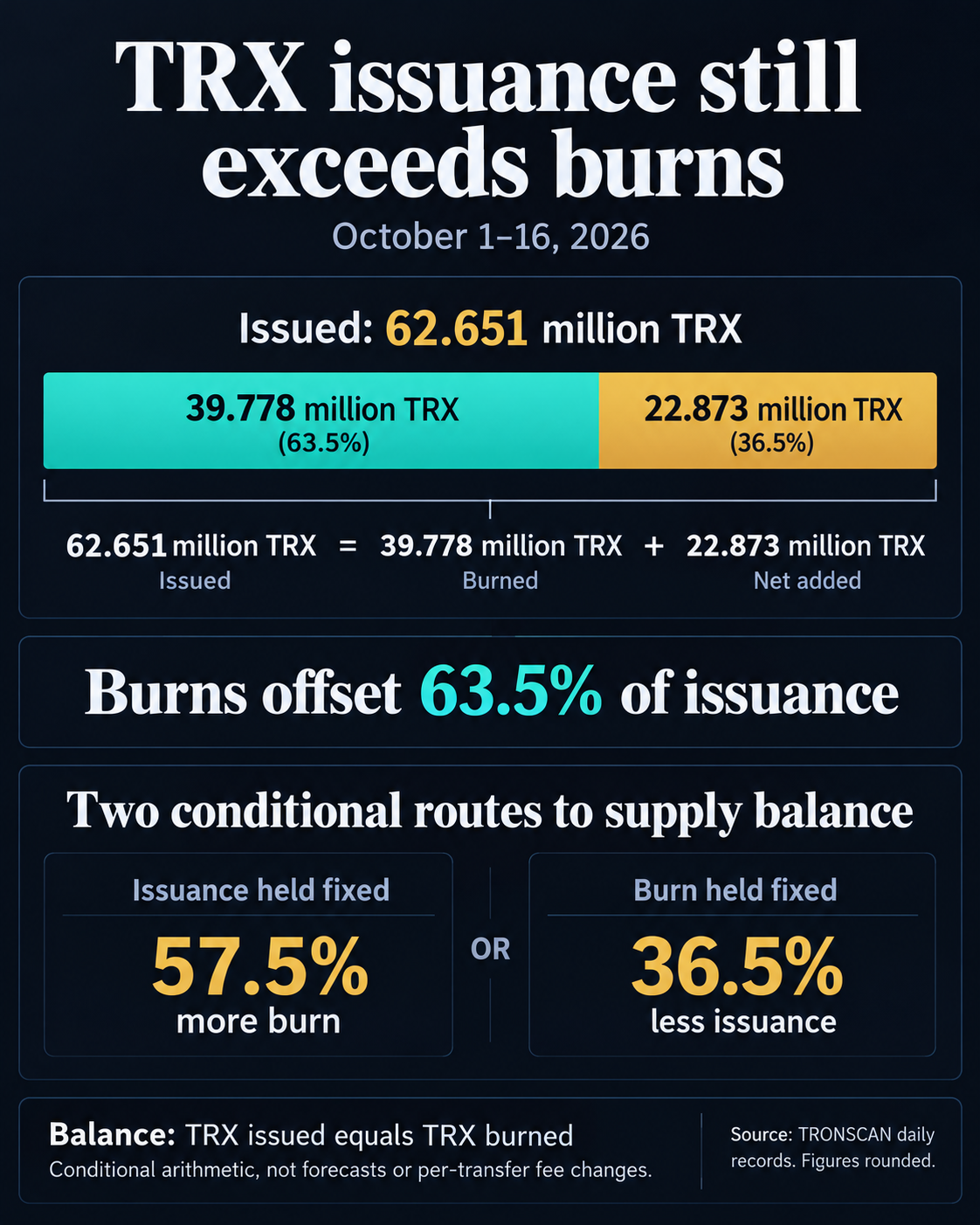
Holding issuance at the observed 62,650,984 TRX, aggregate burns would have needed to increase from 39,778,374 TRX to 62,650,984 TRX to reach balance. The additional 22,872,610 TRX represents a 57.5% increase over observed burns.
Holding burns fixed instead, issuance would have needed to fall by 22,872,610 TRX, or 36.5% of the observed issuance total. The percentages differ because each uses a different starting denominator.
These are separate arithmetic comparisons for the same 16-day window. Aggregate burn depends on both resource use and charging, so a 57.5% increase in total burn need not mean a 57.5% increase in each transfer’s fee.
At supply balance, new tokens could still be issued and destroyed in equal amounts. Deflation would require burns to exceed issuance over the measured period.
Holding issuance and other conditions fixed, a route that closes the gap entirely through more burn requires more TRX to be destroyed through resource payments or other burn charges. That cost falls on the accounts funding those charges.
A route that closes it entirely through lower issuance reduces the aggregate newly minted reward pool, holding other conditions fixed. Individual allocations depend on the reward rules and brokerage.
For holders whose balances remain unchanged, positive net issuance increases the supply against which their tokens are measured. Q3’s roughly 0.133% expansion provides the scale of that effect. Reward recipients may add tokens to their balances, while staked resources provide utility through recurring access to network capacity.





Be the first to comment