



The proposed Canary Staked INJ ETF is designed to give investors exposure to Injective’s INJ token while adding staking rewards to the fund’s holdings. Its structure could offer a way to access staking through brokerage accounts, but rewards are not guaranteed and the fund would still be exposed to INJ’s price volatility.
How Injective Staking Supports the Network’s Security
Injective uses a proof-of-stake model in which validators confirm transactions and help secure the blockchain. INJ holders can delegate tokens to validators, contributing economic backing to network operations in exchange for potential staking rewards. Validators take commissions from those rewards, while delegators remain exposed to validator performance and network rules.
According to Injective’s explanation of the proposed ETF, staking rewards would be earned in INJ and retained within the fund rather than distributed as cash to shareholders. This means rewards could increase the amount of INJ represented by the fund’s holdings over time. However, the value of those holdings would still rise or fall with the market price of INJ.
Also Read: Injective Announces Second Stockdrop as INJ Price Eyes Bullish Reversal

How Canary’s ETF Would Stake INJ and Handle Rewards
The fund’s sponsor, Canary Capital, would oversee staking through third-party providers, while a custodian would safeguard the fund’s INJ. The providers would manage delegation to validators rather than having the ETF operate its own validator. After applicable staking fees, rewards would flow into the fund’s custody wallets and be reflected in its net asset value.
The SEC-filed prospectus says the sponsor anticipates staking at least 90% of the fund’s INJ under normal circumstances. The remaining tokens could help meet redemptions and cover expenses without requiring the fund to immediately unstake assets.
The September filing identifies the proposed exchange ticker as INJS, while Injective’s October explainer calls the product INJC, so the final ticker should be checked against subsequent filings.
Why the 21-Day Unbonding Period Matters for Investors
Injective’s staking mechanism requires a 21-day unbonding period when delegated INJ is withdrawn from staking. During that time, the tokens cannot be freely transferred and do not earn staking rewards. This creates a potential mismatch between the fund’s need to meet redemptions and the time required to release staked assets.
Keeping some INJ unstaked is one way the fund plans to manage that liquidity constraint. However, a large redemption demand could still complicate asset management if readily available tokens were insufficient. Investors should also remember that ETF shares may trade at a premium or discount to the fund’s net asset value, as the prospectus warns.
INJ’s 7-Day Decline Highlights Risks to ETF Staking Returns
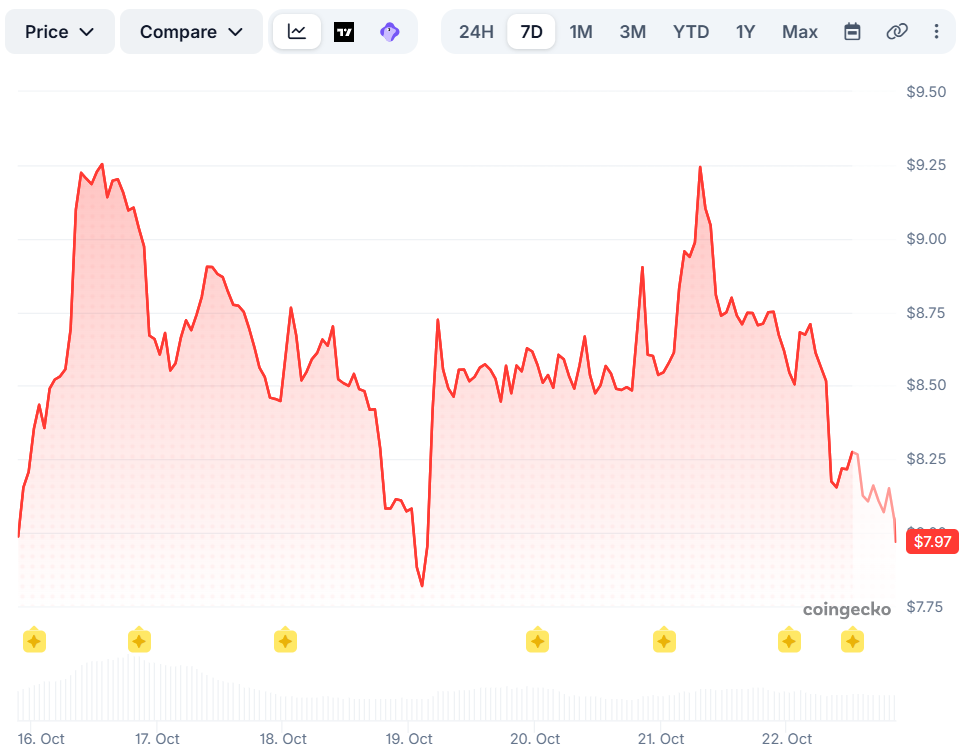
Market conditions remain important even if the fund accumulates additional INJ through staking. On October 22, 2026, CoinGecko’s market data showed INJ trading around $7.97, with a market capitalization of approximately $799.9 million.
Its seven-day performance was down around 0.1%, while the token remained 84.8% below its all-time high of $52.62, recorded in March 2024. This weak price performance highlights a key risk for the proposed ETF: staking rewards may add INJ to the fund, but they may not offset losses if the token’s market value continues to decline.
Other risks include validator downtime, slashing and changes to the staking program. If a validator is penalized, delegated tokens could suffer losses, while lower network rewards would mean less additional INJ for the fund.
The SEC filing also makes clear that the registration statement is preliminary and that the securities cannot be sold until it becomes effective; investors should not interpret the proposal as confirmation that the product is already available.
Also Read: Injective RWA Perpetuals Tops $1.1B as INJ Price Eyes a Breakout Toward $53
This article contains market analysis and price predictions. These are not guarantees. Crypto markets are volatile. Always DYOR. Not financial advice.


Be the first to comment