



In a recent development, the Blockchain Association (BA) has urged the U.S. Congress to introduce clearer and fairer tax rules for cryptocurrencies. They believe that existing regulations create uncertainty and unnecessary compliance burdens for the 67 million Americans who hold and use digital assets.
Therefore, in a letter dated the 22nd of October, 2026, addressed to Senate and House leaders, the industry group outlined its Digital Asset Tax Principles. In fact, they even called for bipartisan legislation that reflects how digital assets function today.
Besides this, the BA also launched TaxClarityforAmerica.com to encourage Americans to contact their elected representatives and support the proposed reforms.
What is the motive behind this?
With this move, the association is seeking a meaningful ‘de minimis’ exemption to simplify taxes on small crypto transactions and cash-like tax treatment for stablecoins. This in turn is intended to reduce reporting requirements potentially.

At the same time, the BA also proposed taxing mining and staking rewards when they are sold or disposed of, rather than when users initially receive them. This is a step that would prevent tax liabilities on rewards that have not been converted into cash.
Additionally, it wants broker reporting requirements to apply only to intermediaries that have custody or control of customer assets. This excludes non-custodial developers and infrastructure providers to protect privacy.
Key recommendation by the Blockchain Association
Another key proposal is to prevent taxes from being triggered when users transfer digital assets between their own wallets, interact with smart contracts, or move assets across blockchains. However, this comes with a condition that their underlying economic ownership remains unchanged.
The association also supports extending wash-sale rules to crypto to prevent investors from claiming artificial losses while ensuring that everyday transactions are not unfairly penalized.
That said, other recommendations include allowing crypto investments in retirement accounts, clarifying staking rules for trusts and investment vehicles. Additionally, permitting mark-to-market accounting for eligible digital assets, simplifying charitable donations of regularly traded cryptocurrencies. It also proposes recognizing blockchain development as eligible research and development activity for tax credits.
The group further advocates a statutory safe harbor for foreign investors trading digital assets on U.S. exchanges. Here, they argue that clearer tax rules could attract liquidity, encourage businesses to remain in the U.S, and prevent innovation from moving offshore.
The unsaid caveat
However, it is important to note that these proposals have not yet been enacted into law.
Instead, they just represent the Blockchain Association’s recommendations to Congress, and any changes would require legislative action before taking effect.
Still, Coinbase CPO applauded this move when he noted,
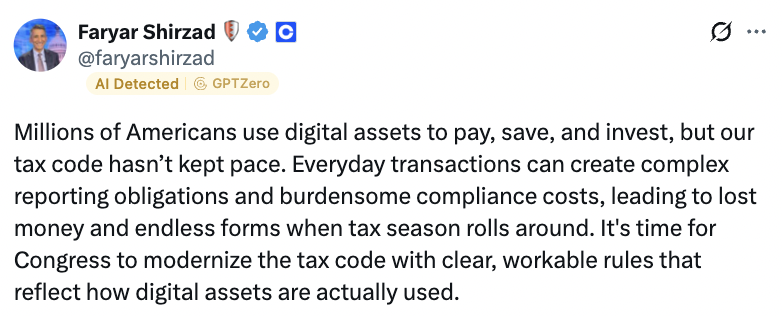
Notably, this coincided with the Blockchain Association (BA) submitting a comment letter to the U.S. Treasury on proposed GENIUS Act regulations, while warning against excessive compliance burdens on crypto firms, exchanges, and DeFi platforms.
Interestingly, all of this follows the U.S. CFTC, led by Chairman Michael Selig, plans to bring more of the crypto market under a unified federal framework after the CLARITY Act failed to advance in September.
Final Summary
- Blockchain Association outlined its Digital Asset Tax Principles and called for bipartisan legislation.
- All the suggestions given by BA are just recommendations to Congress and are not yet accounted for as law.


Be the first to comment