



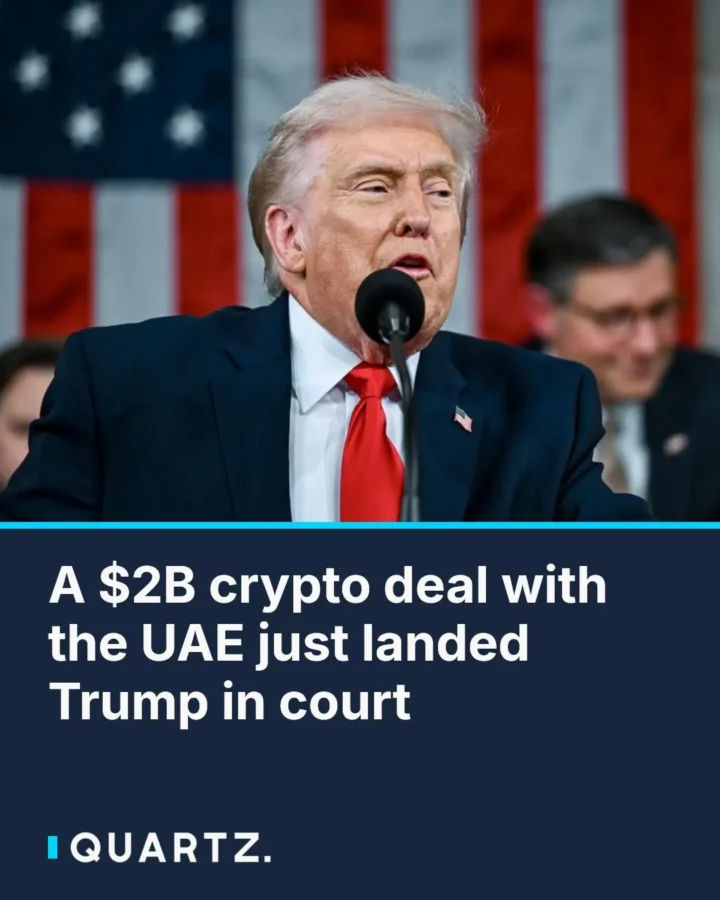
The Circle Shareholder Lawsuit has brought renewed scrutiny to President Donald Trump’s cryptocurrency business and its alleged financial links to the United Arab Emirates (UAE). Filed on October 22, 2026, the complaint accuses Trump and World Liberty Financial of receiving prohibited foreign benefits through two cryptocurrency transactions worth billions of dollars.
J. Benjamin Greenberg, a Circle shareholder and former employee, filed the complaint in federal court in Washington. He alleges that the transactions violated the U.S. Constitution’s Foreign Emoluments Clause and harmed Circle investors by strengthening a competing stablecoin business. The lawsuit seeks the return of alleged illegal profits and other damages.
The case focuses on a $500 million purchase of a 49% stake in World Liberty Financial and a separate $2 billion investment in Binance funded through World Liberty’s USD1 stablecoin. The allegations remain unproven, and the court has not ruled on whether the transactions violated the Constitution.
Also Read | SEI Price: 3 Major Catalysts to Monitor Following a 7.86% Decline

Circle Shareholder Lawsuit Focuses on Two UAE Deals
In the first case, the deal related to an investment fund owned by Sheikh Tahnoon bin Zayed Al Nahyan, who is the national security advisor of the United Arab Emirates and also a member of its ruling family. This party committed itself to acquire a 49% stake in World Liberty Financial for $500 million days before Trump’s inauguration in January 2025.
In the lawsuit, it is alleged that Trump obtained financial gains as a result of this transaction upon his assuming office. In addition, the lawsuit also scrutinizes the $2 billion investment by MGX Company of Abu Dhabi in Binance cryptocurrency exchange, using World Liberty’s USD1 stablecoin to make this deal. As per the complaint, these deals led to the creation of prohibited foreign financial gains.
Furthermore, the complaint makes linkages between these crypto deals and some government decisions taken with regard to the advanced artificial intelligence chips of the UAE. There is also mention of a presidential pardon in relation to the overall affair, which requires separate scrutiny.
Foreign Emoluments Clause Drives Legal Challenge
The case is based on the Foreign Emoluments Clause, which prohibits federal officeholders from receiving payments from foreign states without approval by Congress. According to Greenberg, the transactions provided Trump with some economic advantages connected with the interests of foreign governments during his term as president.
The plaintiff also claims that World Liberty’s growing business activity created unfair competition for Circle, the company behind the USDC stablecoin. The complaint seeks a court declaration concerning the alleged constitutional violations, disclosure of other foreign crypto-related benefits, and the return of profits determined to be unlawful.
World Liberty Financial rejected the allegations. Its representatives described the case as without merit and said the company complies with U.S. laws and regulations. The White House denies any conflicts of interest in the matter, and Trump and his relatives earlier denied similar accusations in relation to their cryptocurrency projects.
Circle and Binance Have a Separate Commercial Agreement
Circle’s September 22 release gives more background on the association between Circle and Binance. In the document, the firms revealed that Binance had made a strategic equity investment worth $100 million in Circle and entered into a new five-year commercial agreement to expand USDC adoption in developing economies.
As per the agreement, Binance will work on integrating USDC into its platform, while Circle will supply infrastructure for using the stablecoin. The aforementioned business arrangement is independent of the $2 billion Binance investment of USD1 mentioned in the lawsuit. Neither does it create any link between the agreement and the constitutional violations.
Circle clarified that it has no role in the shareholder lawsuit, which was initiated by Greenberg derivatively on behalf of the company. Circle further refused to make any comments on the ongoing lawsuit. This point is crucial because the lawsuit is not a company-initiated one but derivative in nature.
USD1 and USDC Competition Faces Further Scrutiny
The increasing economic significance of stablecoins pegged to dollars. USD1 is released via the business conducted by World Liberty, whereas USDC is released by Circle. Stablecoin usage, exchange, and commercial partnerships impact the competitive situation of their respective issuers; however, the claims made in the lawsuit do not prove the fact of the legally remediable loss made by Circle.
Furthermore, the case occurs at a time when there is a debate in Washington concerning the regulation of cryptocurrencies and possible conflicts where public officials’ private business interests come into play. Lawmakers have questioned Trump-linked crypto ventures as Congress considers digital asset rules. The lawsuit adds a legal challenge to those debates, but it does not determine the outcome of pending legislation or future investigations.
The following course of action depends on court proceedings and evidence brought forth by both parties. Greenberg is looking for financial relief and exposure of other foreign benefits. The court needs to consider constitutional claims, answers from defendants, and the harm caused to Circle in order to decide if the remedy is appropriate.
Also Read | Injective Burns 7.2M Tokens as INJ Price Eyes Breakout Amid Revenue Growth



Be the first to comment