




All news is rigorously fact-checked and reviewed by leading blockchain experts and seasoned industry insiders.
- SOL failed again at the top of its range and slipped back below its short-term average.
- Alpenglow replaced Solana’s original consensus system and cut the target time for irreversible transactions to a fraction of a second.
- Stablecoin activity on Solana this year has already passed last year’s total by a wide margin.
- Hong Kong named Solana Company a strategic enterprise, and the firm plans to run validators in the city.
The Solana price is holding near $104.50 on Thursday, down about 3.6% in 24 hours, after buyers failed again to break the $108.50 to $108.70 ceiling on the 4-hour chart. The drop came a day after Anza switched on the Alpenglow consensus upgrade and on the same day Hong Kong named Nasdaq-listed Solana Company a strategic enterprise, two developments that have done little so far for a token still trading under its main trend averages.
Buyers keep losing the $108 fight
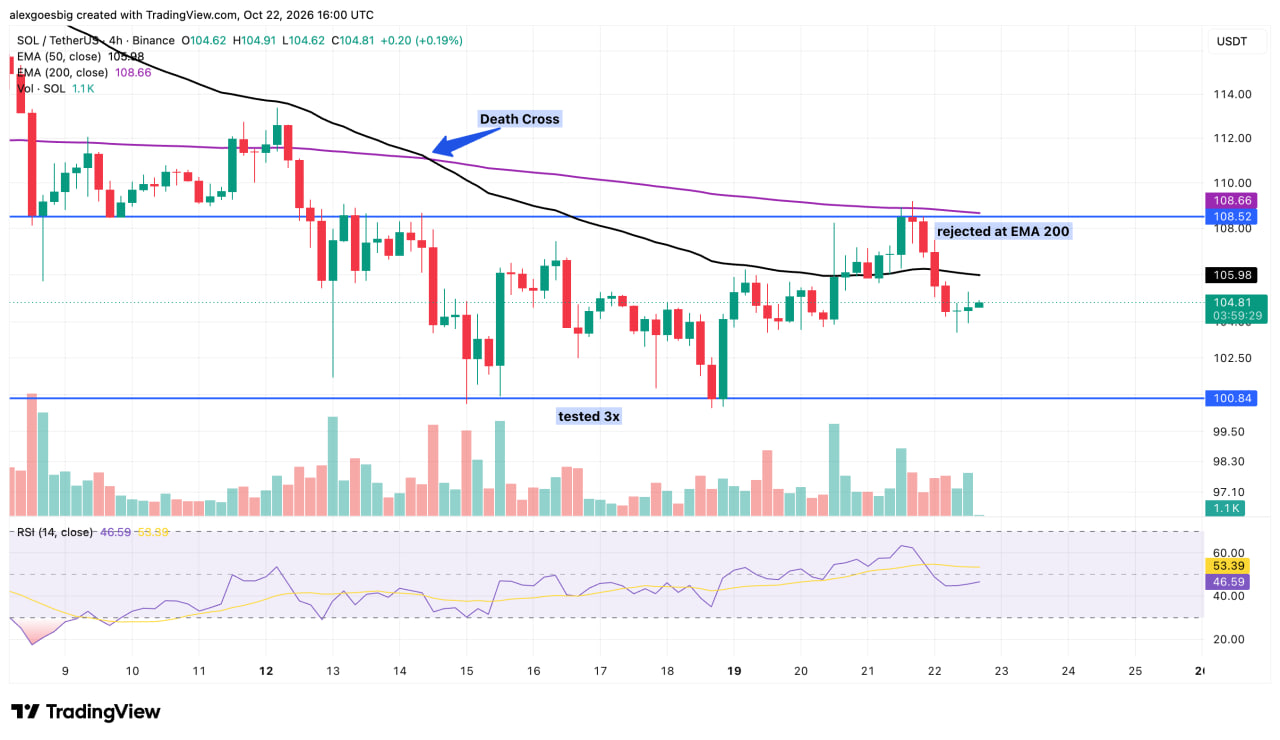
SOL has spent most of the past ten days between $100.84 and $108.52. On October 21, buyers pushed it to roughly $109.30 and briefly pierced the upper line, but the move stalled against the 200-period EMA at $108.66, and three straight red candles took the token back toward $104.60.
The 50-period EMA has stayed below the 200 EMA since a death cross around October 14 near $110.50. Price has now slipped back under the 50 EMA at $105.98, a level it reclaimed only a day earlier on the week’s strongest buying volume, which suggests the rally ran out of buyers the moment it met sellers waiting overhead. The RSI fell from around 65 at the October 21 peak to about 46.6, below its signal line at 53.4 and back under 50, so sellers now set the short-term pace while the reading remains far from levels that usually mark exhausted selling.
For the Solana price to recover, bulls first need a 4-hour close above $106 to put the $108.50 to $108.70 zone back in play, and a break through it would be the first close over the 200 EMA since early October, opening the way toward the $112 to $113.50 area of the October 12 top. Losing the $103.90 pullback low points to $102.50 and then to the $100.84 floor, which has absorbed three tests since October 15 and weakens with each visit.

SOL price ladder, 4-hour chart
October 12 top$112 to $113.50
200 EMA ceiling$108.52 to $108.66
50 EMA$105.98
SOL now$104.50
Pullback low$103.90
Range floor, tested 3x$100.84
12.8 seconds down to 150 milliseconds
Anza, the engineering firm that builds Solana’s main validator client, announced on X that Alpenglow went live at slot 459,653,000 at around 14:00 UTC on October 21, and said in a follow-up post that 654 validators took part in the switch. The upgrade retires TowerBFT, Solana’s consensus system since its 2020 launch, and Anza’s Alpenglow page sets the new finality target at 150 ms, against roughly 12.8 seconds before. Anza CEO Brennan Watt called it the most ambitious blockchain upgrade since Ethereum’s Merge.
Alpenglow is live on mainnet-beta ⛰️ 🎉
Solana’s new consensus protocol: finality reduced from 12.8 seconds to 150 milliseconds, built by Anza.
Why this is important 🧵 pic.twitter.com/uItGPrANdi
— Anza (@anza_xyz) October 21, 2026
Finality marks the point after which a transaction can no longer be reversed, and under TowerBFT, reaching it took time because validators posted votes as ordinary onchain transactions, and a block became final only after confirmations piled up across many slots. The new Votor component sends votes directly between validators as signed messages that merge into one compact certificate, finalizing a block in a single round when 80% of stake responds, or in two rounds at 60%. Wallets, fees and smart contracts stay as they were, while Rotor, the second half of the design that changes how blocks travel across the network, still has no date.
TowerBFT, until October 21
12.8 s
$5 trillion moved, $17.5 billion parked
Solana’s official account said on October 22 that the network has processed $5 trillion in stablecoin volume in 2026, compared with about $3 trillion for all of 2025. Stablecoin supply on the chain hit a record $17.51 billion in September, the same month it logged 557 million stablecoin transfers, and the Solana Foundation tracks these figures on its public data dashboard.
The distance between $5 trillion in volume and a supply base under $18 billion explains how a chain holding about 5% of all stablecoins handled roughly a third of adjusted global transfer volume in its busiest months. Transfers cost a fraction of a cent, so the same dollars cycle many times a day between exchanges, market makers and payment apps, which also lets bots and arbitrage inflate the headline far beyond real payments. Western Union, which issues its USDPT stablecoin on Solana, launched a Visa card using it in 37 markets in August, and for businesses like it a 150 ms finality window cuts the time they carry the risk of a reversed transfer.
$17.51B
Record supply, September
557M
Transfers, September
Hong Kong bets on a SOL treasury firm
Hong Kong’s Office for Attracting Strategic Enterprises (OASES) added Solana Company (NASDAQ: HSDT) to its seventh batch of strategic enterprises at a signing ceremony on October 22. The 18 firms, Johnson & Johnson among them, pledged more than HK$10 billion ($1.28 billion) and 1,600 jobs, and Solana Company says it is the only blockchain infrastructure firm OASES brought in this year.
The company has opened its Asia-Pacific headquarters in the city and plans validators there under its Pacific Backbone network, which already runs a cluster in Tokyo. The announcement discloses no grant or government contract, and OASES director-general Peter Yan said on October 18 that partners are not picked by size or pledged investment.
Because the company also runs a SOL treasury, its balance sheet moves with the token: it held about 2.3 million SOL on September 24, worth roughly $240 million at today’s price, and on September 30 it raised $15 million in a registered direct offering of 4.37 million shares at $3.433 with matching warrants, a structure that funds expansion while diluting existing holders.
Firedancer wants bigger blocks next
With Alpenglow live, developers from Jump Crypto’s Firedancer team have already proposed removing Solana’s cap of 60 million compute units per block now that Alpenglow is live, letting blocks grow as large as the fastest validators can process while slower machines abstain through a skip vote, a change that would lift capacity and, at the same time, raise the hardware bar for smaller operators already squeezed by costs.


Be the first to comment