




All news is rigorously fact-checked and reviewed by leading blockchain experts and seasoned industry insiders.
- Arthur Hayes reportedly expects HYPE to deliver weaker returns than Ethereum and Zcash from current levels.
- The view follows months of position changes, including his full exit from HYPE in June.
- HYPE is pulling back toward the moving average that has supported its entire 2026 rally.
- Ethereum trades furthest below its record high of the three tokens, which sits at the core of the Hayes argument.
Arthur Hayes, the BitMEX co-founder who now serves as chief investment officer of crypto fund Maelstrom, said in an October 16 interview that Hyperliquid’s HYPE token could underperform Ethereum (ETH) and Zcash (ZEC), pointing to growing competition among decentralized perpetual futures exchanges, platforms where traders open leveraged bets on prices without an expiry date. A week later, HYPE trades near $78.26, about 20% below its $97.99 record after four straight weeks of lower highs. Hayes added that he respects what the Hyperliquid team has built and would use its products as a trader, but he no longer wants to own the token, which makes the comment the latest step in a shift that started in June.
From a $150 Target to a Full Exit
Hayes on HYPE in 2026
| ● | March – Discusses a $150 HYPE scenario |
| ● | May – Names HYPE, NEAR and ZEC his “holy trinity” |
| ● | June 4-5 – Sells HYPE, NEAR and then ZEC |
| ● | August – Calls ETH his preferred trade |
| ● | October 16 – Says HYPE could lag ETH and ZEC |
In March, Hayes argued that record open interest in HIP-3 markets, which let developers list new perpetual contracts on Hyperliquid, could carry HYPE to $150. By late May he was grouping it with NEAR and ZEC as his favorite trio, praising the token’s revenue model and its access to traditional assets. Less than two weeks later, on June 4, he sold his HYPE and NEAR positions, citing higher energy prices, the risk that large AI listings would pull liquidity away from crypto and a weaker macro backdrop. A day later he exited ZEC as well, saying a vulnerability in Zcash’s Orchard pool meant the network could not cryptographically prove that extra coins had never been created.
The speed of the reversal drew criticism, and on-chain investigator ZachXBT accused Hayes of using his followers as exit liquidity. In August, Hayes disclosed that Maelstrom had bought HYPE in the low $30s and sold around $75, adding that ETH could rise three to five times relatively quickly. By October he described a barbell approach, pairing scarce monetary assets such as BTC, ETH and ZEC with on-chain businesses that generate revenue.

Why ETH Looks Cheaper on His Math
The case rests on relative valuation. Hyperliquid generated roughly $429 million in revenue between January 1 and September 15, and about 99% of protocol fees go toward buying HYPE on the open market, which ties the token directly to trading activity. Investors now widely recognize that link, so in Hayes’ view much of the success is already reflected in the price. Rival perpetual exchanges pose the specific risk: every share of volume they win reduces the fees Hyperliquid collects, and with them the size of the buybacks that support HYPE.
Ethereum sits on the other side of that trade. It remains the main settlement layer for decentralized finance yet has lagged smaller assets for most of the past year, and it trades about 51% below its August 2025 peak. His Zcash thesis is different in kind, built on the idea that financial privacy gains value as governments, large tech companies and AI systems track more economic activity. Both are investment views, and ZEC in particular carries its own liquidity and regulatory risks.
HYPE Leans on Its 21-Week Average
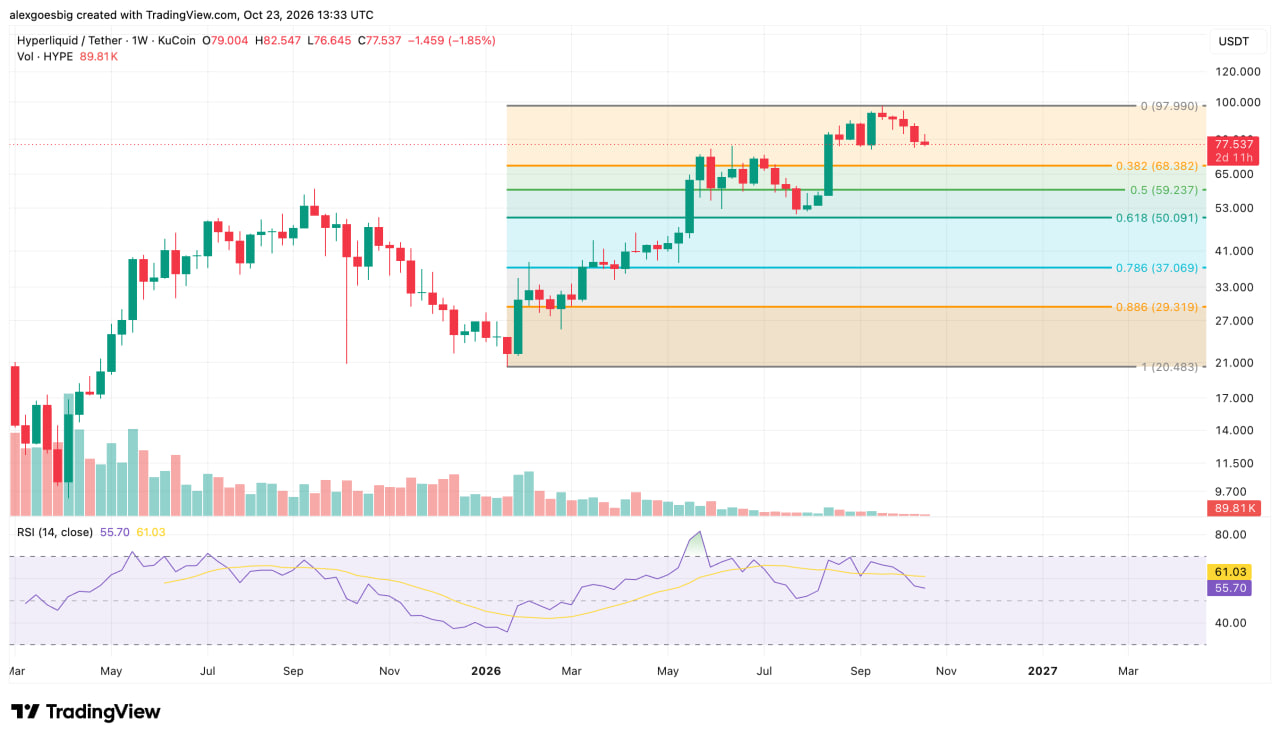
The 21-week exponential moving average at $72.85 has guided the whole 2026 advance. HYPE reclaimed it in January, has closed above it every week since and bounced off it in July before the August breakout. The same line marked the turn in late 2025, when losing it in October and November preceded a three-month slide to $20. Together with the 0.382 Fibonacci retracement at $68.38, it forms a $68.4-72.9 support band that also overlaps the range where price spent most of May through July.
Momentum has weakened. HYPE set a far higher high in September than in June, yet the relative strength index peaked near 83 in late May and reached only about 70 at the record, meaning buyers pushed with less force on the final leg. The reading now sits at 56.2, below its signal line, although still above 50, which fits a cooling trend rather than a reversal. A weekly close below $68.4 would point to $59.24 and then the $50-51 area, where the 0.618 level meets the rising 50-week average. Holding the band and reclaiming $85-88 would reopen a test of $97.99, with $119.07 as the next extension above it.
ETH Is Stuck Between Two Averages

Ethereum trades at $2,407.69, inside a narrow cluster formed by the 50-week EMA at $2,419.68 and the 200-week EMA at $2,462.74. Sellers stopped the September rally at $2,749, which is both the 0.618 Fibonacci level and the measured target of the double bottom ETH built near $1,550-1,600 in June and July. Volume during the pullback has stayed below the August breakout, suggesting profit-taking rather than heavy selling, while the RSI at 52.85 shows no clear direction. A close above $2,463 would turn the cluster into support and open a second test of $2,749, then $3,171. Repeated closes below the 50-week average would send price back toward the $2,149 neckline.
ZEC Defends a Month-Long Floor
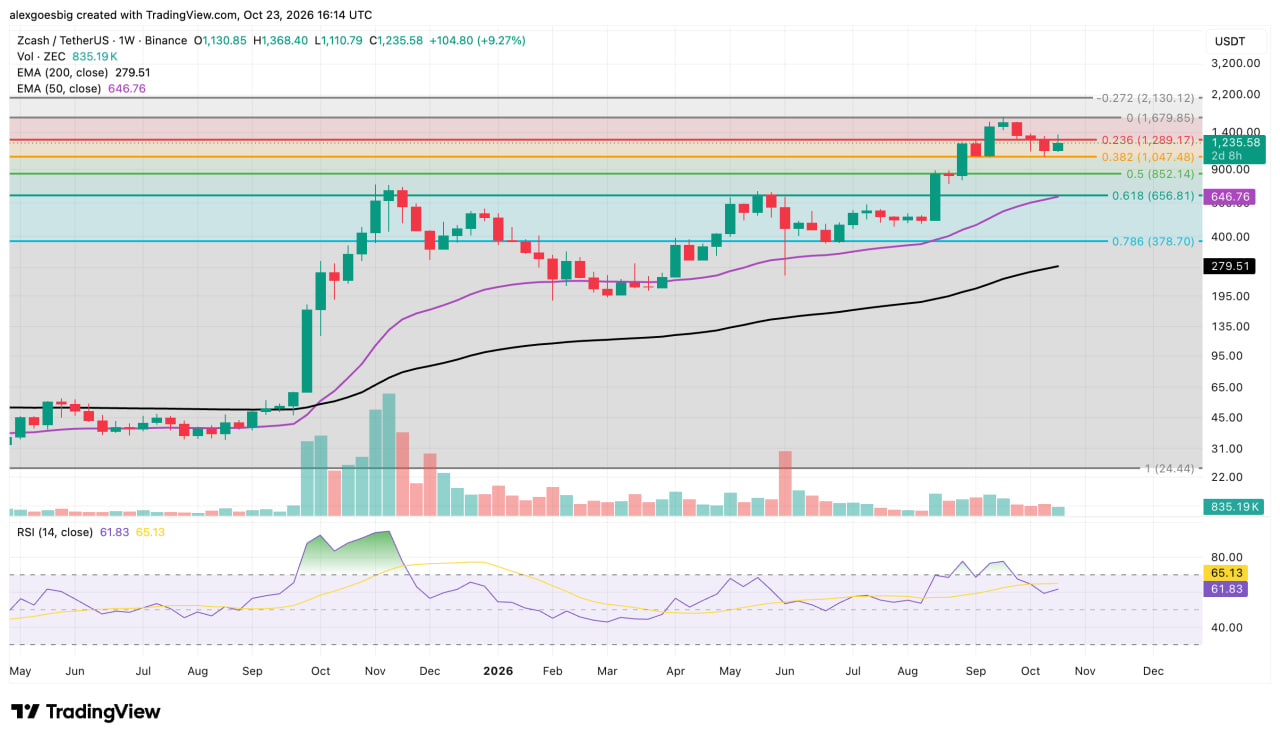
Zcash bounced 9.25% this week to $1,235.40, extending a four-week stretch in which every weekly low held above the 0.382 level at $1,047.48. The upper wick to $1,368 shows sellers remain active above the 0.236 level at $1,289.17. ZEC trades about 90% above its 50-week EMA, and its RSI peaked near 78 at the September record versus roughly 95 during the November 2025 rally, a gap that marks weaker buying pressure at higher prices. A close above $1,289 would put the $1,680 record back in view, with $2,130 beyond it. Losing $1,047 would expose $852, then the $647-657 zone where the 0.618 level and the 50-week average meet.
Sunday’s Closes Will Test the Rotation
The weekly candles close in about two days. If HYPE ends the week below $72.85 while ETH settles above its 200-week average, the charts would show the rotation Hayes describes, with money moving from a token near its highs toward one still far below. Hyperliquid’s buyback size depends directly on its share of perpetual trading volume, so monthly market share data across decentralized derivatives venues offers a more concrete test of the competition argument than price alone.
Hayes has reversed course on all three tokens within months this year, and blockchain analysts track wallets linked to him and Maelstrom closely. Any renewed buying of HYPE, or new selling of ETH or ZEC, would likely appear in on-chain transfer data before he comments on it publicly.



Be the first to comment