



Key Takeaways:
- For licensed payment companies on the XRP Ledger, Arf is rolling out settlement financing using RLUSD.
- About $10 billion in settlement volume is processed annually and the financing is usually repaid within 1-5 days.
- Once necessary changes are put forth, Arf expects to shift most of its activity to native lending on XRPL.
Ripple and Arf are building RLUSD to power short-term institutional credit, giving payment companies that need liquidity until a transaction is completed between countries a way to finance the process. The program aims to address a widespread challenge in global payments – enterprises frequently require liquidity in the destination market prior to receipt of funds.
RLUSD Becomes Working Capital for Global Payments
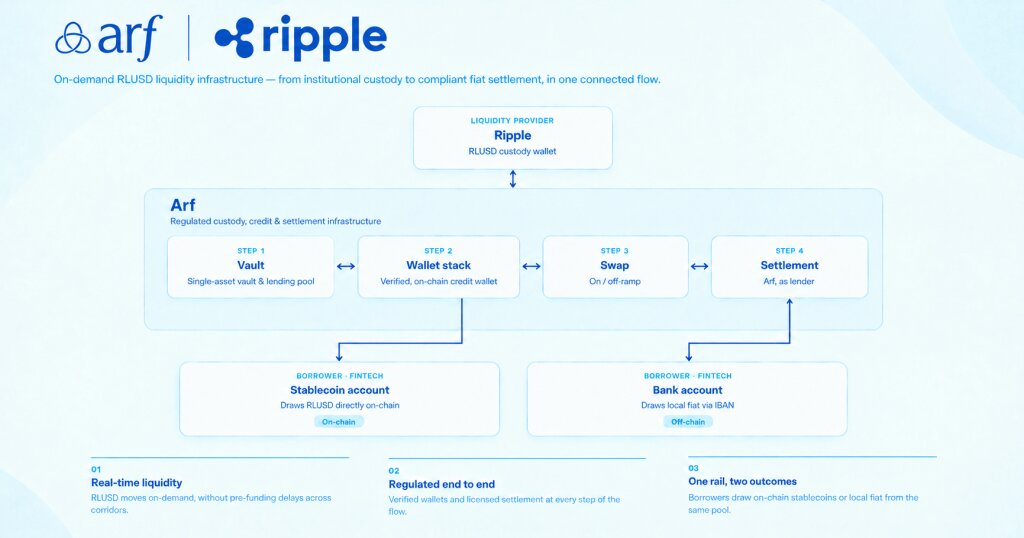
Arf is making a settlement liquidity directly on XRPL in the form of Dollar Based stablecoin RLUSD. The financing will be for licensed payment, remittance and financial firms requiring short-term working capital to maintain cross-border transactions.

Arf says its existing business handles around $10 billion in annual global settlement volume. Its capital turns over about four times each month, reflecting the short duration of its financing model.
A settlement advance is paid back typically in 1-5 days after payments are made. This enables the same fund to be used over and over again and not tied up in long-term loans.
Read More: Ripple RLUSD Hits $2.5B, Enters Cross River Banking Stack for 24/7 Payme
PayFi Links Credit Directly to Payment Flows
Arf’s term for this model is ‘payment finance’, which he also refers to as PayFi. PayFi integrates lending, treasury management and foreign exchange into one single product to incorporate real-time payment flows.
This can cut down on balancing cash flows over a number of markets for cross-border businesses. Arf will take care of underwriting and working-capital as normal, while blockchain is responsible for settling and, ultimately, some aspects of the lending flow.
XRPL Native Lending Could Take the Program Onchain
The first phase does not require XRPL’s upcoming lending capabilities. Arf will issue credits to cover the settlement liquidity needs of the school district, initially through the existing committee infrastructure. The company also aims to shift more activity towards the proposed native lending platform for XRPL later on.
That’s a Single Asset Vault for onchain assets to aggregate funds, and a Lending Protocol to create structured loans out of that aggregation.
The specific ones, XLS-65 and XLS-66, must still complete XRPL’s amendment process for them to be enforced on mainnet. Arf states it has already developed within the proposed framework and will provide feedback for implementation in the future.
Read More: Ripple and Privy Bring XRP Wallets to XRPL After $1T Moved Across 8M Accounts
XRP and RLUSD Play Different Roles
RLUSD will be the collateral behind the loans and their repayments. Meanwhile, what is native to the network and will be needed for account and some ledger objects’ reserve requirements and transaction fees will still be XRP.
There may be a greater amount of recurring institutional activity on XRPL directly associated with actual payment flows, if settlement lending scales. The structure also allows payment companies to leverage Arf’s fiat and stablecoin treasury services without being present onchain while the blockchain layer is managed by XRPL.


Be the first to comment