




As digital asset markets move through a period of slower growth and more cautious capital flows, market participants have increasingly focused on the underlying strength of major trading platforms. During these periods of recalibration, investors often look beyond price movements to evaluate the structural resilience of the platforms that support the ecosystem.
In recent years, stablecoin reserves held on exchanges is the one metric that has begun attracting growing attention across the industry. Because stablecoins represent readily deployable liquidity, their presence on trading platforms can offer insight into both user activity and the level of capital available to support market participation. Stablecoins represent one of the foundational pillars of the crypto and TradFi integration taking place.

Binance Co-CEO Richard Teng commented on institutional use of stablecoins in a recent interview, “For the longest time, retail embraced stablecoins. But now, with developments like the Genius Act, financial institutions are doing a lot of deep dives. They are all trying to introduce their own stablecoins as well.”
Teng continued, “A few major banks have highlighted stablecoins because they solve fundamental architectural problems within the financial landscape that have existed for decades. Now, this technology is finally able to overcome those. So I would say that stablecoin usage will continue to grow from strength to strength. We’re seeing a lot of momentum.”
While exchange longevity has historically served as a broad signal of trust and operational stability, stablecoin reserves are increasingly viewed as a more immediate indicator of platform health. Understanding what these reserves represent, and how market participants interpret shifts in them, can provide a clearer view of how confidence and liquidity are evolving across the crypto ecosystem.

 
Reading the Stablecoin Liquidity Signal
Stablecoin reserves refer to the pool of fiat-pegged digital assets, primarily tokens such as USDT and USDC, that remain deposited on centralized trading platforms. Because stablecoins function as the primary quote currency across much of the crypto market, these balances effectively represent immediately deployable trading liquidity. In other words, they are dry powder sitting on exchanges, ready to move into spot purchases, derivatives margin, or cross-market arbitrage opportunities.
Data from analytics firm CryptoQuant suggests that stablecoin balances across major exchanges have moderated slightly since late 2025 but remain broadly stable overall. At the same time, liquidity has become increasingly concentrated on a handful of large platforms with Binance leading the way. Binance currently holds roughly 65% of the combined USDT and USDC balances across centralized exchanges, highlighting the degree to which market liquidity tends to consolidate around the deepest trading venues.
For market observers, this reserve data serves as a useful sentiment and confidence indicator. When stablecoin balances remain on exchanges, it suggests that capital is still positioned to participate in the market rather than exiting the ecosystem entirely. Traders may be waiting for entry points, managing collateral for derivatives strategies, or maintaining liquidity for opportunistic allocations.
Conversely, large-scale withdrawals of stablecoins from exchanges often signal a shift in investor posture from active market participation toward custody or off-exchange yield strategies. The relatively stable reserve levels seen recently therefore point to a market that remains cautious but engaged, with liquidity still positioned close to the trading layer of the crypto economy.
Current Data Snapshot: Binance’s Dominance
The CryptoQuant report from February 2026 reveals the results of the significant stablecoin inflows with limited capital flight effects following the market downturn. As mentioned above, the majority of stablecoin reserves are being held at Binance.
Normal exchange performance indicators like trade volume can provide insight into how a platform is doing in terms of activity, but stablecoin reserves as a new benchmark instead show growing trust and stability even during times of uncertainty.
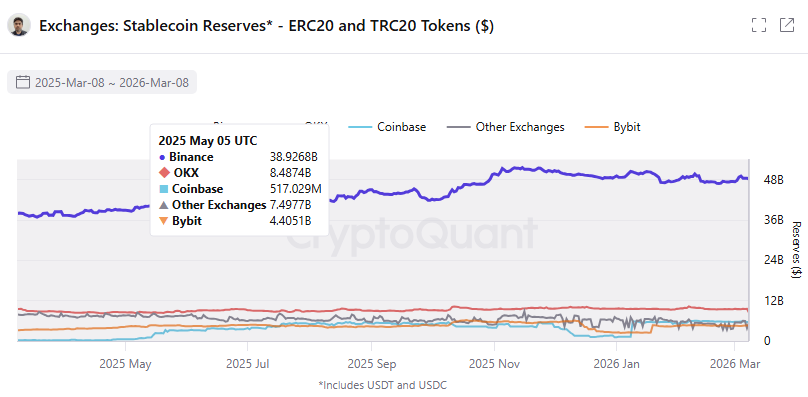
The report does show stablecoin capital leaving all major exchanges, dipping from a high of $11.4 billion in the days leading up to November “before declining $8.4B by December 23 amid the start of the bear market. The pace of outflows has recently moderated, with reserves down only $2B over the past month.” This could be significant as it demonstrates that investors are not widely withdrawing assets in a panic.
To analyze how these stablecoin reserves are distributed, the report describes how after Binance’s $47.5 billion are taken into account, the next largest reserves collections are three other exchanges. Specifically, “OKX holds $9.5B (13% share), Coinbase $5.9B (8%), and Bybit $4B (6%).” In a recent X post by the research group, they described this situation by writing: “Capital isn’t leaving crypto, it’s concentrating.”
CoinMarketCap News had similar sentiments, suggesting that “No other exchange approaches Binance’s concentration level in the current data.” With total stablecoin numbers reaching $300 billion, this situation is informative of the larger market situation.
The Shift to Reserves as a Key Health Indicator
Traditional exchange health indicators like exchange volume are useful and informative, but they can be transitive in nature and change with the mood of the market at large. A high volume of liquidity in the form of stablecoins represents a degree of stickiness, showing that investors are not leaving exchanges behind or closing all of their crypto positions.
High reserves are also a good proxy for resilience and continued platform trust. Where the majority of the reserves are going is also informative as to which exchanges are the most highly valued by the market.
Stablecoin outflows, as seen at the end of 2025, are also informative and show that while there was a retraction in capital deployment within crypto markets, the retraction was relatively muted. This is especially true when compared to earlier market pullbacks that caused unreliable platforms of the past to collapse under their own weight.
Finally, we can realistically assume that the capital that is now in stablecoin reserves in exchanges isn’t likely to be dormant forever. Instead, we can think of these assets as being extremely liquid and ready to deploy into more volatile assets at a moment’s notice. Trust in the platforms is evident based on the lack of mass capital flight. Investable resources are ready as is clear with them being kept in highly liquid stablecoin form. All that remains is for the market to decide what it is going to collectively do next.



Be the first to comment