

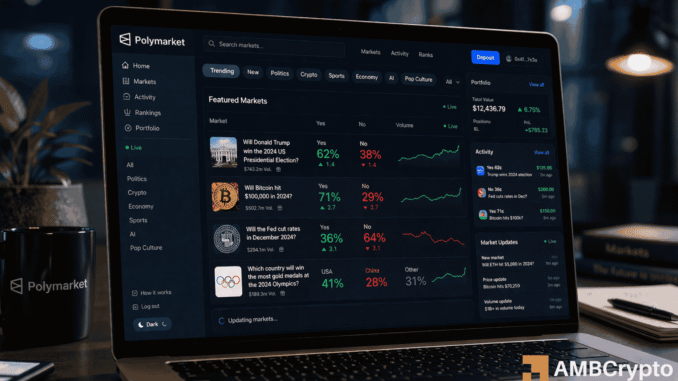

Polymarket is upgrading its core exchange infrastructure and introducing a new platform-native stablecoin. It signals a shift toward more scalable, institutional-grade prediction markets.
The update is expected to roll out over the next two to three weeks. It includes a rebuilt central limit order book [CLOB v2], new smart contracts, and a collateral transition from USDC.e to a new token called Polymarket USD, backed 1:1 by USDC.
The move comes as regulatory clarity around prediction markets improves in the U.S., with recent court rulings reinforcing federal oversight of event-based contracts.
New trading engine aims to improve execution
At the center of the upgrade is CLOB v2, a redesigned order book system intended to improve how trades are matched and executed.

The new system introduces a simplified order structure, optimized matching logic, and improved fee handling.
It also adds support for advanced signing standards and on-chain attribution, allowing developers to track order flow and integrate more effectively with the platform.
Polymarket said the upgrade will require a full reset of existing order books during migration, with a temporary maintenance window planned ahead of launch.
Polymarket USD introduces a native collateral layer
Alongside the infrastructure upgrade, the platform is migrating its collateral system to Polymarket USD, a new token backed 1:1 by USDC.
For most users, the transition will be handled automatically through the platform interface. However, advanced users and API-based traders will need to manually wrap their USDC or USDC.e into the new token.
The introduction of a platform-native collateral token reflects a broader trend among crypto exchanges. They do this to streamline liquidity and improve trading efficiency by standardizing settlement assets.
Infrastructure scales as regulatory clarity improves
Polymarket’s upgrade comes at a time when prediction markets are gaining clearer legal footing in the U.S.
Recent court rulings have supported the view that event-based contracts fall under federal derivatives law. It strengthens the position of platforms operating within regulated frameworks.
At the same time, regulators continue to debate how these markets should be classified and overseen.
Final Summary
- Polymarket’s infrastructure upgrade and new stablecoin reflect a broader push toward scalable, exchange-grade prediction market platforms.
- The move comes as regulatory clarity improves, signaling alignment between market structure development and legal momentum in the sector.


Be the first to comment