

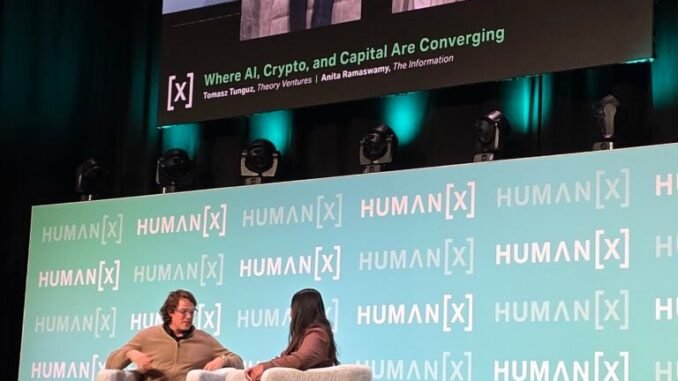

“The real innovation is not the tokens, but the blockchain.” With these words, Tomasz Tunguz, Venture Capitalist at Theory, summarized one of the most profound changes impacting the crypto sector during his speech at HumanX in San Francisco.

His intervention fits into a broader context: the evolution of the relationship between AI, crypto, and capital, and especially the way startups today raise funds and build sustainable businesses in the long term.
From Token Economy to Equity: How the Crypto Market Has Changed
According to Tunguz, the cycle of ICOs and tokens as the primary funding instrument is now over.
Between 2016 and 2022, tokens represented a true innovation:
they allowed startups to access capital markets without incurring the costs (even exceeding 20-25 million dollars) of a traditional listing.

However, today the scenario is completely different:
- increased regulation
- decline in retail interest
- more selective approach by institutional investors
The symbolic figure is the price of Bitcoin, which in a few months dropped from approximately 120,000 dollars to 70,000.
At the same time, institutional players like BlackRock are focusing almost exclusively on established assets, reducing exposure to altcoins and more speculative projects.
The result? Crypto startups today increasingly resemble traditional software companies:
- raise equity capital
- develop products
- generate revenue
- sell to enterprise clients such as banks and fintech
In other words, we are witnessing a true “SaaS-ification of crypto”.
Crypto Paradox: Less Hype, More Real Adoption
Despite the decline in speculative interest, Tunguz highlights a crucial point:
blockchain technology has never been used as much as it is now.
In particular, stablecoins are experiencing unprecedented growth:
- the transaction volume has exceeded that of traditional networks like Visa by 2-3 times
- major banks like JPMorgan Chase move up to billions of dollars daily on internal infrastructures based on stablecoins
This marks a key transformation: crypto is no longer driven by retail, but by institutionalization.
And here emerges another paradox highlighted by Tunguz:
when an asset becomes institutional, early-stage investment opportunities typically increase.
In the case of crypto, however, these decrease because the market target changes radically.
Where Value is Created Today: Infrastructure, Not Applications
Another key point of the speech concerns value creation.
If in the past it was thought that value lay in protocols or applications, today the reality is different: value is concentrated in the core infrastructure
In particular:
- payment systems
- digital identity
- data infrastructure and compliance
- high-frequency trading
The applications, on the other hand, are generating less value than expected.
An example cited is that of the new ultra-fast trading infrastructures, inspired by the world of traditional high-frequency trading, but applied to crypto.
The Opportunity of Prediction Markets
One of the most promising sectors according to Tunguz is that of prediction markets.
These markets are rapidly growing, evolving from tools primarily linked to elections into true ecosystems where bets are placed on geopolitical events, financial markets, or sports.
But the real opportunity is much larger.
“Imagine being a large company like Apple and wanting to insure against a supply chain risk, such as a war in the South China Sea.”
Today, a company would turn to Lloyd’s of London to obtain a tailored policy.
Tomorrow, you could use a prediction market to build a hedge over multiple time horizons (6, 12, 18 months), with greater liquidity and market pricing.
The Key Issue: Contract Standardization
The main limitation of prediction markets today is the interpretation of contracts.
In traditional futures markets (oil, wheat, etc.), there are clear and universally accepted standards.
In prediction markets, however, contracts are often ambiguous and open to interpretation.
This represents a significant hurdle for institutional adoption. And this is where blockchain comes into play.
Smart contracts can transform these agreements into:
- standardized contracts
- verifiable
- automatically executable
“A smart contract is essentially a legal contract written in code. We haven’t reached this level in prediction markets yet, but we will get there.”
AI + crypto: where convergence is real
Another central theme of the speech is the intersection between AI and crypto. According to Tunguz, the truly interesting applications are those where both are necessary.
The main areas are:
1. Agency Payments
AI agents will be able to conduct transactions autonomously, using crypto wallets and stablecoins.
2. Identity of the Agents
Distinguishing between “good” and “malicious” agents will become essential.
3. Proof of Humanity
Prove that behind an action there is a human and not an algorithm.
4. Source Verification (ZK proof)
An AI agent will be able to demonstrate that it has used specific and reliable sources.
In this context, crypto is ideal because it is transparent, programmable, fast, and verifiable.
The Future: Autonomous Companies Created by AI Agents
Looking towards 2030, Tunguz envisions a radical scenario:
a sort of “Shopify for AI agents”. Essentially, you have an idea, you communicate it to an agent, the agent builds the business, manages marketing, logistics, and sales, and autonomously generates revenue. The result?
A world where one person can manage dozens of autonomous businesses, all operated by AI agents.
The Return of Crypto (Driven by AI)
Finally, Tunguz debunks another widespread belief: that AI and crypto are in competition.
Today, the majority of talent is shifting towards AI, but this could change rapidly.
In the coming years, in fact, crypto could become central again thanks to:
- zero-knowledge proof
- verification of the AI models used
- security and agent audits
And precisely for this reason, venture capital in the crypto sector appears today to be “more open” compared to the past, offering new opportunities for startups and investors.



Be the first to comment