



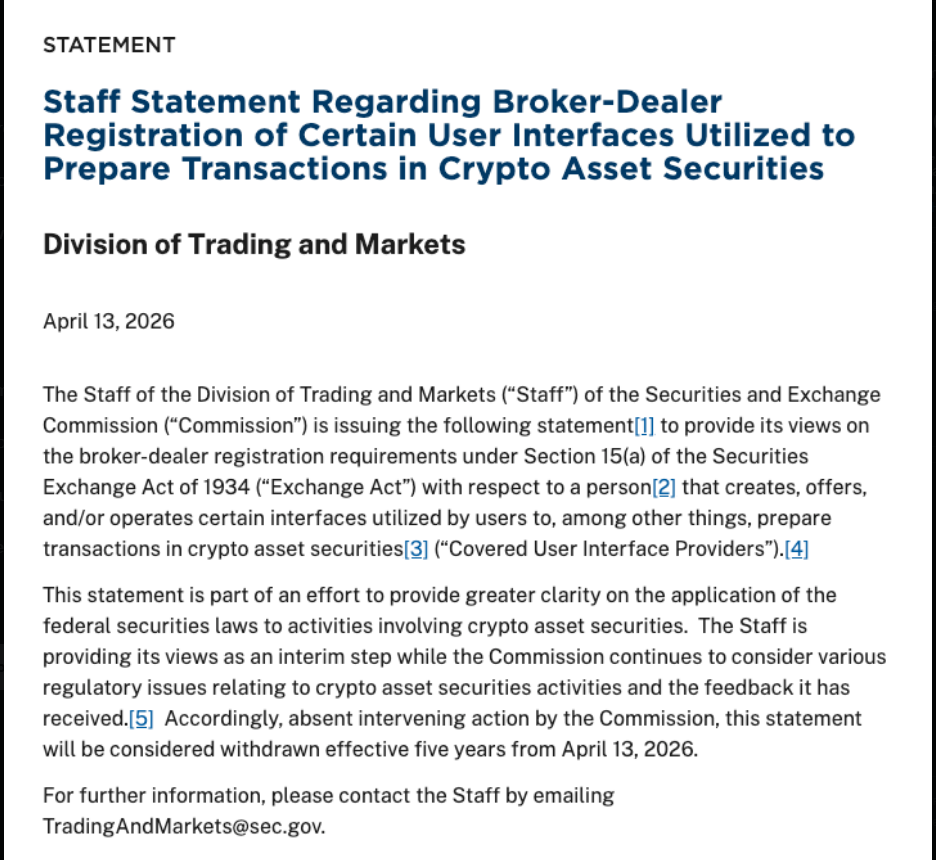
The Securities and Exchange Commission said on April 13 that certain crypto user interfaces tied to XRP other digital assets can avoid broker-dealer registration when they stay out of custody, order routing, and trade execution.
Related Reading
The staff statement is temporary and will be withdrawn in five years unless the Commission acts first, but it gives developers a clearer lane for now.
XRPL Gets A Lift From The New Guidance
That shift matters for the XRP Ledger because the network already includes a built-in decentralized exchange, along with order books, automated market makers, and cross-currency routing.

XRPL documentation says those features are native to the ledger, which means developers can build on top of existing market infrastructure instead of creating a separate exchange from scratch.
Extremely good news for DeFi on XRP!
Why?
We have XRP protocol level Decentralized Exchange, with orderbooks and automated market makers and native cross currency transaction routing.
Means, providing just access to the XRP DEX doesn’t require registration. Because you don’t… https://t.co/Z8U5tsX02O
— Vet (@Vet_X0) April 13, 2026
Some analysts say the setup aligns closely with the SEC’s new language. XRPL validator Vet argued that simply giving users access to the XRP DEX should not trigger registration, since the interface is not holding funds or carrying out trades itself.
On X, Vet called the development “extremely good news for DeFi on XRP,” citing the XRP Ledger’s built-in design.
That reading matches the general direction of the SEC statement, but it is still an interpretation, not a formal exemption.
Reports point to the ledger’s design as a reason XRP DeFi could move faster than many other ecosystems. Because the network already handles routing and settlement at the protocol level, front-end builders may have less work to do than on chains where liquidity is split across many separate venues.
What The SEC Drew The Line Around
The SEC staff statement is narrow. It covers interfaces that let users prepare crypto asset securities transactions through a self-custodial wallet, while staying away from solicitation, custody, trade execution, and order routing.
It also says such providers should rely on objective, pre-disclosed parameters, offer users control over defaults, and disclose material facts about fees, conflicts, and the limits of the interface.
Related Reading
The statement goes further by saying a covered interface should not comment on routes, claim a route is best, or exercise discretion over the market data and transaction details it shows. It also says the provider’s compensation must be fixed and product-agnostic, with no payments tied to the size or outcome of individual trades.
Those conditions matter because they set the boundary between a software tool and a broker-like service. For XRP developers, the point is not that the SEC has blessed the XRPL outright. The point is that the agency’s staff is now describing a category of front ends that may be able to operate without broker-dealer registration if they stay inside strict limits.
Featured image from Vecteezy, chart from TradingView





Be the first to comment