


Lira Slides Into Record-Low Territory
The Turkish lira is trading near fresh record lows against the U.S. dollar, extending a long depreciation cycle that has kept inflation pressure, dollar demand, and crypto hedging behavior in focus.
Market analyst Ted Pillows drew attention to the move in a post on X, writing that the Turkish lira had hit a new all-time low against the dollar and was down 99.999% from its peak. The headline number captures the scale of Turkey’s multi-decade currency collapse, but it needs redenomination context to stand correctly.

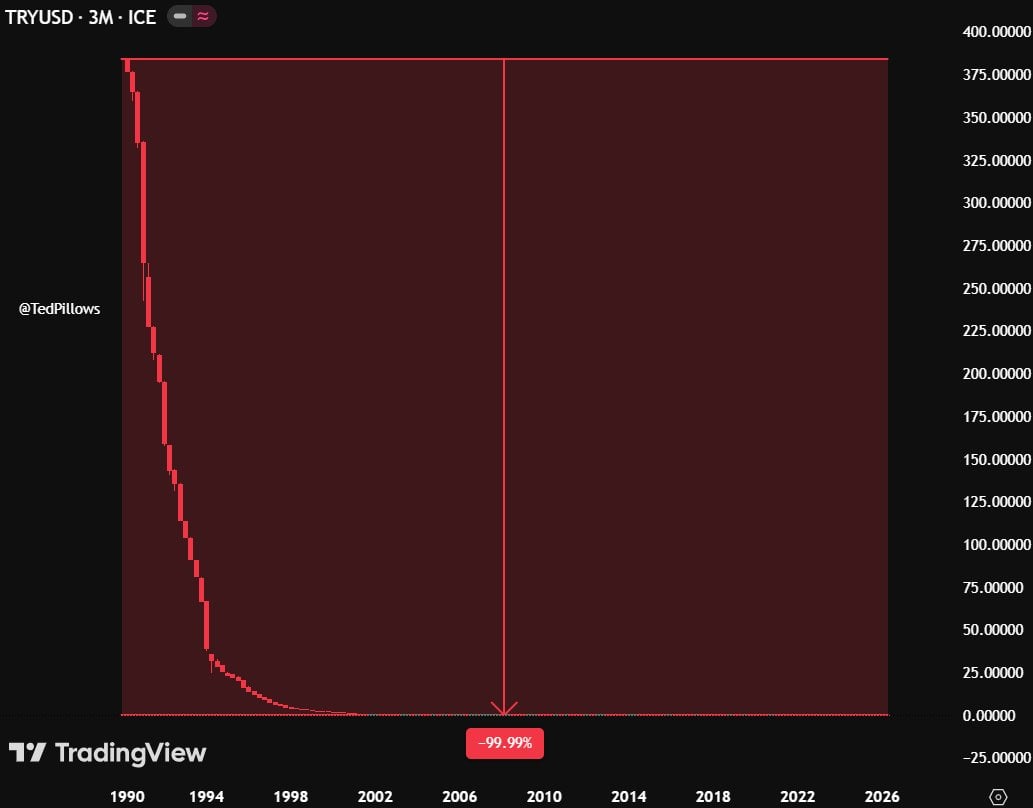
Turkey removed six zeros from the lira in 2005, when 1 new lira replaced 1,000,000 old lira, a reform recorded in the Central Bank of the Republic of Türkiye’s history. Using that old-lira-adjusted lens, today’s exchange rate around 45 new lira per dollar is equivalent to roughly 45 million old lira per dollar. That is why the 99.999% framing is best understood as a long-horizon measure of currency debasement, not as a one-cycle move in the post-2005 lira.
USD/TRY Holds Near Its Highest Levels
USD/TRY recently traded around the 45 lira-per-dollar zone, with Trading Economics placing the pair near 45.17 on May 1 and noting that the exchange rate reached an all-time high of 45.22 in April. The move continues a steady weakening trend, with the lira down more than 17% against the dollar over the past 12 months.
The pressure remains tied to the same macro forces that have shaped Turkey’s economy for years: high inflation, hard-currency demand, import sensitivity, political risk, and investor skepticism around policy durability. Turkey’s annual inflation eased to 30.87% in March, according to Trading Economics inflation data, but that level still erodes purchasing power quickly and keeps households focused on assets that preserve value against the dollar.
Even when inflation slows, the currency can remain fragile if savers do not believe local-currency returns can compensate for future price increases. A weaker lira also raises the cost of imported energy, food inputs, machinery, and dollar-priced goods, which can feed back into inflation expectations and complicate the central bank’s disinflation path.
Stablecoins Stay Part Of The Hedge Trade
Turkey has already become a key example of how currency stress can push users toward dollar-linked crypto assets. Local investors have previously turned to Tether and other dollar-backed stablecoins as an alternative store of value when the lira loses ground. That demand is not only speculative. It is also about access to dollar exposure, faster settlement, and the ability to move value outside normal banking hours.
The stablecoin angle still carries risk. Dollar-pegged tokens depend on issuer reserves, redemption access, exchange liquidity, chain reliability, and regulatory treatment. A broader stablecoin risk guide explains why stablecoins can be useful for payments and trading while still carrying depeg, freeze, custody, and chain-level risks.
For crypto markets, the lira’s record-low zone reinforces a familiar emerging-market pattern. When local currencies weaken sharply, Bitcoin and stablecoins often become part of the savings conversation. Turkey’s next pressure point is whether lower inflation can restore enough confidence in the lira, or whether continued weakness near 45 per dollar keeps dollar-linked assets at the center of local hedging behavior.


Be the first to comment