

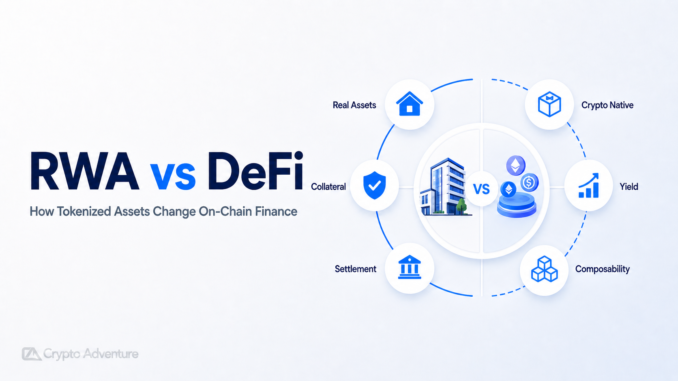

What RWA Means In DeFi
Real-world assets, or RWAs, are tokens that represent claims on assets outside crypto-native markets. These can include tokenized Treasuries, private credit, commodities, real estate, institutional funds, stocks, bonds, invoices, or other financial claims. DeFi is the smart contract layer where users lend, borrow, trade, collateralize, settle, and compose financial products on-chain.
The two categories are now merging. Tokenized assets bring offchain cash flows into smart contract markets. DeFi gives those assets programmable settlement, automated collateral logic, transparent balances, and global wallet access. The result is not traditional finance simply moving onto a blockchain. It is a new design space where real-world yield and crypto-native execution meet.

RWA.xyz tracks tokenized real-world assets across major public blockchains, including asset managers, tokenization platforms, issuers, and networks. Its market data shows why the category matters: RWAs are no longer only a research theme. They now represent a measurable on-chain market across stablecoins, Treasuries, private credit, commodities, funds, and real estate.
How DeFi Worked Before RWAs
Early DeFi was mostly circular. Users borrowed crypto against crypto, traded tokens against tokens, provided liquidity in token pairs, and earned yield from emissions or trading fees. That created open financial infrastructure, but it often depended on speculative demand.
A lending market could function well while collateral was ETH, BTC wrappers, or stablecoins. A DEX could route billions in swaps while most activity stayed inside crypto markets. A yield strategy could look attractive while token incentives flowed, then weaken when emissions slowed.
RWAs add a different source of return. Tokenized Treasuries can bring government debt yield on-chain. Tokenized private credit can bring borrower interest. Tokenized funds can bring portfolio exposure. These cash flows are not created by crypto trading alone, which changes how DeFi protocols think about yield, collateral, and risk.
What Tokenized Assets Add
Tokenized assets add offchain value to on-chain systems. A tokenized Treasury product can represent exposure to government debt. A tokenized private credit product can represent a loan portfolio. A tokenized fund can represent shares in a regulated investment vehicle.
This changes DeFi in three ways. First, it gives protocols new collateral types. Second, it gives users yield sources that are not only based on token emissions. Third, it creates new settlement and reporting workflows that connect legal assets to smart contracts.
The RWA.xyz asset schema shows how different this data model is from ordinary tokens. RWA assets need fields for issuer, jurisdiction, custody, rights, fees, peg mechanics, fund structure, ratings, yield, supply, transfers, holders, and credit metrics. DeFi can use these assets only when the legal and data layers are clear enough.
Collateral Changes
Crypto collateral is volatile. ETH, BTC, SOL, and governance tokens can move sharply in a single day. Stablecoins reduce volatility, but they still depend on issuers, reserves, redemption, and regulatory trust. Tokenized Treasuries and other RWAs add another type of collateral: lower-volatility, yield-bearing assets tied to traditional markets.
This can make DeFi lending more capital-efficient. A protocol can potentially accept tokenized Treasuries as collateral, let users borrow against them, or use them inside treasury-management strategies. The asset can keep earning yield while sitting inside smart contract infrastructure.
The trade-off is complexity. A tokenized Treasury is not just an ERC-20 balance. It may have transfer restrictions, KYC requirements, redemption windows, fund fees, custodians, and eligible investor rules. A lending protocol must understand those constraints before treating the token as safe collateral.
Yield Changes
DeFi yield has often come from trading fees, borrowing demand, staking rewards, liquidity incentives, and token emissions. RWAs add yield from offchain assets. Treasury bills, private credit, real estate debt, and fund portfolios can generate returns that are not purely dependent on crypto speculation.
That can make DeFi yield more durable when designed well. A tokenized Treasury product does not need a meme coin cycle to generate base yield. It depends on Treasury market rates, fund structure, custody, and redemption terms.
The risk is that yield can become misunderstood. A higher RWA yield may reflect higher credit risk, weaker liquidity, longer lockups, or less transparent underwriting. DeFi users used to instant liquidity may underestimate how slowly real-world assets unwind when stress arrives.
Liquidity Changes
RWAs can improve market breadth, but they do not automatically solve liquidity. A token can be transferable, but the underlying asset may still be illiquid. Private credit loans, real estate interests, and some funds can have redemption windows, gates, notice periods, or limited secondary buyers.
This creates a mismatch. DeFi users expect 24/7 markets, instant swaps, and fast exits. Real-world assets often settle through legal entities, banks, custodians, transfer agents, servicers, and business-day workflows.
A strong RWA-DeFi market must handle this mismatch honestly. That means clear redemption terms, liquidity buffers, conservative loan-to-value ratios, whitelisted transfer controls, and risk parameters that reflect the underlying asset rather than the token wrapper.
Compliance Changes
RWAs bring compliance into DeFi more directly. Many tokenized assets are securities, fund interests, debt claims, or regulated products. That means KYC, accreditation checks, jurisdiction filters, transfer restrictions, sanctions controls, and issuer permissions can all matter.
This can make RWA DeFi less permissionless than classic DeFi. A user may be able to see the smart contract but not hold the token. A protocol may need whitelisted pools, permissioned collateral markets, or compliant wrappers.
That is not necessarily bad. Institutional capital often needs compliance before it can enter on-chain markets. The challenge is designing systems that preserve transparency and settlement benefits while respecting legal constraints.
Settlement Changes
Traditional finance settlement often depends on intermediaries, business days, reconciliation, and fragmented records. DeFi settlement is faster and more transparent because smart contracts update balances directly.
Tokenized assets can bring some of that speed to real-world markets. Fund subscriptions, redemptions, collateral movements, and distributions can become more automated. On-chain records can improve auditability and reduce reconciliation work.
The limitation is that final real-world settlement still depends on offchain parties. A token can move instantly, but cash movement, asset custody, fund accounting, and legal ownership may still require traditional infrastructure. The best RWA systems connect both layers cleanly instead of pretending the offchain layer disappears.
Main Risks When RWA Meets DeFi
The first risk is legal uncertainty. Token holders need to know what they own and what happens if the issuer fails.
The second risk is oracle and data quality. A protocol using RWA collateral needs reliable NAV, price, yield, default, and redemption data.
The third risk is liquidity mismatch. Instant token transfers can hide slow underlying exits.
The fourth risk is smart contract integration. A tokenized asset with transfer restrictions can break if a DeFi protocol assumes unrestricted ERC-20 behavior.
The fifth risk is concentration. If many DeFi protocols depend on the same issuer, custodian, or fund, a single offchain failure can spread through several markets.
Who Benefits Most
Institutions benefit because tokenized assets can make settlement, reporting, and distribution more efficient. DeFi protocols benefit because RWAs can add new collateral and yield sources. Users benefit when they get clearer access to assets that were previously harder to reach.
The strongest use cases are not speculative wrappers. They are products where tokenization improves something real: settlement speed, collateral mobility, distribution, reporting, composability, or access. If the token adds no practical advantage over the traditional product, the DeFi integration may be mostly cosmetic.
Conclusion
RWAs change DeFi by bringing offchain assets, yields, and legal claims into smart contract markets. That can make DeFi more useful, more institution-friendly, and less dependent on crypto-native speculation.
The trade-off is complexity. Tokenized assets introduce custody, redemption, compliance, liquidity, legal, and data risks that ordinary DeFi tokens do not carry in the same way. The strongest RWA-DeFi systems will not be the ones with the highest headline yields. They will be the ones that connect real asset rights, reliable data, conservative risk controls, and useful on-chain settlement into products that work during stress as well as during growth.



Be the first to comment