


TrustSwap at a Glance
| Category | Assessment |
|---|---|
| Product Type | Token fundraising platform and Web3 infrastructure ecosystem |
| Native Token | SWAP |
| Main Use Case | Launchpad access, staking score, allocation power, token services, and ecosystem utility |
| Strongest Feature | Institutional-style launchpad process with KYC, due diligence, and token-market infrastructure |
| Main Weakness | SWAP trades with small-cap liquidity and depends heavily on launchpad demand returning |
| Best Fit | Users who understand early-stage token sales and want structured access through staking |
| Risk Level | High |
| Editorial Score | 7.0/10 |
What Is TrustSwap Launchpad?
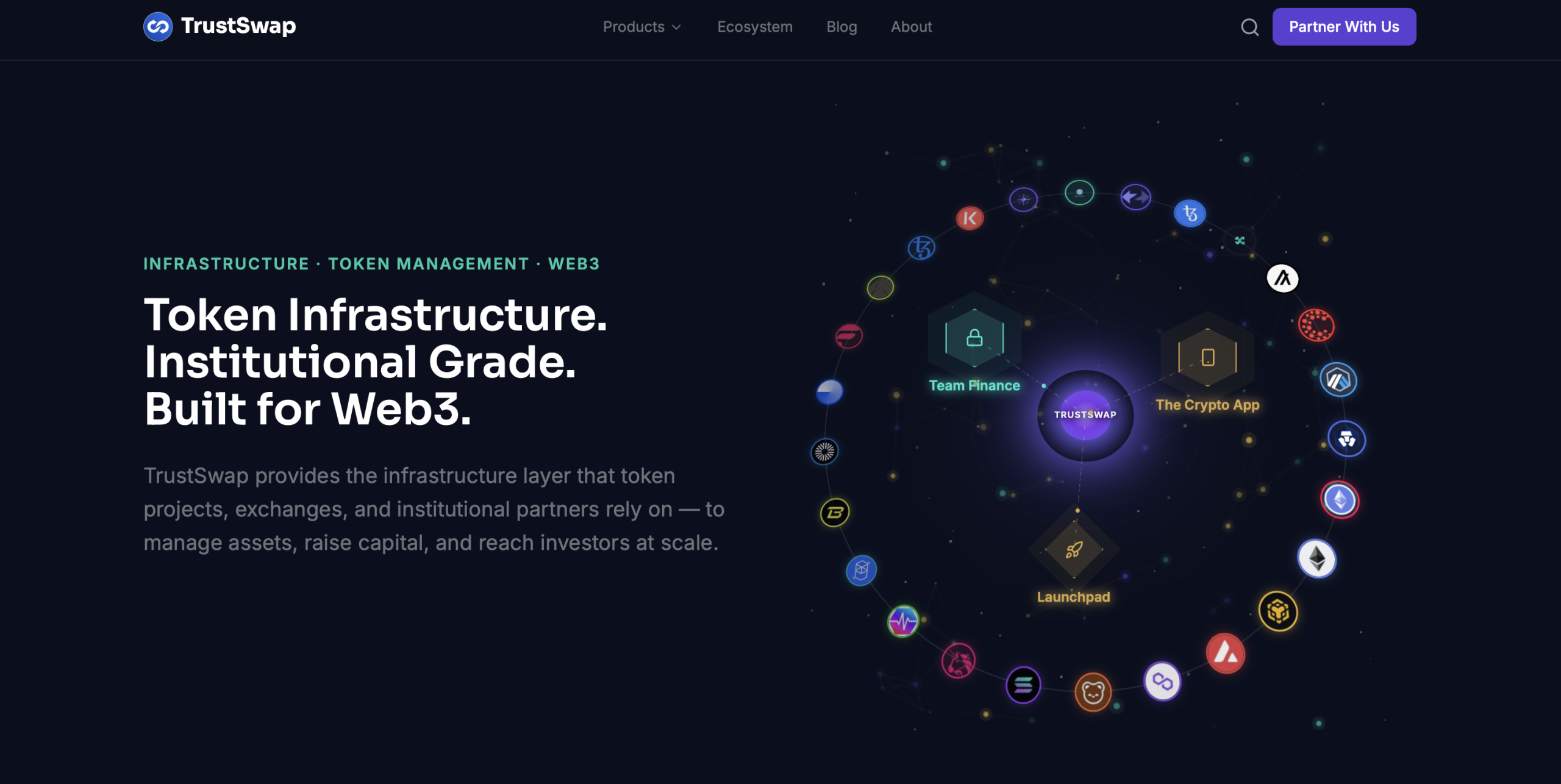
TrustSwap is a Web3 infrastructure platform built around token markets. Its ecosystem includes TrustSwap Launchpad for fundraising, Team Finance for token locking, smart contract tools, and The Crypto App for market data and user-facing crypto services. That gives TrustSwap a wider infrastructure profile than launchpads that only list token sales.
The TrustSwap Launchpad is the fundraising product inside that ecosystem. It gives projects a structured route to raise capital through token sales, while participants use SWAP staking and allocation tiers to access launch opportunities. The platform is built around multi-stage due diligence, KYC infrastructure, advisory support, compliance-oriented sale design, and post-launch support.

This makes TrustSwap more institutional than hype-first. Its best use case is not a random meme-token presale. It is a project that wants a structured fundraising process, token-locking support, and a community of participants already familiar with launchpad mechanics.
How TrustSwap Launchpad Works
TrustSwap’s launchpad access is built around staking and scoring. Users stake SWAP to build a SWAP Score, and that score helps determine eligibility and allocation size in token launches. The score reflects the amount staked and the lock duration, so longer commitment can improve participation power.
This design creates a more predictable path than pure lottery access. Users know that deeper staking commitment can improve their launchpad position, while projects get a community with economic alignment. The model also creates a direct reason for SWAP to exist inside the product.
The launchpad process still requires caution. Users may need KYC, registration, wallet setup, sale timing discipline, and sufficient SWAP Score before participating. Even after allocation, early-stage tokens can underperform, unlock slowly, or lose liquidity after launch.
SWAP Token Utility
SWAP is the utility token behind TrustSwap’s access model. Its main launchpad role is staking power. Users stake SWAP to build score, qualify for launchpads, and improve allocation opportunity.
The token also sits inside a wider TrustSwap ecosystem that includes token services, infrastructure products, and payment or fee-related utility. That broader footprint is important because SWAP is not tied only to one launchpad page. It can benefit if TrustSwap’s wider token-market infrastructure gains more usage.
The challenge is demand depth. SWAP utility becomes more meaningful when launchpad opportunities are active and competitive. If the market is not excited about new token sales, staking demand weakens. A strong staking score matters only when users want the allocations it unlocks.
Fundraising Track Record And 2026 Activity
TrustSwap’s strongest launchpad argument is operating history. The platform has been active since 2020 and has supported many token launches across several market cycles. TrustSwap’s launchpad pages position the product as full-service fundraising infrastructure, while ecosystem coverage around SparkDEX on Flare showed the launchpad can still support chain-specific public sale activity.
The April 2026 SparkDEX white-label launchpad example is useful because it shows TrustSwap’s model evolving beyond one generic launchpad page. A project can use TrustSwap infrastructure, investor access, allocation scoring, and chain-specific distribution to run a more controlled raise.
That is the stronger 2026 angle. TrustSwap can remain relevant if it becomes launch infrastructure for ecosystems and partner chains, not only a place where retail users wait for the next IDO. The risk is that launchpad demand remains cyclical. Strong launches can revive SWAP demand, while weak sale flow can leave the token dependent on thin market trading.
Market Performance And Liquidity
SWAP trades like a small-cap recovery token in 2026. Late-April market data placed SWAP around $0.05, with a market cap near $5 million and extremely low daily trading volume on some trackers. CMC also shows SWAP trading more than 99% below its $5 all-time high.
That profile creates a clear split. The bullish view is that TrustSwap still has real infrastructure, launchpad history, brand recognition, and a broader product suite while SWAP trades at a depressed valuation. The bearish view is that market demand for SWAP is weak, liquidity is thin, and the token needs stronger catalysts before any recovery looks durable.
Low liquidity matters. It can make upward moves look dramatic when demand returns, but it can also make exits difficult. Users who stake SWAP for launchpad access should treat price exposure as part of the allocation cost.
Strengths
TrustSwap’s first strength is product breadth. Launchpad access, Team Finance token locks, token infrastructure, and The Crypto App create a larger ecosystem than a single-sale launchpad.
The second strength is a clear allocation model. SWAP Score gives the token a direct role, and longer staking can improve participation. That is easier to evaluate than tokens with vague governance or branding-only utility.
The third strength is launchpad process. KYC, due diligence, structured token sales, and post-launch support make TrustSwap more serious than open presale platforms where projects and users take on more unchecked risk.
Weaknesses And Risks
The biggest weakness is token momentum. SWAP’s drawdown, low market cap, and thin volume show that the market is not pricing it as a dominant launchpad asset in 2026.
The second risk is sector dependence. TrustSwap Launchpad needs strong token-sale demand. If early-stage crypto launches remain weak, SWAP staking demand can stay muted even if the product is still operational.
The third risk is access friction. Launchpad users may need to buy and stake SWAP, wait through lock periods, complete KYC, register on time, and still receive less allocation than expected. Early-stage tokens can also perform poorly after launch.
Verdict
TrustSwap Launchpad remains a credible fundraising platform, but SWAP should be treated as a high-risk small-cap utility token. The platform has a real product, a clear access model, and broader token-market infrastructure through TrustSwap’s ecosystem. That gives it more depth than many abandoned IDO platforms.
The investment case is not as strong as the product case yet. SWAP needs stronger launchpad demand, deeper trading volume, and more visible high-quality raises before it can justify a higher conviction score. The platform is still useful, but token upside depends on renewed demand for launch access.
TrustSwap Launchpad earns a 7.0/10 because the infrastructure is real, the SWAP Score model is clear, and the platform still has relevant fundraising use cases. It does not score higher because liquidity is thin, the token is deeply down from its all-time high, and launchpad demand remains cyclical.
Conclusion
TrustSwap Launchpad is a mature launchpad and token-market infrastructure platform with a clear staking-based access model. It is best suited to users who understand IDO risk, can evaluate early-stage projects, and want structured launch access through SWAP Score.
The strongest reason to use TrustSwap is participation in curated token raises backed by a broader infrastructure ecosystem. The biggest reason for caution is SWAP’s small-cap liquidity and dependence on active deal flow. Users should judge TrustSwap by current launch quality, SWAP staking demand, allocation rules, liquidity, and post-launch project performance before treating SWAP as a long-term recovery asset.



Be the first to comment